 flip
flipChiles en nogada
Chiles en nogada
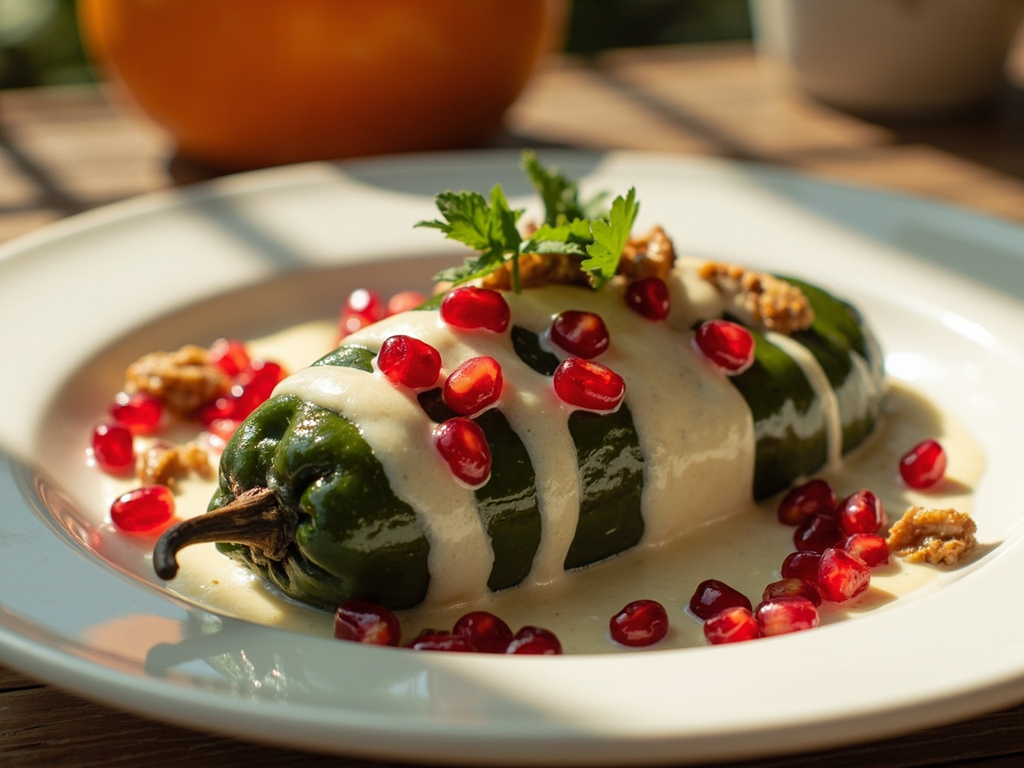
Why this dish? No dish better embodies the Mexican identity that Fuentes loved to probe: its three colors—green chile, white nogada, red pomegranate—are those of the national flag, and it is served around the September Independence celebrations. For a writer who relentlessly questioned *mestizaje* and the legacy of the Conquest, this baroque dish, marrying indigenous ingredients and Old World fruits, was a true edible allegory of Mexico.
Large poblano chiles stuffed with a sweet-savory picadillo of meat, fruits, and spices, topped with a cold fresh walnut sauce and crowned with pomegranate seeds. A baroque masterpiece from the cuisine of Puebla.
Allow me to present this dish as one presents a homeland: it bears our three colors—the green of the chile, the white of the walnut, the red of the pomegranate. At our table, my mother insisted that the nogada be beaten by hand, without a trace of bitterness, and that the pomegranate come from the last days of summer. You see, this dish is all of Mexico on a plate: the Conquest and the Indian, sweet and salt, memory and invention. One does not eat it—one deciphers it.
- •Poblano chiles — a few, large and fleshy (green casing, roasted and peeled)
- •Pork and beef, knife-chopped — a good portion (base of the picadillo)
- •Apple, pear, peach, plantain — equal parts, small dice (fruity sweetness)
- •Raisins and almonds — a handful of each (softness and crunch)
- •Cinnamon, clove, pepper — to taste, ground on the metate (warm spices)
- •Fresh Castilian walnuts — a lot, peeled of their bitter skin (nogada sauce)
- •Milk, fresh cheese, a splash of sherry — as needed for consistency (creaminess of the sauce)
- •Pomegranate — one, very ripe (crown of red seeds)
Chiles en nogada
Large poblano chiles stuffed with a sweet-savory picadillo of meat, fruits, and spices, topped with a cold fresh walnut sauce and crowned with pomegranate seeds. A baroque masterpiece from the cuisine of Puebla.
Why this dish? No dish better embodies the Mexican identity that Fuentes loved to probe: its three colors—green chile, white nogada, red pomegranate—are those of the national flag, and it is served around the September Independence celebrations. For a writer who relentlessly questioned *mestizaje* and the legacy of the Conquest, this baroque dish, marrying indigenous ingredients and Old World fruits, was a true edible allegory of Mexico.
Allow me to present this dish as one presents a homeland: it bears our three colors—the green of the chile, the white of the walnut, the red of the pomegranate. At our table, my mother insisted that the nogada be beaten by hand, without a trace of bitterness, and that the pomegranate come from the last days of summer. You see, this dish is all of Mexico on a plate: the Conquest and the Indian, sweet and salt, memory and invention. One does not eat it—one deciphers it.
Ingredients (period version)
- Poblano chiles — a few, large and fleshy (green casing, roasted and peeled)
- Pork and beef, knife-chopped — a good portion (base of the picadillo)
- Apple, pear, peach, plantain — equal parts, small dice (fruity sweetness)
- Raisins and almonds — a handful of each (softness and crunch)
- Cinnamon, clove, pepper — to taste, ground on the metate (warm spices)
- Fresh Castilian walnuts — a lot, peeled of their bitter skin (nogada sauce)
- Milk, fresh cheese, a splash of sherry — as needed for consistency (creaminess of the sauce)
- Pomegranate — one, very ripe (crown of red seeds)
Ingredients
- Poblano chiles (or long green bell peppers if unavailable) — 6 (to roast, peel, slit, and stuff)
- Ground pork — 300 g (picadillo)
- Ground beef — 200 g (picadillo)
- Apple + pear + peach — 1 each, diced (fruits for the filling)
- Plantain (or firm banana) — 1/2, diced (sweetness)
- Raisins — 50 g (sweet softness)
- Slivered almonds — 40 g (crunch)
- Onion + garlic — 1 + 2 cloves (aromatic base)
- Cinnamon, clove, pepper — 1/2 tsp each (spices)
- Walnut halves — 200 g (nogada sauce)
- Fresh cheese like queso fresco (or ricotta) — 100 g (creamy binder)
- Milk — 150 ml (to thin the sauce)
- Dry sherry (optional) — 1 tbsp (sauce flavor)
- Pomegranate — 1 (red garnish)
Method
- Roast the poblanos directly over a flame or in the oven until the skin blackens, then seal in a bag for 10 minutes and peel. Slit each lengthwise and carefully remove the seeds without tearing.
- Sauté onion and garlic, add the meats and brown. Stir in the ground spices, then the diced fruits, raisins, and almonds. Cook over low heat until the mixture is tender and fragrant. Season with salt.
- For the nogada: if possible, briefly blanch the walnuts and remove the thin skin (key to a white, mild sauce). Blend the walnuts with the fresh cheese, milk, and sherry until smooth and creamy. Refrigerate.
- Stuff each chile with warm picadillo without overfilling.
- Arrange the chiles on a plate, drizzle with cold nogada, and crown with a scattering of pomegranate seeds. Serve immediately—the warm-cold contrast is part of the dish.
How it was made : Tradition attributes the dish to the Augustinian nuns of Puebla, who supposedly created it in 1821 to celebrate Independence and honor Agustín de Iturbide, composing the colors of the flag of the Army of the Three Guarantees. It was ground on the metate, the walnuts peeled one by one, and the dish served only during the season of fresh walnuts and pomegranates, late August to September.
The contemporary twist : Some chefs today serve the nogada as a siphon emulsion or deconstruct the dish into a graphic plate—but Fuentes, a lover of the baroque, would surely have preferred the full, generous version.
Sources : Diana Kennedy, The Cuisines of Mexico · Patricia Quintana, Mexico's Feasts of Life
Carlos Fuentes · Charactorium