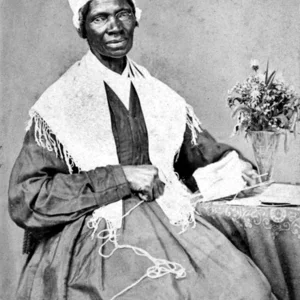

African-American abolitionist and women's rights activist
Sojourner Truth(1797 — 1883)
Sojourner Truth
États-Unis
7 min read
Frequently asked questions
Key Facts
Works & Achievements
Landmark speech delivered at the Women's Rights Convention in Akron, Ohio. This powerful address denounced sexism within the abolitionist movement and asserted the equality of Black women, becoming a foundational text of intersectional feminism.
Oral and autobiographical accounts detailing her journey as an enslaved person and her struggle for freedom. These firsthand testimonies made a powerful contribution to the abolitionist movement by humanizing the experience of enslaved people.
Forty years of tours across the United States preaching the abolition of slavery and women's rights. These speaking tours mobilized thousands of people and shaped public opinion throughout North America.
Active participation in feminist conventions and campaigns for women's right to vote. Sojourner Truth explicitly linked the struggles for abolition and women's political rights.
Work to establish Freedmen's Village in Virginia, providing shelter and resources to formerly enslaved people freed after the Civil War.
Petition submitted to Congress seeking land grants for formerly enslaved people, demonstrating her commitment to economic justice and the empowerment of freed Black Americans.
Anecdotes
In 1843, Isabella Baumfree changed her name to Sojourner Truth, meaning 'one who travels to speak the truth.' She left New York with nothing but a dress and a loaf of bread to preach against slavery and for women's rights. Her new name embodied her mission: to travel across the United States and speak out against injustice.
On May 29, 1851, at a women's rights convention in Akron, Ohio, Sojourner Truth delivered her most famous speech: 'Ain't I a Woman?' In it, she challenged the idea that Black women were doubly oppressed — because of both their gender and the color of their skin — a founding message of intersectional feminism.
Sojourner Truth successfully secured the freedom of her son Peter in 1828, after he had been illegally sold into slavery. She won the case and became one of the first Black women to prevail in a court of law, inspiring other enslaved people to fight for their freedom through legal means.
During the Civil War, Sojourner Truth visited President Abraham Lincoln in Washington in 1864. She urged him to ensure that Black soldiers were treated fairly and received the same pay as white soldiers, demonstrating her commitment to the concrete struggles of her time.
After the war, Sojourner Truth campaigned for land grants for freed formerly enslaved people, knowing that freedom alone was not enough without economic resources. She continued to travel and speak until her death in 1883, embodying the enduring fight for justice.
Primary Sources
I have plowed and planted, and gathered into barns, and no man could head me! And ain't I a woman? I could work as much and eat as much as a man, when I could get it, and bear the lash as well! And ain't I a woman?
I am a Black woman who was a slave. My mother was a slave before me, and my grandmother before her. But I heard a call from the Lord and I rose up from my bed of affliction and went freely into the world to preach the good news.
I have traveled from east to west, speaking against slavery and for women's rights. God gave me a powerful voice, and I will not cease to cry out until every slave is free and every woman has her rights.
You say that women need to be helped into carriages and lifted over ditches, and to have the best place everywhere. But nobody ever helped me into a carriage, or over a mud puddle, or gave me any best place!
Key Places
Birthplace of Sojourner Truth in 1797, in the Hudson Valley. It was in this region that she grew up enslaved before escaping in 1826.
The city where Sojourner Truth settled after her escape and began her abolitionist activism. There she developed her commitment to freedom and women's rights.
Site of the 1851 Women's Rights Convention, where Sojourner Truth delivered her landmark speech 'Ain't I a Woman?', which became a defining manifesto of Black feminism.
The city where Sojourner Truth settled in 1857 and spent the final years of her life, continuing her activism until her death in 1883.
The U.S. capital where Sojourner Truth met President Lincoln in 1864 and continued to advocate for the abolition of slavery and women's rights.
Typical Objects

A symbol of the oppression Sojourner Truth endured during her years of enslavement in New York State. These chains represent the condition she suffered before escaping in 1826.

Sojourner Truth used a lectern during her abolitionist and feminist speaking tours across the United States. It was from a podium like this that she delivered her famous speech "Ain't I a Woman?" in 1851.
A foundational text in Sojourner Truth's rhetoric — she drew on biblical references to argue for women's equality and the abolition of slavery in her public speeches.

Sojourner Truth wore modest, simple dresses, reflecting her values and moral commitments. Her appearance conveyed the humility and authenticity that defined her work on behalf of the oppressed.

A symbol of the anti-slavery movements of the 19th century, carried in the marches and rallies in which Sojourner Truth took part to advocate for the abolition of slavery.

Representing the legal freedom Sojourner Truth obtained in 1827, years before the Emancipation Proclamation. Such documents symbolized the struggle for freedom and legal rights for African Americans.

A symbol of African identity and pride used by abolitionist and feminist activists like Sojourner Truth to assert their heritage and dignity.

A collection of Sojourner Truth's words and speeches — particularly her famous "Ain't I a Woman?" — serving as both a documentary record and an educational tool of her fight for equality.
School Curriculum
Vocabulary & Tags
Key Vocabulary
Tags
Daily Life
Morning
Sojourner Truth rose before dawn to prepare herself before her public engagements. After a quick wash, she would have a simple breakfast of bread, porridge, or coffee before turning to her correspondence or the preparation of her abolitionist and feminist speeches.
Afternoon
Afternoons were often devoted to public meetings, lectures, or gatherings with fellow abolitionist and feminist activists. She traveled across the United States delivering powerful speeches in churches, public halls, and conventions — most famously her 'Ain't I a Woman?' address in 1851.
Evening
Evenings were spent in discussion with other social reformers, writing letters and memoirs, or attending meetings in abolitionist homes. She would share her thoughts on slavery and women's equality in intimate settings before retiring for the night.
Food
Her diet was simple and practical, typical of working-class people in the 19th century: bread, porridge, dried legumes, occasional fish or meat, and coffee or tea. After gaining her freedom in 1827, her eating habits remained frugal — both out of long-standing custom and moral conviction.
Clothing
Sojourner Truth wore plain, modest long dresses characteristic of the 19th century, with no unnecessary ornamentation. She was known for her dignified bearing and commanding presence, and was often photographed wearing a white cap or turban — symbols of both her dignity and her past.
Housing
After gaining her freedom, she lived in modest lodgings, often provided by abolitionist families or religious communities who welcomed her. Her living conditions remained austere, reflecting her commitment to simplicity and her refusal to prioritize material comfort over her mission of social reform.
Historical Timeline
Period Vocabulary
Visual Style
Un style réaliste et puissant combinant techniques historiques du 19e siècle (portraits photographiques, gravures abolitionnistes) avec une approche moderne. L'illustration capture la dignité, la force et l'éloquence de Sojourner Truth à travers un éclairage chaleureux et des contrastes prononcés.
Sound Ambience
Une ambiance sonore qui mêle les sons de la communauté afro-américaine esclavisée du 19e siècle (chants spirituels, travail aux champs) avec la puissance oratoire d'une femme qui s'élève contre l'injustice, créant un univers sonore de résilience, de sacré et de détermination inébranlable.
Liens externes & ressources
Références
Œuvres
Discours 'Ain't I a Woman?'
1851
Narration de sa vie et de ses expériences d'esclave
1850-1860s
Campagne de tournées de conférences
1843-1883
Plaidoyer pour le droit de vote des femmes
1860-1870s
Établissement d'une communauté pour anciens esclaves
1864
Pétition au Congrès américain
1870