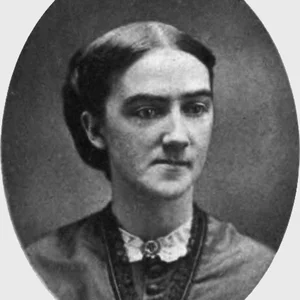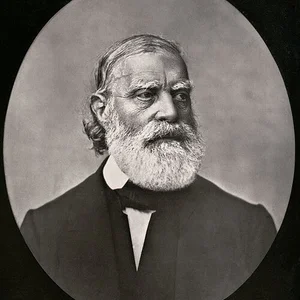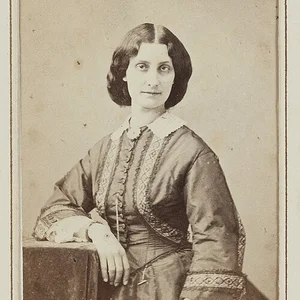

Wife of the great chemist Marcellin Berthelot, Sophie Berthelot (1837-1907) was a cultured woman who accompanied her husband throughout his entire career. Having died on the same day as him, she became the first woman interred in the Panthéon in 1907, a symbol of the grateful Republic.
Sophie Berthelot(1837 — 1907)
Sophie Berthelot
France
7 min read
Frequently asked questions
Key Facts
- Born in 1837 in Paris into a cultured bourgeois family
- Married Marcellin Berthelot in 1861, a renowned chemist and republican statesman
- Died on March 18, 1907, a few hours after her husband
- First woman interred in the Panthéon on March 20, 1907, alongside her husband
- Her entry into the Panthéon was more a gesture by the Republic toward Marcellin than a recognition of her own achievements
Works & Achievements
For nearly fifty years, Sophie was the first reader of her husband's works, refining the writing through her command of language and broad culture. This role as a learned editor is attested in the chemist's correspondence.
Sophie spent decades organizing and archiving Marcellin's extensive correspondence with scholars, ministers, and academicians from around the world — essential behind-the-scenes work for the lasting legacy of his output.
Drawing on her mastery of Greek inherited from her father, Sophie helped Marcellin work through ancient sources for his study of medieval alchemy, quietly contributing to the history of science.
During her husband's ministerial terms, Sophie organized receptions bringing together scholars, artists, and statesmen, making the Berthelot household an influential republican salon of the Belle Époque.
Anecdotes
On March 18, 1907, Marcellin Berthelot passed away at his desk in the Collège de France. A few hours later, Sophie died in turn, as though she could not conceive of outliving him. Witnesses reported that she had refused to leave his side since his final agony. This simultaneous death struck contemporaries as the very symbol of a perfect union.
On March 20, 1907, the Berthelot spouses entered the Panthéon together. Sophie thus became the first woman to be interred there — carried in by a grateful Republic honoring her illustrious husband. This entry into the Panthéon long fueled debate: does a woman owe her place in that monument to her own glory, or to her husband's?
Sophie Berthelot was the daughter of a Greek father, which meant she grew up in a cultivated, multilingual household. Speaking Greek, French, and several other European languages, she was a quietly intellectual woman who helped her husband sift through ancient sources for his research on the history of chemistry. Marcellin often cited her as his first reader.
During the Siege of Paris in 1870–1871, Marcellin Berthelot put his chemical knowledge at the service of the national defense, working on the manufacture of explosives. Sophie remained by his side throughout that difficult period, single-handedly managing the family home and their six children in a besieged and starving city.
The Berthelots' funeral ceremony brought together the whole of the Republic: President Fallières, ministers, and members of learned academies. Victor Hugo had been the first great man to enter the Panthéon in 1885; in 1907, it was the Berthelot couple who entered together — a unique case in the monument's history.
Primary Sources
M. Berthelot is no more... and Mme Berthelot, as if she could not survive the loss of the man whose entire life she had shared, passed away a few hours after him.
Mme Sophie Berthelot, née Nilidis, passed away yesterday evening, a few hours after her illustrious husband. For forty-six years she had been the devoted and cultivated companion of the great chemist.
A grateful Nation bestows the honours of the Panthéon upon Marcellin Berthelot and his wife Sophie Berthelot, who died on 18 March 1907.
To my wife, whose affection and devotion have been for me an inexhaustible source of strength and encouragement through many long years of work.
Key Places
The Berthelots' Parisian home was the center of their intellectual and social life. Marcellin received scientists and politicians there; Sophie played the role of cultured hostess, organizing dinners and receptions.
National monument where Sophie Berthelot was interred on March 20, 1907, becoming the first woman to rest there, alongside her husband Marcellin.
The institution where Marcellin Berthelot taught and conducted his research for decades. It was here that he died on March 18, 1907, with Sophie at his side.
The Berthelots owned a secondary residence in Meudon where Marcellin had a laboratory. Sophie spent many summers there with her family, in a leafy setting conducive to both work and rest.
Sophie Nilidis was born in Paris in 1837 into a cultured, bilingual household. Throughout her adult life, she remained rooted in the intellectual circles of the Left Bank.
Typical Objects

Hundreds of letters exchanged with the leading scientists, politicians, and intellectuals of the era. Sophie read and filed a portion of this mail, preserving the administrative and intellectual memory of the Berthelot household.

The Berthelot home housed an extensive library in French, Greek, and Latin. Sophie kept her own volumes there, including Greek classics connected to her paternal heritage.

Instruments found in Marcellin's home laboratory that Sophie lived alongside on a daily basis. She understood her husband's work without being its practitioner herself, and showed a genuine familiarity with the scientific approach.

A gown in dark silk or velvet worn at ministerial and academic receptions. Republican restraint was the order of the day, far removed from the ostentation of more frivolous social circles.

Photography, a technique flourishing in the mid-nineteenth century, immortalized the Berthelot spouses. These portraits symbolize their inseparable union, as the Republic celebrated it by admitting them together to the Panthéon.

A discreet but essential tool of the educated bourgeois woman of the nineteenth century: a ledger of expenses, menus, and staff organisation. Sophie ran a household of six children while supporting the career of a leading scientist.
School Curriculum
Vocabulary & Tags
Key Vocabulary
Daily Life
Morning
Sophie rose early to oversee the household staff and organize the day for the large family. She then devoted part of the morning to reading and correspondence, replying to invitations and letters on behalf of the couple.
Afternoon
In the afternoons, Sophie read works on history, literature, or science, or received visits from friends in republican bourgeois circles. She sometimes accompanied her husband to the Collège de France or to academic ceremonies.
Evening
Evenings were often social occasions: family dinners, receptions with Marcellin's colleagues, and sometimes a trip to the Opéra or the theatre. Sophie was known for her cultured conversation and quiet composure at these gatherings.
Food
The Berthelot table reflected the French bourgeois cuisine of the late nineteenth century: roasted meats, seasonal vegetables, cheeses, and regional wines. Meals were an opportunity to bring together family and distinguished guests in an atmosphere that was both warm and intellectually stimulating.
Clothing
Sophie wore the sober, elegant dress of the republican bourgeoisie: wool or silk gowns depending on the occasion, often in dark tones (navy blue, burgundy, black), with lace at the collar. She avoided the ostentation typical of more frivolous society circles.
Housing
The Berthelots lived in a spacious Parisian apartment richly furnished with books and scientific instruments, complemented by a secondary residence in Meudon where family life, garden, and laboratory came together in a verdant setting.
Historical Timeline
Period Vocabulary
Liens externes & ressources
Références
Œuvres
Première lecture et correction des manuscrits de Marcellin Berthelot
1861–1907
Classement et conservation de la correspondance scientifique et politique
1861–1907
Aide aux recherches sur les sources grecques anciennes (Les Origines de l'alchimie)
1885
Animation des salons républicains Berthelot
1886–1907