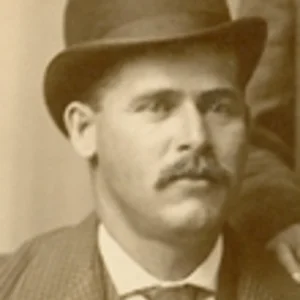

The Sundance Kid was an American Old West outlaw and a member of the famous Wild Bunch gang. A loyal sidekick of Butch Cassidy, he took part in numerous train and bank robberies before fleeing to South America.
Sundance Kid(1867 — 1908)
Sundance Kid
États-Unis
6 min read
Frequently asked questions
Key Facts
- Born in 1867 in Pennsylvania under the name Harry Alonzo Longabaugh
- Nicknamed the “Sundance Kid” after a stint in prison in Sundance, Wyoming, around 1887
- Member of the Wild Bunch gang led by Butch Cassidy, carrying out a string of train and bank robberies in the 1890s and 1900s
- Fled to Argentina and then Bolivia around 1901 with Butch Cassidy and Etta Place
- Presumed killed in 1908 in Bolivia, most likely during a shootout with the army at San Vicente
Works & Achievements
One of the Wild Bunch's most sensational train heists, against the Union Pacific in Wyoming, which triggered a massive manhunt.
Another Union Pacific holdup in Wyoming, showing the gang's daring and organization despite being hunted by the Pinkertons.
The robbery of Nevada's First National Bank, one of the gang's last great jobs in the United States before fleeing to South America.
An attempt to go straight as honest ranchers in Argentina, under false identities, before returning to a life of crime.
A bank robbery in Argentina attributed to the two fugitives, marking the end of their attempt at a settled life.
The theft of the miners' wages in Bolivia, the last job attributed to the duo, which directly preceded the shootout at San Vicente.
Anecdotes
The Sundance Kid's real name was Harry Alonzo Longabaugh. His nickname came from the small town of Sundance, Wyoming, where he was imprisoned for eighteen months for stealing a horse, a saddle, and a revolver in 1887. It was the only prison sentence he ever served.
Contrary to his reputation, no reliable source proves that the Sundance Kid ever killed anyone before he fled to South America. Reputed to be an excellent marksman, it was above all his skill with a revolver that built his legend, far more than any proven killings.
In 1901, the Sundance Kid, his companion Etta Place, and Butch Cassidy posed in a New York photo studio before sailing for Argentina. This famous portrait, polished and elegant, contrasts with the image of grimy outlaws: the three fugitives look like respectable middle-class citizens.
Together with Butch Cassidy, the Sundance Kid tried for a time to lead an honest life in Patagonia: they bought a ranch in the province of Chubut, Argentina, and raised cattle and sheep for a few years before returning to their robbing ways.
The Sundance Kid's exact fate remains a mystery. The most widespread account claims that he died alongside Butch Cassidy in a shootout against the Bolivian army at San Vicente in 1908, but no body was ever formally identified, which long fueled rumors that he had survived.
Primary Sources
Harry Longbaugh, alias 'Kid' Longbaugh, alias the Sundance Kid: wanted for armed robbery and participation in train holdups with the gang known as the Wild Bunch.
Harry Longabaugh, convicted of stealing a horse, saddle, and firearm, incarcerated for a term of eighteen months.
Studio shot taken at John Swartz's in Fort Worth, Texas, showing five members of the gang seated and standing in suits, including Harry Longabaugh and Butch Cassidy.
Two North American foreigners, suspected of robbing the Aramayo mining payroll, were surrounded by a patrol in a house in the village of San Vicente, where they met their deaths.
Key Places
Village in Montgomery County where Harry Longabaugh was born in 1867, into a modest working-class family.
Small town where Longabaugh was imprisoned in 1887 for theft, and which gave him his nickname, the “Sundance Kid.”
Remote, rugged region that served as a hideout for the Wild Bunch, nearly impossible for law enforcement to reach.
City where the gang posed for its famous group photograph in 1900, a picture that ironically helped the Pinkertons identify them.
Region of Patagonia where the Sundance Kid and Butch Cassidy ran a cattle ranch between 1902 and 1905, attempting to live a settled life.
Mining village where, in November 1908, two North Americans besieged by the army met their deaths; they are believed to have been the Sundance Kid and Butch Cassidy.
Typical Objects

The iconic handgun of the Wild West, the 'Colt .45' was the weapon of choice for outlaws and sheriffs alike. The Sundance Kid was renowned for his skill in handling it.

A lever-action rifle nicknamed “the gun that won the West.” Indispensable during train robberies and getaways on horseback.

A rugged western saddle designed for long rides and working cattle. A horse and its saddle were vital to an outlaw's survival and escape.

A wide-brimmed felt hat that shielded its wearer from sun and rain, becoming the signature garment of the cowboy and the man of the West.

An explosive used by the Wild Bunch to blow open the safes in Express railcars. One poorly measured charge once blew up an entire mail car.

A leather or canvas bag used to carry off the gold, banknotes, and coins stolen during bank and train robberies.

A poster printed by the authorities or the Pinkerton agency, offering a reward for the capture of outlaws. Those for the Wild Bunch used photographs stolen by the detectives.
School Curriculum
Vocabulary & Tags
Key Vocabulary
Tags
Daily Life
Morning
When he lived on the run, the Sundance Kid's morning began with saddling his horse and checking his weapons before moving on. During his ranching years in Patagonia, he rose early to tend the cattle and horses like any other rancher.
Afternoon
An outlaw's afternoons alternated between long rides across the plains, scouting out banks or train stations, and endless waiting in remote hideouts. At the ranch, he repaired fences and buildings and watched over the herds.
Evening
In the evening, around a campfire or in a small-town saloon, men played cards, drank whiskey, and traded news and rumors about their pursuers. Vigilance never let up, for an encounter with a sheriff could prove fatal.
Food
The diet of men of the West relied on beef, salt pork, beans, cornbread, and strong coffee boiled in a pot. On the run, they ate whatever they could carry or hunt, including canned goods and dried meat.
Clothing
He wore the classic cowboy outfit: a wide-brimmed hat, a cotton shirt, a vest, wool trousers or reinforced jeans, spurred boots, and a bandanna. For the famous 1900 photograph, by contrast, he sported an elegant city suit with a bowler hat.
Housing
At various times, he lodged in boarding-house rooms, saloons, makeshift camps, and remote hideouts like Hole-in-the-Wall. In Patagonia, he lived in a simple log cabin on his cattle ranch.
Historical Timeline
Period Vocabulary
Liens externes & ressources
Références
Œuvres
Attaque du train de Wilcox
1899
Attaque du train de Tipton
1900
Braquage de la banque de Winnemucca
1900
Ranch de Cholila (Patagonie)
1902-1905
Braquage de la Banco de la Nación à Villa Mercedes
1905
Vol de la paie de la mine d'Aramayo
1908