 flip
flipŞurpa (spiced fatty mutton broth)
Şurpa (spiced fatty mutton broth)
Why this dish? Şurpa was the daily meal of every Tatar household, from the palace to the yurts of Kazan's outskirts. Söyembikä, even in the difficult years of the regency, when harvests were threatened by Muscovite raids, could count on this nourishing broth — a dish that embodied the resilience of the people she governed.
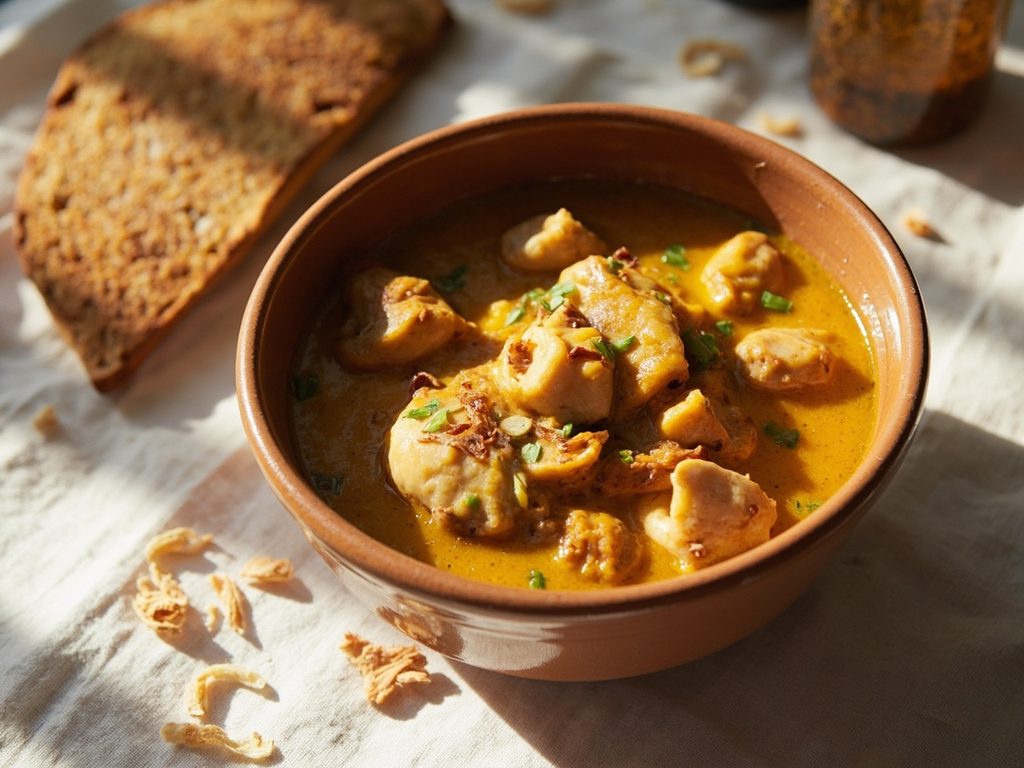
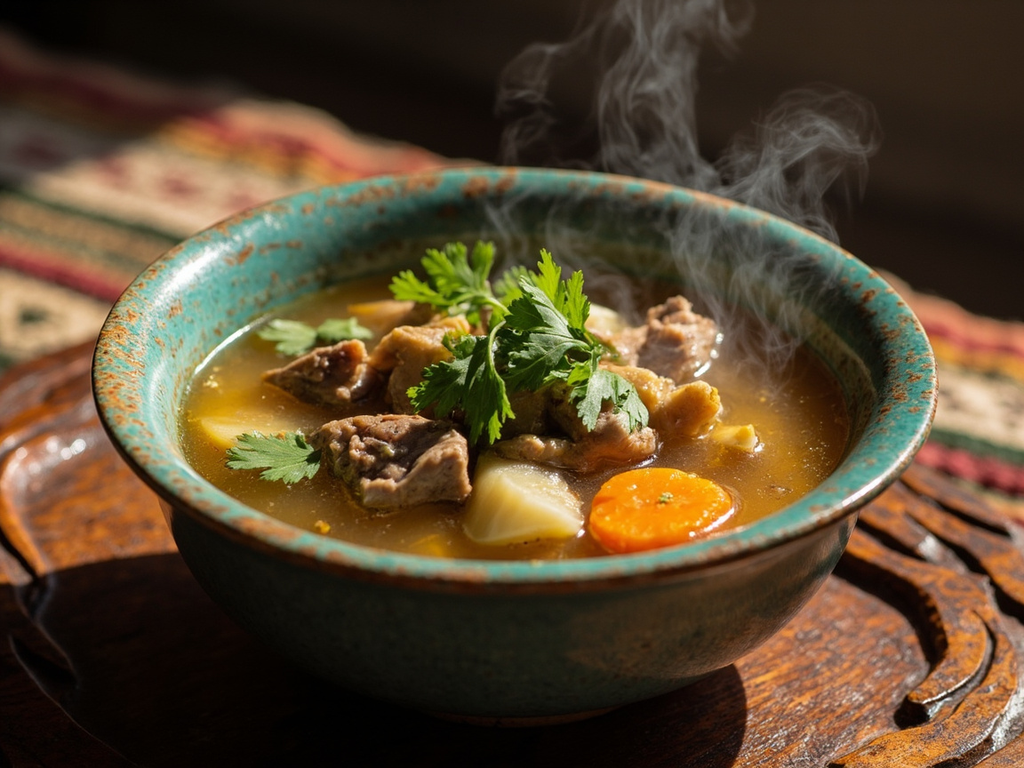
Clear, fatty mutton broth simmered long with onions, carrots, and turnips, perfumed with cumin and black pepper. Served boiling hot in individual bowls with fresh coriander, it traditionally opens every Tatar meal.
At my table in the Kremlin, no meal begins without steaming şurpa. My cooks choose a fat sheep whose tail drips, they boil it slowly from dawn with herbs from the garden and cumin that Bukhara merchants bring us along the Volga. Even when Ivan's armies camped at the gates, my women prepared this soup — for a people that eats its şurpa has not yet bent the knee. I drink it slowly, thanking the Most High for every day of freedom He still grants us.
- •Mutton on bone (breast or neck) — a good piece (broth base)
- •Fat-tailed sheep fat — a piece (enrich broth)
- •Onions — one or two (aromatic)
- •Carrots — two (vegetable)
- •Turnips — one (vegetable)
- •Cumin seeds — a pinch (spice)
- •Black peppercorns — a few (spice)
- •Salt — to taste (seasoning)
- •Fresh coriander — a handful (finishing herb)
Şurpa (spiced fatty mutton broth)
Clear, fatty mutton broth simmered long with onions, carrots, and turnips, perfumed with cumin and black pepper. Served boiling hot in individual bowls with fresh coriander, it traditionally opens every Tatar meal.
Why this dish? Şurpa was the daily meal of every Tatar household, from the palace to the yurts of Kazan's outskirts. Söyembikä, even in the difficult years of the regency, when harvests were threatened by Muscovite raids, could count on this nourishing broth — a dish that embodied the resilience of the people she governed.
At my table in the Kremlin, no meal begins without steaming şurpa. My cooks choose a fat sheep whose tail drips, they boil it slowly from dawn with herbs from the garden and cumin that Bukhara merchants bring us along the Volga. Even when Ivan's armies camped at the gates, my women prepared this soup — for a people that eats its şurpa has not yet bent the knee. I drink it slowly, thanking the Most High for every day of freedom He still grants us.
Ingredients (period version)
- Mutton on bone (breast or neck) — a good piece (broth base)
- Fat-tailed sheep fat — a piece (enrich broth)
- Onions — one or two (aromatic)
- Carrots — two (vegetable)
- Turnips — one (vegetable)
- Cumin seeds — a pinch (spice)
- Black peppercorns — a few (spice)
- Salt — to taste (seasoning)
- Fresh coriander — a handful (finishing herb)
Ingredients
- Mutton neck or breast — 600 g (broth base)
- Yellow onion — 1 large (aromatic)
- Carrots — 2 medium (vegetable)
- Turnip — 1 medium (vegetable)
- Cumin seeds — 1 tsp (spice)
- Black peppercorns — 6-8 (spice)
- Salt — to taste (seasoning)
- Water — 2 liters (broth)
- Fresh coriander — 1 bunch (finishing)
Method
- Place mutton in a large pot, cover with cold water and bring to a boil. Skim thoroughly.
- Add the peeled onion cut in half, cumin, and peppercorns. Reduce heat and simmer covered for 1 h 30 min.
- Add carrots and turnip cut into large chunks. Salt. Continue cooking 30 min until vegetables are tender.
- Remove meat, cut into pieces. Divide meat and vegetables among bowls, ladle boiling broth over.
- Sprinkle with chopped coriander and serve immediately with round bread.
How it was made : Şurpa (or chorba) is common to the entire Turco-Mongol world. In the Kazan Khanate, it was made with mutton or horse. Cumin arrived via Volga trade routes from Central Asia. Turnips and carrots were locally cultivated. The fatty broth provided essential caloric intake in the region's harsh continental climate.
The contemporary twist : Serve in a turquoise-glazed ceramic bowl, with a drizzle of toasted cumin oil swirled on the surface of the broth.
Sources : Mukhamedova, R. Tatary-Mishari (The Mishar Tatars), Moscow, 1972 · Pokhlebkin, V. Natsionalnye kukhni nashikh narodov (National Cuisines of Our Peoples), Moscow, 1978
Söyembikä · Charactorium