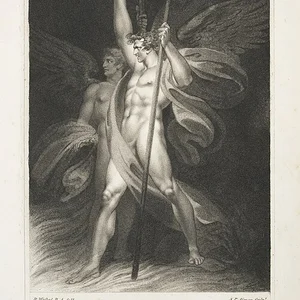
Tenazuchi is an earthly deity (kunitsukami) of Japanese Shinto mythology. Wife of Ashinazuchi and mother of Kushinada-hime, she appears in the myth where the god Susanoo saves her daughter from the eight-headed serpent Yamata-no-Orochi.
Tenazuchi
Tenazuchi
5 min read
Frequently asked questions
Key Facts
- Mentioned in the Kojiki (712) and the Nihon Shoki (720), the earliest mythological chronicles of Japan
- Wife of Ashinazuchi, an earthly deity of the Izumo region
- Mother of Kushinada-hime, the eighth and last daughter of the couple
- Her seven elder daughters were devoured by the serpent Yamata-no-Orochi
- The god Susanoo marries Kushinada-hime after defeating the serpent, making Tenazuchi his mother-in-law
Works & Achievements
Tenazuchi and her husband brew the strong sake that will intoxicate the serpent, a decisive step in Susanoo's stratagem.
The union of their youngest daughter with the savior god founds an important divine lineage of the Izumo pantheon.
Promoted to guardians of Susanoo's palace, Tenazuchi and Ashinazuchi are given a lasting honorary role in the tale.
Through their daughter and Susanoo, Tenazuchi is among the mythical ancestors of Ōkuninushi, the great deity who built the land.
Anecdotes
Tenazuchi and her husband Ashinazuchi form a couple of earthly deities whose names evoke the gesture of stroking: according to a traditional reading, Tenazuchi 'strokes the hands' and Ashinazuchi 'strokes the feet' of their daughter to console her, an image of loving parents overwhelmed by misfortune.
When Susanoo descends from heaven and arrives at the bank of the Hi River in the land of Izumo, he finds Tenazuchi and Ashinazuchi in tears: the giant serpent Yamata-no-Orochi has already devoured seven of their eight daughters, and the last one, Kushinada-hime, is to be handed over in turn.
To defeat the monster, Susanoo asks the two parents to prepare a very strong sake distilled eight times and to set it out in eight vats: the eight-headed serpent plunges each head into a vat, gets drunk, and falls asleep, allowing the god to cut it to pieces.
It is while slicing through the tail of the sleeping serpent that Susanoo discovers a marvelous sword, Kusanagi-no-tsurugi, which would become one of the three sacred treasures of Japan passed down to the imperial line.
After the victory, Susanoo marries Kushinada-hime, whom Tenazuchi and Ashinazuchi had promised to him, and he appoints the old couple as guardians of his new palace at Suga, thus sealing the alliance between the god and the deities of the soil of Izumo.
Primary Sources
Susanoo asked: “Who are you?” The old man replied: “I am an earthly deity, son of Ōyamatsumi. My name is Ashinazuchi, my wife is called Tenazuchi, and our daughter is named Kushinada-hime.”
Susanoo came upon an old man and an old woman holding a young girl between them and weeping. They said that every year the eight-headed serpent came to devour one of their daughters, and that only one of them remained.
Key Places
Region in southwestern Japan where the myth takes place, home to the cult of the earthly deities. Tenazuchi lives there with her family.
An Izumo waterway near which Susanoo meets Tenazuchi and Ashinazuchi as they weep. The serpent travels up it every year.
The place where Susanoo establishes his dwelling after his victory and appoints Tenazuchi and Ashinazuchi as guardians of the site. Associated with the Suga Shrine.
A major shrine dedicated to the earthly deities of Izumo, the historical center of the cults tied to this mythological cycle.
Typical Objects

Sake distilled eight times and poured into eight great jars to intoxicate the serpent Yamata-no-Orochi. Tenazuchi and Ashinazuchi prepare it on Susanoo's orders.

A prodigious sword discovered in the tail of the serpent slain by Susanoo. It would become one of the three sacred treasures of the Japanese imperial line.

A comb into which Susanoo transforms Kushinada-hime to hide her in his hair and protect her during the battle. An object of protective metamorphosis.

An enclosing fence fitted with eight openings, erected around the vats to channel the serpent's eight heads toward the sake.

The long sword that Susanoo wields to cut up the sleeping serpent. A weapon typical of the gods in the myths of the Kojiki.
School Curriculum
Vocabulary & Tags
Key Vocabulary
Daily Life
Morning
As an earthly deity bound to the soil of Izumo, Tenazuchi symbolically begins the day beside the Hi River and the fields. The myth shows her watching over her daughters, a parental occupation that structures her existence.
Afternoon
Afternoons are marked by the work tied to land and water that these kami embody: tending the rice paddies, the springs, and the harvests on which the village community depends.
Evening
In the evening, the tale depicts her in tears alongside Ashinazuchi, overwhelmed by the yearly threat of the serpent that devours one daughter after another, until the saving arrival of Susanoo.
Food
The diet associated with her world is that of the archaic Japan of Izumo: rice, fish and river produce, wild vegetables, and above all rice sake, the ritual drink at the heart of her myth.
Clothing
She is imagined dressed in the manner of the earthly deities of the ancient texts: draped robes of hemp or plant fibers, without the splendor of the celestial deities of the court.
Housing
Her dwelling is a rustic home in Izumo, near the river, before the family came to be associated with the palace of Suga built by Susanoo after his victory.
Historical Timeline
Period Vocabulary
Liens externes & ressources
Références
Œuvres
Préparation du saké distillé huit fois
Mythe (récit du Kojiki)
Mariage de Kushinada-hime et de Susanoo
Mythe
Garde du palais de Suga
Mythe
Lignée d'Ōkuninushi
Mythe