 flip
flipAndalusian Gazpacho
Andalusian Gazpacho
Why this dish? In 1840, Gautier traveled through Spain and produced his famous Voyage en Espagne. On the burning roads of Andalusia, he tasted this cold peasant soup, which he described with the verve of a man both astonished and refreshed.
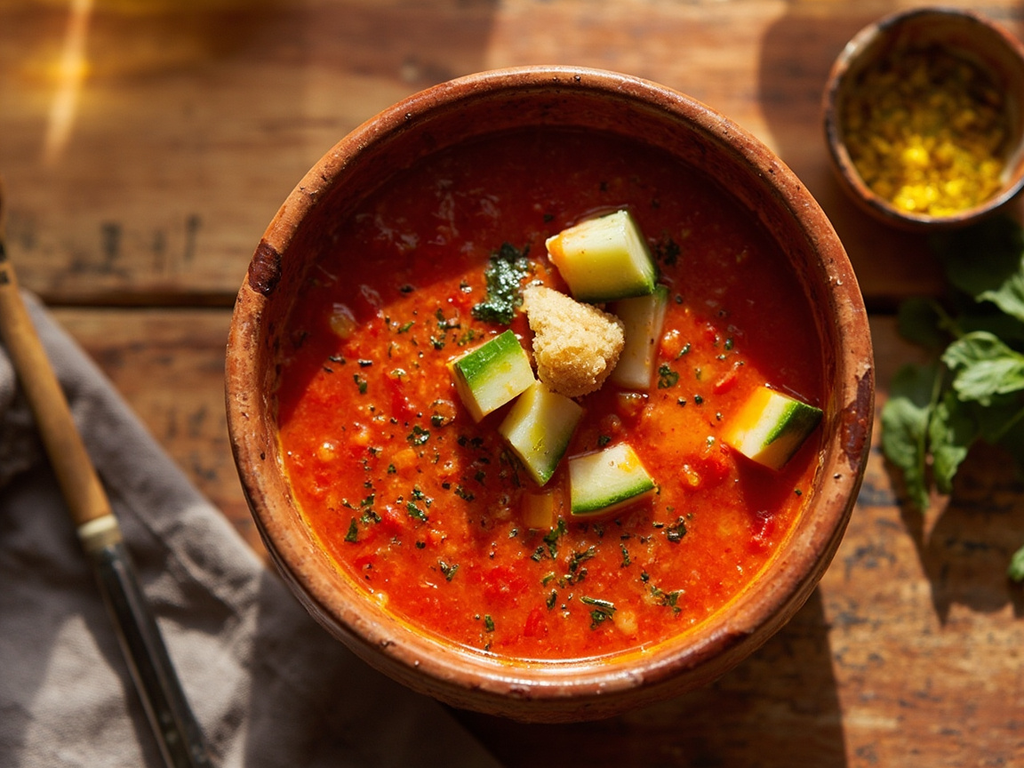
A cold Andalusian soup, based on soaked bread, olive oil, vinegar, garlic, and crushed raw vegetables. Served chilled, it quenches thirst and nourishes the traveler in the heat of the South.
On the dusty roads of Andalusia, under a sun that splits stones, I was served a most singular beverage that the locals call gazpacho. Imagine bread, oil, vinegar, garlic, and fresh water, all beaten into a cold soup that one drinks more than one eats! I confess that at first this mixture disconcerts a Parisian's palate; but in this heat, it is a fountain of freshness, and one quickly understands why the muleteer makes it his daily fare. Travel, you see, is also learned by mouth.
- •Stale bread — soaked crumb (binder)
- •Olive oil — generous (fat)
- •Wine vinegar — a dash (acidity)
- •Garlic — one clove (flavoring)
- •Tomatoes and cucumber — as desired (fresh vegetables)
- •Fresh water — to adjust (liquid)
- •Salt — to taste (seasoning)
Andalusian Gazpacho
A cold Andalusian soup, based on soaked bread, olive oil, vinegar, garlic, and crushed raw vegetables. Served chilled, it quenches thirst and nourishes the traveler in the heat of the South.
Why this dish? In 1840, Gautier traveled through Spain and produced his famous Voyage en Espagne. On the burning roads of Andalusia, he tasted this cold peasant soup, which he described with the verve of a man both astonished and refreshed.
On the dusty roads of Andalusia, under a sun that splits stones, I was served a most singular beverage that the locals call gazpacho. Imagine bread, oil, vinegar, garlic, and fresh water, all beaten into a cold soup that one drinks more than one eats! I confess that at first this mixture disconcerts a Parisian's palate; but in this heat, it is a fountain of freshness, and one quickly understands why the muleteer makes it his daily fare. Travel, you see, is also learned by mouth.
Ingredients (period version)
- Stale bread — soaked crumb (binder)
- Olive oil — generous (fat)
- Wine vinegar — a dash (acidity)
- Garlic — one clove (flavoring)
- Tomatoes and cucumber — as desired (fresh vegetables)
- Fresh water — to adjust (liquid)
- Salt — to taste (seasoning)
Ingredients
- Ripe tomatoes — 1 kg (base)
- Cucumber — 1 (freshness)
- Green bell pepper — 1/2 (vegetable)
- Rustic country bread — 100 g (binder)
- Garlic — 1 clove (flavoring)
- Extra virgin olive oil — 6 tbsp (fat)
- Sherry vinegar — 2 tbsp (acidity)
- Salt — 1 tsp (seasoning)
- Ice water — to adjust (texture)
Method
- Soak the bread in a little water.
- Coarsely chop the tomatoes, cucumber, and bell pepper.
- Blend all the vegetables with the squeezed bread, garlic, and salt.
- Add the vinegar, then drizzle in the olive oil while continuing to blend to emulsify.
- Thin with a little ice water to the desired consistency; adjust salt and vinegar.
- Chill for at least 2 hours and serve very cold, with a drizzle of olive oil.
How it was made : The ancient gazpacho was first a simple porridge of bread, oil, vinegar, and garlic, pounded in a mortar by Andalusian agricultural workers. Tomato and bell pepper, from the New World and adopted in Spain from the 16th century, only entered it widely around the turn of the 19th—exactly when Gautier discovered it.
The contemporary twist : Served in chilled verrines with a little hat of diced vegetables and oil croutons, 'traveler's aperitif' style.
Théophile Gautier · Charactorium