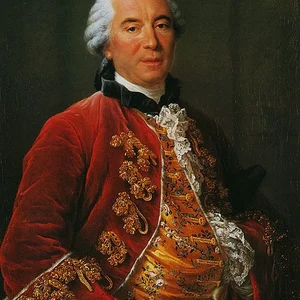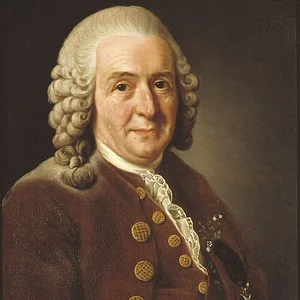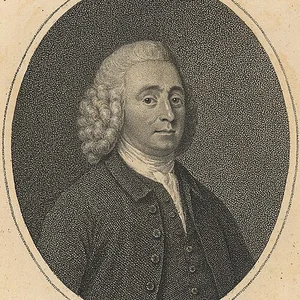

Eighteenth-century British physician, a pioneer of variolation (inoculation against smallpox). He gained European fame by inoculating Empress Catherine II of Russia and her son in 1768.
Thomas Dimsdale(1712 — 1800)
Thomas Dimsdale
royaume de Grande-Bretagne
5 min read
Frequently asked questions
Key Facts
- Born in 1712 in Essex (England) into a Quaker family.
- Published in 1767 'The Present Method of Inoculating for the Small-Pox', a landmark treatise on inoculation.
- Inoculated Empress Catherine II of Russia and Grand Duke Paul in 1768, putting an end to the fear of the practice at court.
- Ennobled by Catherine II as a baron of the Russian Empire and richly rewarded for his intervention.
- Died in 1800 in Hertford, after a career split between medicine and his work as a banker.
Works & Achievements
Landmark treatise setting out his simplified method of inoculation; it established his European reputation and was translated into several languages.
Dimsdale's most famous medical feat, which gave variolation a dazzling royal endorsement across Europe.
An account and defence of his method written during his stay in Russia, an important testimony to the practice of inoculation.
A reflection on the benefits and dangers of inoculating populations on a large scale.
A second journey to Russia to protect Catherine II's grandsons, confirming his status as a trusted physician of the court.
An honorary title and position conferred by Catherine II, turning this Quaker physician into a figure of the court.
Anecdotes
In 1768, Catherine II of Russia summoned Dimsdale to Saint Petersburg to inoculate her against smallpox. Because the operation was risky and the empress feared a revolt should she die, post-horses were kept ready day and night so the doctor could flee the country if it failed.
Catherine II's inoculation was such a success that the empress afterwards appeared in public to reassure her people, and the date of the operation was for a time celebrated as a holiday at the Russian court. Dimsdale had first inoculated a young boy in order to take from him the smallpox matter intended for the sovereign.
As a reward, Catherine II made this simple English country doctor a baron of the Russian Empire, paid him 10,000 pounds sterling along with an annual pension of 500 pounds, and appointed him councillor of state and physician to the court.
Dimsdale was a Quaker: he belonged to a religious movement that rejected titles, oaths, and pomp. Yet here he was, a Russian baron — a paradox for a man accustomed to the sobriety and the egalitarian familiar address of the Friends.
In 1781, by then nearly 70 years old, he made the long journey to Russia once more, this time to inoculate Catherine's grandsons, the grand dukes Alexander (the future Tsar Alexander I) and Constantine.
Primary Sources
The practice of inoculation, as I describe it here, aims to communicate the smallpox in a mild and safe form, by means of a slight incision and a moderate preparation of the body.
Her Imperial Majesty, judging it of the highest importance to set an example for her subjects, resolved to submit herself to inoculation before recommending its use.
The general inoculation of an entire town, if not conducted with prudence, may spread the contagion instead of preventing it.
Key Places
Village in Essex where Thomas Dimsdale was born in 1712 into a Quaker family of physicians.
Town in Hertfordshire where Dimsdale practiced medicine, was elected a Member of Parliament, and died in 1800.
London hospital where Dimsdale studied medicine.
Capital of the Russian Empire where Dimsdale inoculated Catherine II in 1768, then her grandsons in 1781.
Imperial residence near Saint Petersburg, linked to Dimsdale's stay at the court of Catherine II.
Typical Objects

Small sharp instrument used to make a slight incision in the skin in order to introduce the smallpox matter. It was the central tool of variolation.

Fluid taken from the pustule of a patient suffering from a mild form of smallpox, used to transmit a controlled infection to the inoculated patient.

Work by Dimsdale detailing his method of inoculation, distributed throughout Europe and translated into several languages.

Leather case containing lancets, vials and instruments that the doctor carried during home visits and travels.

Official act by which Catherine II raised Dimsdale to the rank of baron of the Russian Empire, together with the coat of arms granted to him.

Simple, unadorned garment in a dull color, worn by Quakers as a sign of modesty and rejection of luxury.
School Curriculum
Vocabulary & Tags
Key Vocabulary
Tags
Daily Life
Morning
A country doctor based in Hertford, Dimsdale began his day by reading his mail and preparing his instruments. A Quaker, he observed a moment of silent reflection before receiving his first patients.
Afternoon
The afternoon was devoted to house calls, sometimes several hours away on horseback, and to inoculation procedures that required careful preparation and monitoring of patients. He kept precise records of every case.
Evening
In the evening, he studied medical treatises, wrote up his observations, and corresponded with other practitioners across Europe. Quaker sobriety left no room for gambling or drinking.
Food
The diet of a well-off 18th-century doctor combined bread, meats, cheeses, beer, and wine. As a Quaker, Dimsdale advocated moderation and simplicity at the table.
Clothing
He wore the plain, dark dress of the Quakers, without lace or ornament, with a broad-brimmed hat — a striking contrast with the splendour of the courts he frequented.
Housing
He lived in a comfortable house in Hertford. In Saint Petersburg, he was lodged in the luxury of an imperial residence, surrounded by an opulence that stood in sharp contrast with his usual way of life.
Historical Timeline
Period Vocabulary
Liens externes & ressources
Références
Œuvres
The Present Method of Inoculating for the Small-Pox
1767
Inoculation de Catherine II et du grand-duc Paul
1768
Tracts on Inoculation written and published at St. Petersburg
1781
Thoughts on General and Partial Inoculations
1776
Inoculation des grands-ducs Alexandre et Constantin
1781
Baron de l'Empire russe et conseiller d'État
1768