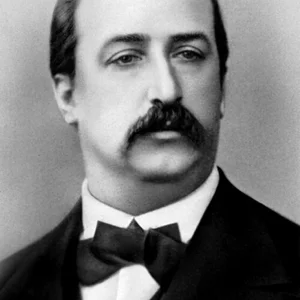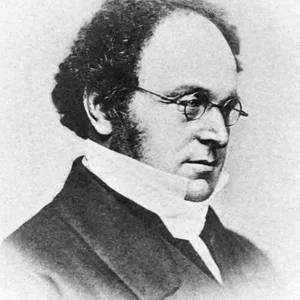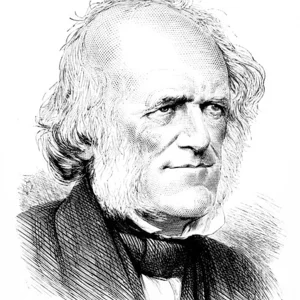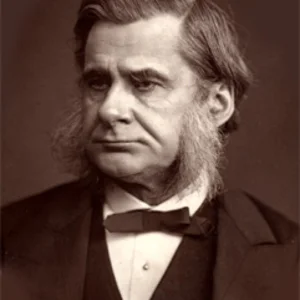

A British biologist and palaeontologist, and a fervent defender of Charles Darwin's theory of evolution — which earned him the nickname “Darwin's bulldog.” A renowned comparative anatomist, he was one of the foremost popularizers of science in the 19th century.
Thomas Henry Huxley(1825 — 1895)
Thomas Henry Huxley
Royaume-Uni de Grande-Bretagne et d'Irlande
6 min read
Frequently asked questions
Famous Quotes
« Science is simply common sense at its best.»
Key Facts
- Born in 1825 in Ealing, near London
- 1860: famous debate at Oxford against Bishop Samuel Wilberforce on evolution
- Public champion of Darwin's “On the Origin of Species” (1859), nicknamed “Darwin's bulldog”
- Coined the term “agnosticism” in 1869 to describe his stance on religious questions
- Died in 1895 in Eastbourne
Works & Achievements
The first work to openly apply the theory of evolution to the human species, demonstrating the anatomical kinship between humans and the great apes.
A now-legendary verbal duel in which Huxley publicly defended Darwin's ideas against religious authorities.
A famous lecture in which Huxley sets out the idea of protoplasm as the material basis common to all forms of life.
Huxley created this word to describe an intellectual stance grounded in the limits of knowledge when faced with metaphysical questions.
A collection of popular-science essays that helped spread scientific thinking among the wider Victorian public.
Palaeontological research establishing an evolutionary link between dinosaurs and birds, an idea confirmed by modern science.
As a member of the London School Board, Huxley campaigned to introduce the natural sciences into public education and teacher training.
Anecdotes
In 1860, during a famous debate at Oxford, Bishop Samuel Wilberforce asked Huxley whether it was through his grandfather or his grandmother that he was descended from a monkey. Huxley is said to have replied that he would rather be descended from a monkey than from a man who used his intelligence to ridicule a serious scientific discussion. The room was stunned.
Huxley attended school for only two years in his entire life. Almost entirely self-taught, he learned German, Latin, and philosophy on his own, and became one of the most respected scholars of his century.
At the age of 21, he set sail as an assistant surgeon aboard HMS Rattlesnake on a four-year expedition to the seas of Australia. During the voyage, he studied jellyfish and marine organisms and sent his work back to London, which made him famous even before his return.
It was Huxley who coined the word “agnostic” in 1869 to describe his position: he argued that one can neither prove nor disprove the existence of God, and that we must remain honest about the limits of our knowledge.
Nicknamed “Darwin's bulldog,” Huxley defended Darwin's ideas with such public energy that Darwin himself, shy and often ill, let him take the front line of the debates in his place.
Primary Sources
The question of questions for mankind — the problem which underlies all others, and is more deeply interesting than any other — is the ascertainment of the place which Man occupies in nature and of his relations to the universe of things.
My business is to teach facts to be masters and not servants; to sit down before fact as a little child, ready to give up every preconceived notion, to follow humbly wherever nature leads me.
In matters of the intellect, follow your reason as far as it will take you, without regard to any other consideration. And negatively: in matters of the intellect, do not pretend that conclusions are certain which are not demonstrated or demonstrable.
Protoplasm, whether simple or nucleated, is the formal basis of all life. It is the living matter, and all life is one with it in its material foundation.
Key Places
Town where Huxley was born in 1825, where his father taught at a school.
Exploration ship on which Huxley served as assistant surgeon from 1846 to 1850 and conducted his first research on marine fauna.
Institution where Huxley taught natural history for more than thirty years and trained generations of naturalists.
Site of the famous 1860 debate on evolution between Huxley and Bishop Wilberforce.
Coastal town in southern England where Huxley died in 1895.
Typical Objects

An optical instrument essential to Huxley for studying protoplasm, jellyfish, and animal tissues. He made it the central tool of his research in comparative anatomy.

A thin knife used to dissect animals in order to compare their skeletons and organs. Huxley, a comparative anatomist, used it daily.

A notebook in which Huxley drew, with great precision, the organisms he observed under the microscope or dissected. His plates were then used to illustrate his publications.

The petrified remains of extinct animals that Huxley studied to reconstruct the history of evolution, notably that of horses and of birds descended from dinosaurs.

Bones mounted side by side (human, ape, other vertebrates) to highlight their structural similarities. Huxley used them to demonstrate the kinship between humans and the great apes.

The writing tools with which Huxley composed his popular-science essays, his lectures, and his abundant scientific correspondence.
School Curriculum
Vocabulary & Tags
Key Vocabulary
Tags
Daily Life
Morning
Huxley rose early and often devoted his mornings to dissection and microscopic observation in his laboratory. He liked to work rigorously, taking detailed notes and drawing his observations.
Afternoon
Afternoons were frequently set aside for teaching at the Royal School of Mines or for preparing his lectures. He also received students and colleagues to discuss their work.
Evening
In the evening, Huxley wrote his essays, read in several languages and kept up a vast correspondence with Darwin and other scholars. He also took part in the meetings of the X Club, a circle of influential scientists.
Food
The diet of a Victorian middle-class man relied on meat, bread, potatoes and tea. Often overworked, Huxley suffered from digestive troubles and bouts of depression that forced him to take rest cures.
Clothing
Huxley wore the dark attire of the Victorian man of science and scholar: a frock coat, a high-collared shirt, a tie or cravat, and thick whiskers in keeping with the fashion of the day.
Housing
He lived in a middle-class London house with his wife Henrietta and their many children, in an interior cluttered with books, naturalist specimens and scientific instruments.
Historical Timeline
Period Vocabulary
Liens externes & ressources
Références
Œuvres
De la place de l'homme dans la nature (Evidence as to Man's Place in Nature)
1863
Débat d'Oxford contre Wilberforce
1860
On the Physical Basis of Life
1868
Invention du terme « agnostique »
1869
Lay Sermons, Addresses and Reviews
1870
Travaux sur l'origine des oiseaux
1868
Réforme de l'enseignement scientifique
1870-1895