 flip
flipBeshbarmak — Boiled Meat on Pasta
Beshbarmak — Boiled Meat on Pasta
Why this dish? Beshbarmak ("five fingers", because eaten with the hand) is the central dish of all Turco-Mongol peoples of the steppe. At Tokhtamysh's court in Sarai, as under the yurt of the last rider, it is the shared boiled meat that seals hospitality. This dish accompanied every war council and every victory feast of the khan.
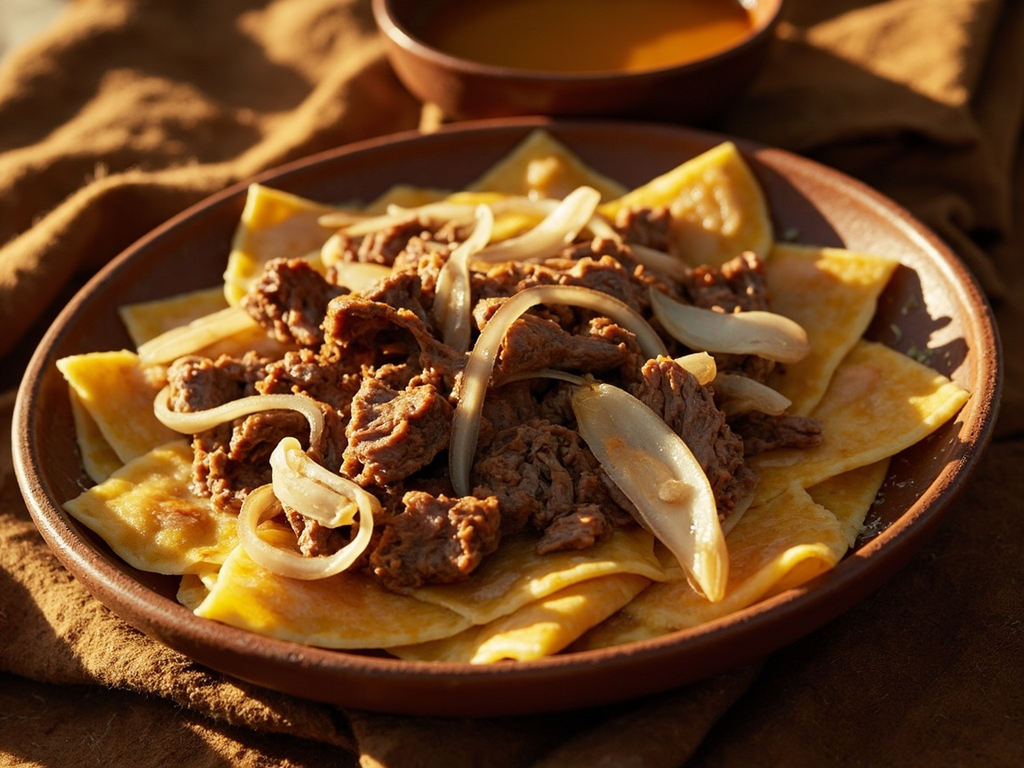
Lamb long-boiled in a fragrant broth, cut into pieces and served on pasta sheets cooked in the same broth, drizzled with fatty juice and melted onion. A deceptively simple dish whose flavor relies entirely on the quality of the meat and the patience of cooking.
Listen well, you who come from beyond the river. In my golden yurt at Sarai, when my emirs gather around the dastarkhan, it is always the boiled mutton that speaks first. I myself carve the head for my most worthy guest — that is the law of the steppe, the law of Genghis Khan that no one breaks. The fat must coat the pasta until it shines like the Itil under the moon. Eat with your five fingers, do not fear getting dirty: a man who eats cleanly is a man who is not hungry.
- •Mutton shoulder with bone — a good quarter (Main meat)
- •Fat-tail sheep fat — a fist-sized piece (Cooking fat for broth)
- •Wild steppe onion — several bulbs (Aromatic)
- •Rock salt — to taste (Seasoning)
- •Wheat or millet flour — enough for dough (Accompaniment pasta)
- •Spring water — abundant (Broth)
Beshbarmak — Boiled Meat on Pasta
Lamb long-boiled in a fragrant broth, cut into pieces and served on pasta sheets cooked in the same broth, drizzled with fatty juice and melted onion. A deceptively simple dish whose flavor relies entirely on the quality of the meat and the patience of cooking.
Why this dish? Beshbarmak ("five fingers", because eaten with the hand) is the central dish of all Turco-Mongol peoples of the steppe. At Tokhtamysh's court in Sarai, as under the yurt of the last rider, it is the shared boiled meat that seals hospitality. This dish accompanied every war council and every victory feast of the khan.
Listen well, you who come from beyond the river. In my golden yurt at Sarai, when my emirs gather around the dastarkhan, it is always the boiled mutton that speaks first. I myself carve the head for my most worthy guest — that is the law of the steppe, the law of Genghis Khan that no one breaks. The fat must coat the pasta until it shines like the Itil under the moon. Eat with your five fingers, do not fear getting dirty: a man who eats cleanly is a man who is not hungry.
Ingredients (period version)
- Mutton shoulder with bone — a good quarter (Main meat)
- Fat-tail sheep fat — a fist-sized piece (Cooking fat for broth)
- Wild steppe onion — several bulbs (Aromatic)
- Rock salt — to taste (Seasoning)
- Wheat or millet flour — enough for dough (Accompaniment pasta)
- Spring water — abundant (Broth)
Ingredients
- Lamb shoulder with bone — 1.2 kg (Main meat)
- Lamb fat or suet — 80 g (Cooking fat)
- Yellow onions — 3 medium (Aromatic and garnish)
- Salt — 2 tsp (Seasoning)
- Black peppercorns — 6 (Aromatic)
- Bay leaf — 2 (Broth aromatic)
- Wheat flour — 300 g (Pasta)
- Egg — 1 (Pasta binder)
- Water — 2.5 liters + 120 ml for pasta (Broth and pasta)
Method
- Place the lamb shoulder in a large pot, cover with cold water, bring to a boil and skim off the foam thoroughly.
- Add salt, peppercorns and bay leaf. Reduce heat and simmer covered for 2.5 to 3 hours, until the meat falls off the bone.
- Meanwhile, prepare the pasta: mix flour, egg, a pinch of salt and water. Knead for 10 minutes until smooth. Let rest 30 minutes under a cloth.
- Finely slice the onions. Ladle out 3 scoops of fatty broth and cook the onions over low heat until translucent and coated with fat.
- Roll out the pasta thinly (2 mm) and cut into diamonds about 8 × 5 cm.
- Remove the meat from the broth and keep warm. Bring the broth to a boil and cook the pasta diamonds for 4-5 minutes.
- Arrange the drained pasta on a large platter. Cut the meat into generous pieces and place on the pasta. Top with the onions melted in fatty broth.
- Serve the hot broth separately in bowls. Eat with fingers or a spoon.
How it was made : Beshbarmak is attested among Turkic and Mongol peoples since the early Middle Ages. Pasta was not always present — in the oldest versions, only meat was served with broth (shorpa). The use of pasta sheets developed through contact with sedentary Central Asian populations. At the Golden Horde court, whole boiled mutton was a prestige marker, with meat distribution following a strict protocol based on rank.
The contemporary twist : Serve the pasta diamonds arranged in a rosette on a large terracotta plate, shredded meat in the center, drizzled with reduced broth and a few flat-leaf parsley leaves — like a steppe carpaccio.
Sources : Paul D. Buell, Eugene N. Anderson, « A Soup for the Qan: Chinese Dietary Medicine of the Mongol Era as Seen in Hu Sihui's Yinshan Zhengyao », Brill, 2010 · Nurlan Kenjeahmetuly, « Kazakh Cuisine », Almaty, 2003
Tokhtamysh · Charactorium