 flip
flipKasav — Cassava Flatbread
Kasav — Cassava Flatbread
Why this dish? The cassava flatbread, dry and durable, was slipped into the soldier's haversack and kept for weeks in the Antillean climate. For an army campaigning in the hills — the one Toussaint led from victory to victory — it was the bread of all, inherited from the island's first Taíno inhabitants.
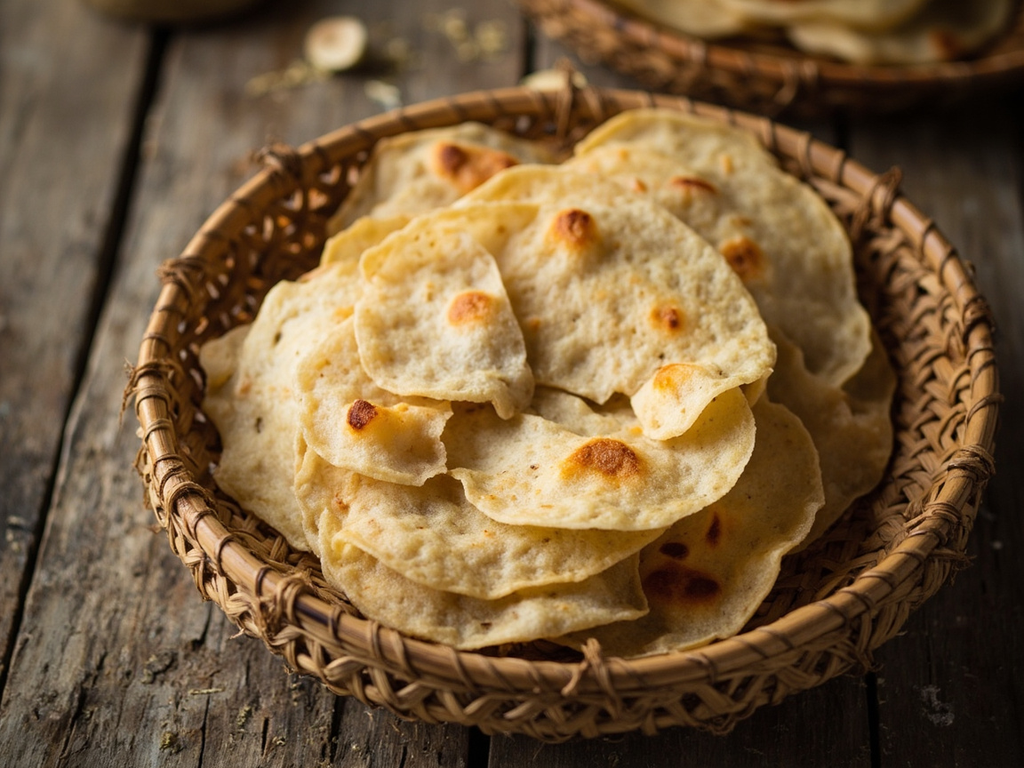
A thin flatbread of cassava flour, dry-cooked on a hot griddle until crisp. Without leavening, nearly imperishable: the travel and reserve bread of Saint-Domingue.
Here is the bread that never betrays the soldier. Cassava is treacherous raw — it must be grated, its juice pressed out, and only the dry flour kept. Spread it thin on the hot griddle; it sets by itself, without leaven or oven. Once dry, it keeps for whole moons in the haversack, and in camp, dipped in sauce, it is worth the best bread of France. The ancients of this land made it thus before us.
- •Bitter cassava — several roots (base)
- •Salt — a pinch (seasoning)
Kasav — Cassava Flatbread
A thin flatbread of cassava flour, dry-cooked on a hot griddle until crisp. Without leavening, nearly imperishable: the travel and reserve bread of Saint-Domingue.
Why this dish? The cassava flatbread, dry and durable, was slipped into the soldier's haversack and kept for weeks in the Antillean climate. For an army campaigning in the hills — the one Toussaint led from victory to victory — it was the bread of all, inherited from the island's first Taíno inhabitants.
Here is the bread that never betrays the soldier. Cassava is treacherous raw — it must be grated, its juice pressed out, and only the dry flour kept. Spread it thin on the hot griddle; it sets by itself, without leaven or oven. Once dry, it keeps for whole moons in the haversack, and in camp, dipped in sauce, it is worth the best bread of France. The ancients of this land made it thus before us.
Ingredients (period version)
- Bitter cassava — several roots (base)
- Salt — a pinch (seasoning)
Ingredients
- Cassava flour (gari/cassava coarse flour) — 250 g (base)
- Water — a splash, to moisten (cohesion)
- Salt — 1 pinch (seasoning)
Method
- If starting from fresh (bitter) cassava: peel, finely grate, then press the pulp firmly in a cloth to extract all the juice (toxic raw) — the essential step.
- With ready-to-use cassava flour: sift it and season very lightly with salt, moisten just enough so that it clumps under the hand.
- Heat a griddle or heavy pan dry, without fat, over medium-high heat.
- Spread a thin, even layer of flour, press with a spatula: the heat fuses it into a flatbread.
- Cook for 3–4 min, carefully flip, dry the other side until firm and lightly golden.
- Let cool flat: the flatbread hardens and keeps for several days in a dry place.
How it was made : Cassava bread is the culinary heritage of the Taíno and Arawak of the Greater Antilles. Bitter cassava, toxic raw, had to be grated and pressed (formerly in a woven "couleuvre") to expel hydrocyanic acid, then dry-cooked on a stone or iron griddle. An ideal preserved food in the tropics, it nourished slaves, colonists, and armies.
The contemporary twist : As an appetizer "cracker," rubbed warm with garlic and lime zest, broken into pieces over a kalalou.
Toussaint Louverture · Charactorium