 flip
flipI'a ota
I'a ota
Why this dish? Tupaia lived surrounded by the ocean on Ra'iatea, where raw fish marinated in coconut milk was the quintessential daily food. Polynesian navigators ate this dish at every stop, including during the voyage on the Endeavour where Tupaia fished and prepared the fish in his own way, astonishing Cook's crew.
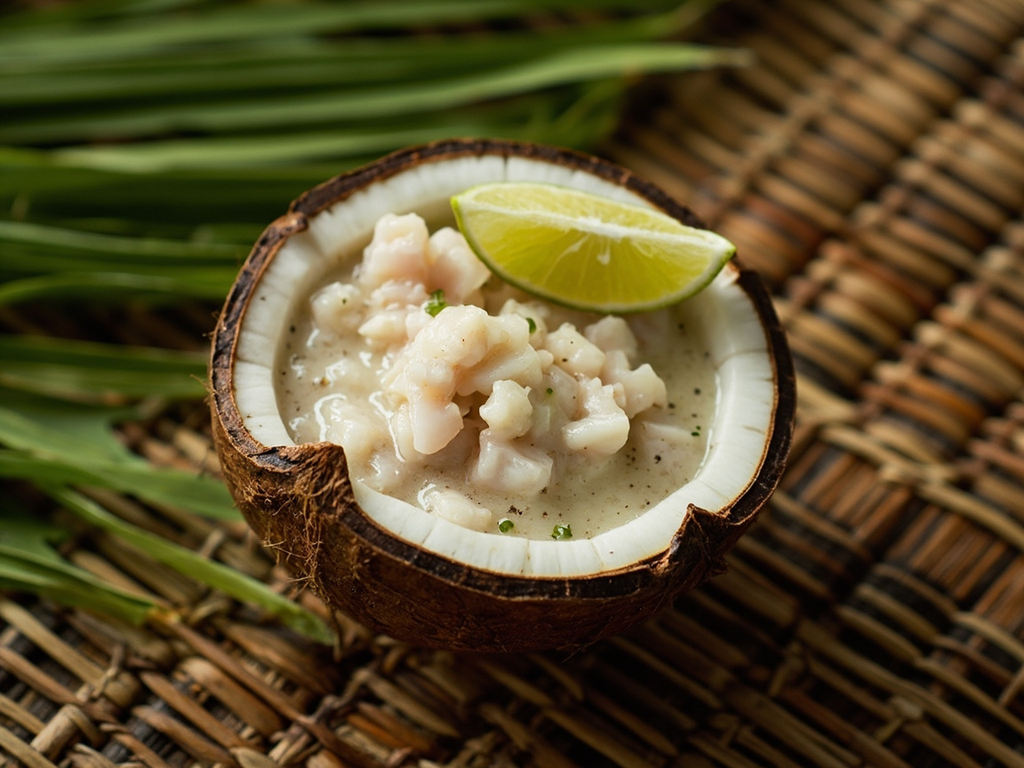
Raw fish diced and marinated in lime juice until the flesh whitens, then drizzled with fresh coconut milk. This dish embodies Polynesian cuisine in its purest form: the sea, the coconut tree, and nothing superfluous.
Listen, stranger. You do not need fire to feed a man. Take the fish the sea offers you, slice it with your mother-of-pearl knife, and pour over it the juice of the lime — the flesh will cook before your eyes, it whitens like foam. Then you press the coconut, and that milk is the goodness of the land joining the goodness of the sea. On the deck of that great English ship, I prepared this ma'a for Mr. Banks, and he acknowledged that our way was worth their copper pots.
- •Fresh reef fish (tuna, bonito, or parrotfish) — A fine fish, boned and diced (Base)
- •Limes (tipolo) — Juice of several ripe fruits (Acid marinade)
- •Ripe coconut — One nut, grated and pressed (Creamy sauce)
- •Sea salt — A pinch (Seasoning)
I'a ota
Raw fish diced and marinated in lime juice until the flesh whitens, then drizzled with fresh coconut milk. This dish embodies Polynesian cuisine in its purest form: the sea, the coconut tree, and nothing superfluous.
Why this dish? Tupaia lived surrounded by the ocean on Ra'iatea, where raw fish marinated in coconut milk was the quintessential daily food. Polynesian navigators ate this dish at every stop, including during the voyage on the Endeavour where Tupaia fished and prepared the fish in his own way, astonishing Cook's crew.
Listen, stranger. You do not need fire to feed a man. Take the fish the sea offers you, slice it with your mother-of-pearl knife, and pour over it the juice of the lime — the flesh will cook before your eyes, it whitens like foam. Then you press the coconut, and that milk is the goodness of the land joining the goodness of the sea. On the deck of that great English ship, I prepared this ma'a for Mr. Banks, and he acknowledged that our way was worth their copper pots.
Ingredients (period version)
- Fresh reef fish (tuna, bonito, or parrotfish) — A fine fish, boned and diced (Base)
- Limes (tipolo) — Juice of several ripe fruits (Acid marinade)
- Ripe coconut — One nut, grated and pressed (Creamy sauce)
- Sea salt — A pinch (Seasoning)
Ingredients
- Very fresh tuna or sea bream fillet (sashimi quality) — 400 g (Base)
- Limes — 6 to 8 (about 150 ml juice) (Acid marinade)
- Fresh or canned coconut milk (unsweetened) — 200 ml (Creamy sauce)
- Cucumber — 1 small, diced (optional modern addition) (Freshness)
- Fine salt — 1 tsp (Seasoning)
Method
- Cut the fish into 2 cm cubes. Check for any remaining bones.
- Place the cubes in a bowl, pour the lime juice over them and mix. Cover and marinate in the fridge for 20 to 30 minutes: the flesh should whiten on the surface.
- Drain the fish, discarding the marinade juice.
- Pour the coconut milk over the fish, add salt, and mix gently.
- If desired, add the diced cucumber.
- Serve immediately in a bowl, well chilled.
How it was made : I'a ota is attested by the first European visitors to Tahiti, including Joseph Banks and Sydney Parkinson during Cook's voyage in 1769. The technique of 'cooking' fish with lime acid is common throughout Polynesia. Fish was cut with mother-of-pearl or basalt blades, and coconut grated on coral graters.
The contemporary twist : Serve in a half coconut shell, with a few local herbs (cilantro or chives) and a drizzle of virgin coconut oil for fragrance.
Sources : Banks, Joseph. The Endeavour Journal of Joseph Banks, 1768–1771. · Oliver, Douglas L. Ancient Tahitian Society. University of Hawaii Press, 1974.
Tupaia · Charactorium