 flip
flipHalva-yi ardi (Toasted Flour Halva with Saffron)
Halva-yi ardi (Toasted Flour Halva with Saffron)
Why this dish? Flour halva is a festive confection throughout the Timurid world, prepared for religious celebrations, military victories, and diplomatic receptions. Ulugh Beg, who inaugurated his madrasa and hosted the greatest mathematicians of his time, certainly served this halva on such solemn occasions.
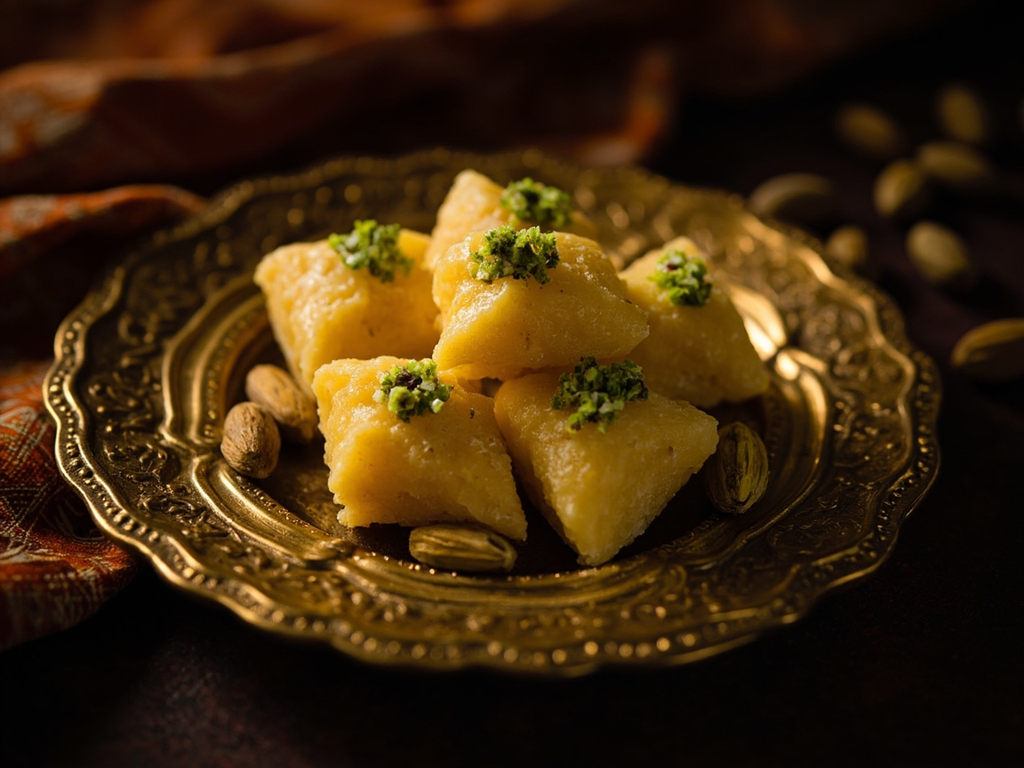
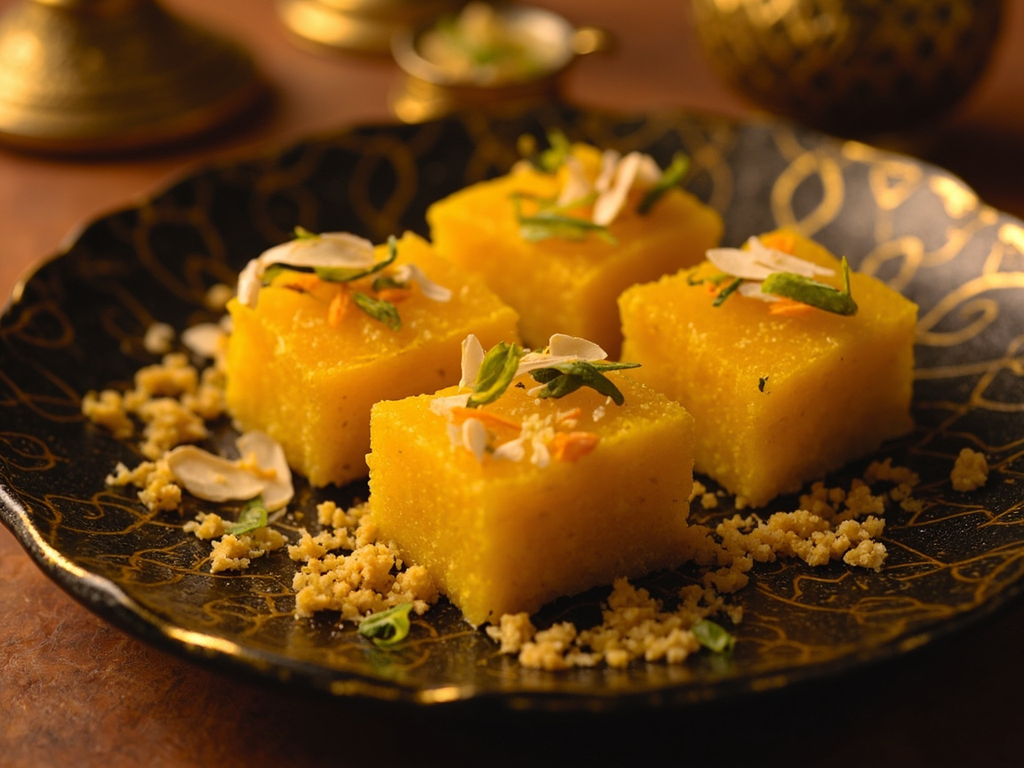
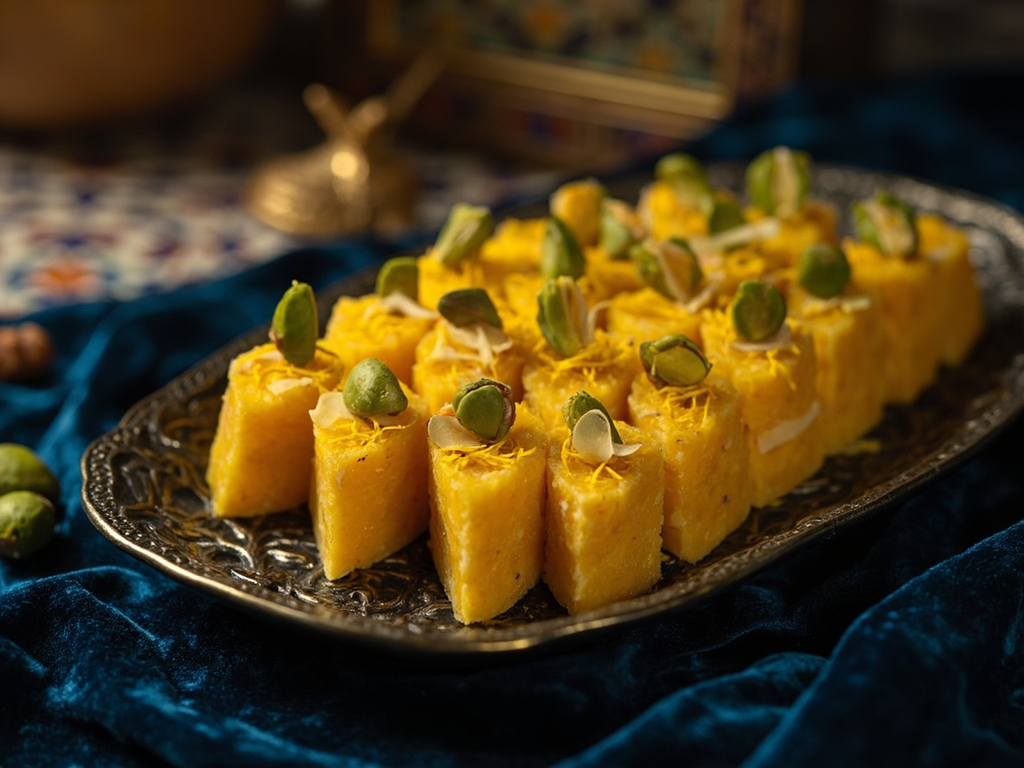
Dense, melt-in-the-mouth halva made from wheat flour slowly toasted in clarified butter until golden, then bound with a honey syrup perfumed with saffron and cardamom. Enriched with pistachios and almonds, it is cut into diamonds. Neither cake nor candy, it is a confection apart, typically Persian and Central Asian.
When we completed the astronomical tables that bear my name, I had halva distributed to all the scholars of the madrasa — for a great work deserves a great sweetness. The flour must be stirred without pause in the butter, patiently, as one polishes a bronze mirror to reflect the stars. If you stop stirring, everything burns: haste is the enemy of halva as of astronomy. When the nutty scent fills the kitchen, that is the sign that the moment has come to pour in the honey syrup with saffron.
- •Fine wheat flour — a measure (Base of halva)
- •Clarified butter (roghan) — as much as flour (Fat)
- •Honey — a measure (Sweetener and binder)
- •Saffron — a few threads (Color and perfume)
- •Cardamom — a few crushed pods (Spice)
- •Pistachios and almonds — a handful of each (Garnish)
- •Rose water — a few drops (Perfume)
Halva-yi ardi (Toasted Flour Halva with Saffron)
Dense, melt-in-the-mouth halva made from wheat flour slowly toasted in clarified butter until golden, then bound with a honey syrup perfumed with saffron and cardamom. Enriched with pistachios and almonds, it is cut into diamonds. Neither cake nor candy, it is a confection apart, typically Persian and Central Asian.
Why this dish? Flour halva is a festive confection throughout the Timurid world, prepared for religious celebrations, military victories, and diplomatic receptions. Ulugh Beg, who inaugurated his madrasa and hosted the greatest mathematicians of his time, certainly served this halva on such solemn occasions.
When we completed the astronomical tables that bear my name, I had halva distributed to all the scholars of the madrasa — for a great work deserves a great sweetness. The flour must be stirred without pause in the butter, patiently, as one polishes a bronze mirror to reflect the stars. If you stop stirring, everything burns: haste is the enemy of halva as of astronomy. When the nutty scent fills the kitchen, that is the sign that the moment has come to pour in the honey syrup with saffron.
Ingredients (period version)
- Fine wheat flour — a measure (Base of halva)
- Clarified butter (roghan) — as much as flour (Fat)
- Honey — a measure (Sweetener and binder)
- Saffron — a few threads (Color and perfume)
- Cardamom — a few crushed pods (Spice)
- Pistachios and almonds — a handful of each (Garnish)
- Rose water — a few drops (Perfume)
Ingredients
- All-purpose wheat flour (T55) — 200 g (Base)
- Clarified butter (ghee) — 200 g (Fat)
- Liquid honey — 150 g (Sweetener)
- Water — 200 ml (Syrup)
- Saffron — 1 generous pinch (infused in 2 tbsp hot water) (Color and aroma)
- Ground cardamom — ½ tsp (Spice)
- Rose water — 1 tsp (Perfume)
- Unsalted pistachios, chopped — 50 g (Garnish)
- Slivered almonds — 30 g (Garnish)
Method
- Prepare the syrup: in a saucepan, heat the water with honey, infused saffron, cardamom, and rose water. Bring to a simmer, then keep warm.
- In a large heavy-bottomed pan, melt the clarified butter over medium heat. Add the flour all at once and stir constantly with a wooden spatula.
- Continue stirring without interruption for 20 to 25 minutes: the flour will first clump, then become sandy, then take on a beautiful golden color and release a nutty fragrance. This is the key moment — do not let it brown.
- Pour the hot syrup all at once over the toasted flour, stirring vigorously. The mixture will crackle then quickly thicken into a smooth, shiny mass.
- Add half the pistachios and almonds, mix.
- Pour into a greased or parchment-lined mold, smooth the surface, sprinkle with the remaining nuts, pressing lightly.
- Let cool completely (at least 2 hours), then cut into diamonds.
How it was made : Flour halva (halvâ-ye ârd) is one of the oldest confections of the Persian world, mentioned in Arabic culinary treatises as early as the 10th century (Kitab al-Tabikh by al-Warraq). The Timurid version used honey rather than cane sugar, the latter being rarer in Transoxiana. Saffron came from Iran via the Silk Road.
The contemporary twist : Cut into small diamonds and present in individual cups with a drizzle of saffron honey, like golden stars on a dark plate — a nod to Ulugh Beg's star catalog.
Sources : Nawal Nasrallah, « Annals of the Caliphs' Kitchens » (2007), translation of al-Warraq — medieval halva recipes · Charles Perry, « Medieval Arab Cookery » (2001), Prospect Books
Ulugh Beg · Charactorium