 flip
flipHalva-ye ârd (Flour Halva with Pistachios and Cardamom)
Halva-ye ârd (Flour Halva with Pistachios and Cardamom)
Why this dish? Flour halva was the sweet for great occasions in the Timurid world: victories, births, religious festivals. After the Battle of Panipat in 1526, which founded the Mughal Empire, Babur is said to have ordered festivities where confections abounded. The pistachio halva recalls the gardens of Kabul where pistachio trees grew in abundance.
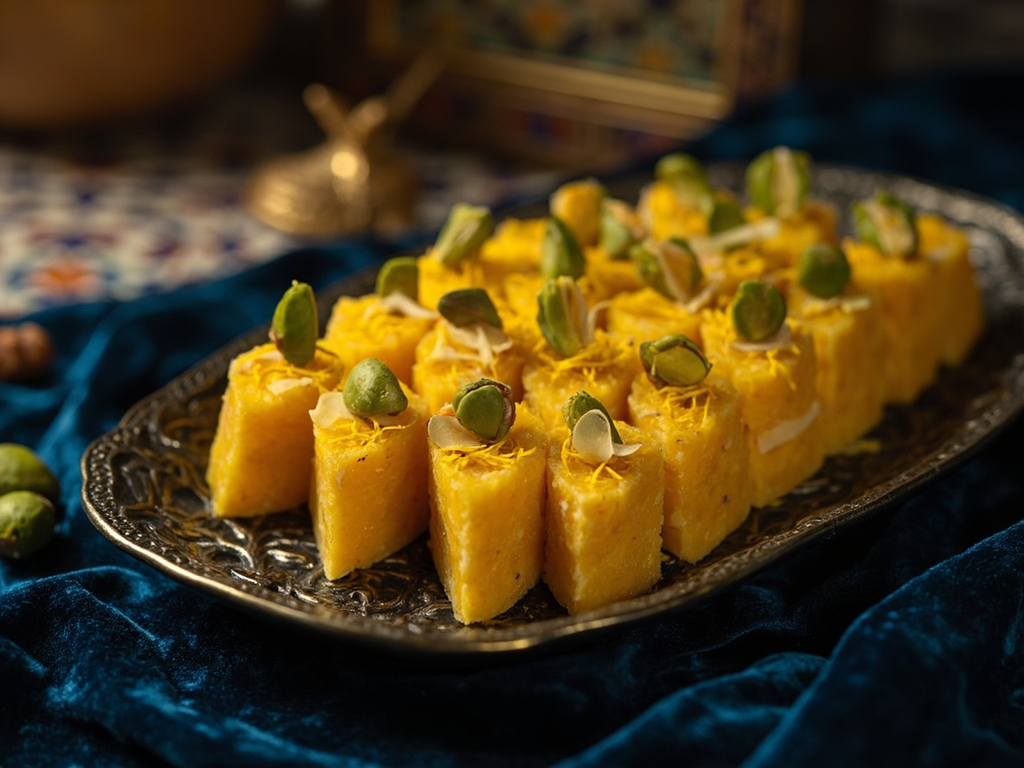
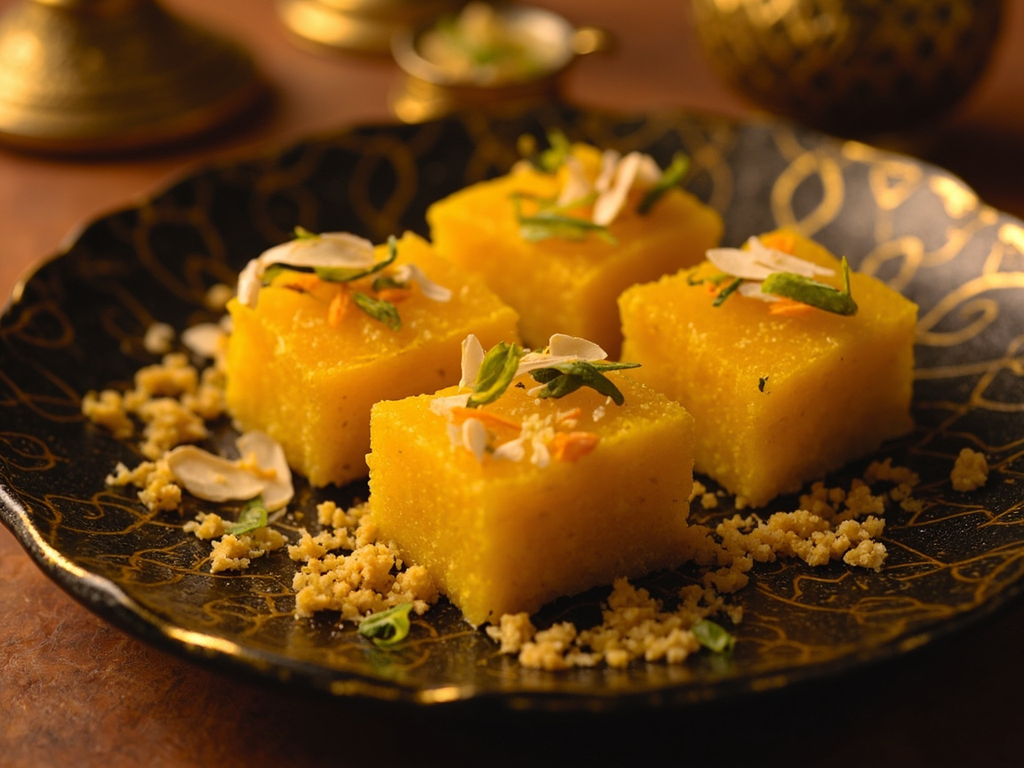
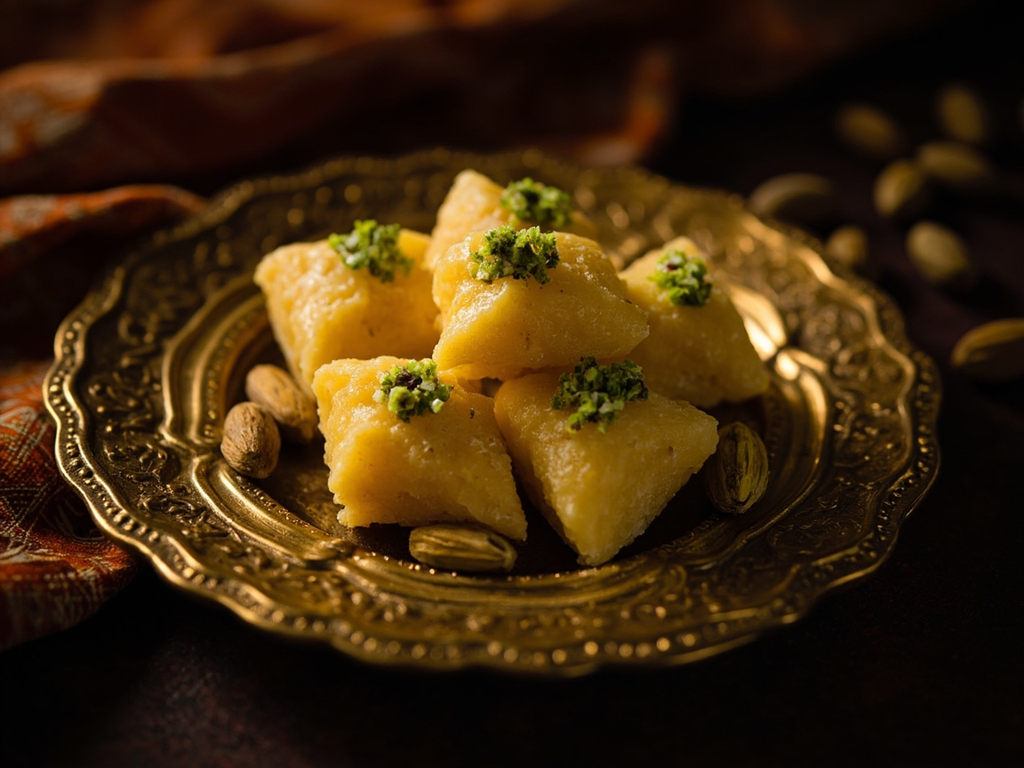
A dense, fragrant confection: flour is slowly toasted in clarified butter until golden and nutty, then bound with a honey and cardamom syrup, and sprinkled with pistachios. A single square is enough — rich, melting, and intensely aromatic.
After Panipat, when Sultan Ibrahim lay among the dead and the throne of Delhi was finally mine, I had halva distributed to the entire army. It is our custom: victory is shared in sweetness. My mother had taught me that halva is patience — you must stir the flour in ghee without ever stopping, otherwise it burns and all is lost. Like conquest, my friend: patience, patience, and at the right moment, the syrup.
- •Fine wheat flour — one measure (base)
- •Clarified butter (ghee) — as much as the flour (fat and toasting)
- •Honey — half the weight of flour (sweetener)
- •Water — one glass (syrup)
- •Green cardamom — a few crushed pods (spice)
- •Pistachios — a handful (garnish)
- •Rose water — a few drops (flavoring)
Halva-ye ârd (Flour Halva with Pistachios and Cardamom)
A dense, fragrant confection: flour is slowly toasted in clarified butter until golden and nutty, then bound with a honey and cardamom syrup, and sprinkled with pistachios. A single square is enough — rich, melting, and intensely aromatic.
Why this dish? Flour halva was the sweet for great occasions in the Timurid world: victories, births, religious festivals. After the Battle of Panipat in 1526, which founded the Mughal Empire, Babur is said to have ordered festivities where confections abounded. The pistachio halva recalls the gardens of Kabul where pistachio trees grew in abundance.
After Panipat, when Sultan Ibrahim lay among the dead and the throne of Delhi was finally mine, I had halva distributed to the entire army. It is our custom: victory is shared in sweetness. My mother had taught me that halva is patience — you must stir the flour in ghee without ever stopping, otherwise it burns and all is lost. Like conquest, my friend: patience, patience, and at the right moment, the syrup.
Ingredients (period version)
- Fine wheat flour — one measure (base)
- Clarified butter (ghee) — as much as the flour (fat and toasting)
- Honey — half the weight of flour (sweetener)
- Water — one glass (syrup)
- Green cardamom — a few crushed pods (spice)
- Pistachios — a handful (garnish)
- Rose water — a few drops (flavoring)
Ingredients
- All-purpose flour — 200 g (base)
- Clarified butter (ghee) — 150 g (toasting)
- Liquid honey — 100 g (sweetener)
- Water — 150 ml (syrup)
- Green cardamom — 6 pods (seeds crushed) (spice)
- Unsalted pistachios — 50 g, chopped (garnish)
- Rose water — 1 tsp (flavoring)
Method
- Make the syrup: in a saucepan, heat water with honey and crushed cardamom seeds. Bring to a simmer, add rose water, keep warm.
- In a large heavy-bottomed pan, melt ghee over medium-low heat.
- Add flour all at once and stir CONSTANTLY with a wooden spatula for 15-20 minutes. The flour should become golden and smell nutty. Never stop stirring.
- When the flour is well toasted, pour the warm syrup in a steady stream while stirring vigorously. Watch for splatters.
- Continue stirring until the mixture forms a homogeneous mass that pulls away from the sides (3-5 min).
- Pour into a lightly oiled square mold. Smooth the surface and sprinkle with crushed pistachios, pressing lightly.
- Let cool completely before cutting into diamonds or squares.
How it was made : Flour halva (halva-ye ârd) is one of the oldest forms of halva, attested in medieval Persian culinary treatises well before the Timurid period. It is distinct from sesame halva (tahini) and semolina halva. At the Timurid court, pistachios came from the orchards of Kabul and Badakhshan, regions renowned for their thin-shelled varieties.
The contemporary twist : Cut into small diamonds and serve in individual cups with a drizzle of fresh honey and edible gold leaf to recall Mughal splendor.
Sources : Nasrallah, Nawal, Annals of the Caliphs' Kitchens (translation of al-Baghdadi's Kitab al-Tabikh), Brill, 2007 · Fragner, Bert, From the Caucasus to the Roof of the World: A Culinary Adventure, in Sami Zubaida (ed.), A Taste of Thyme, I.B. Tauris, 2000
Babur · Charactorium