 flip
flipQotirma (Spiced Dried Travel Meat)
Qotirma (Spiced Dried Travel Meat)
Why this dish? Ulugh Beg traveled between Samarkand, Bukhara, and Soltaniyeh, crossing semi-arid expanses. Travel provisions were essential for caravans and royal movements. Qotirma — meat preserved in its own fat, spiced and stored — was the ideal viaticum for the Timurid nobility on the move.
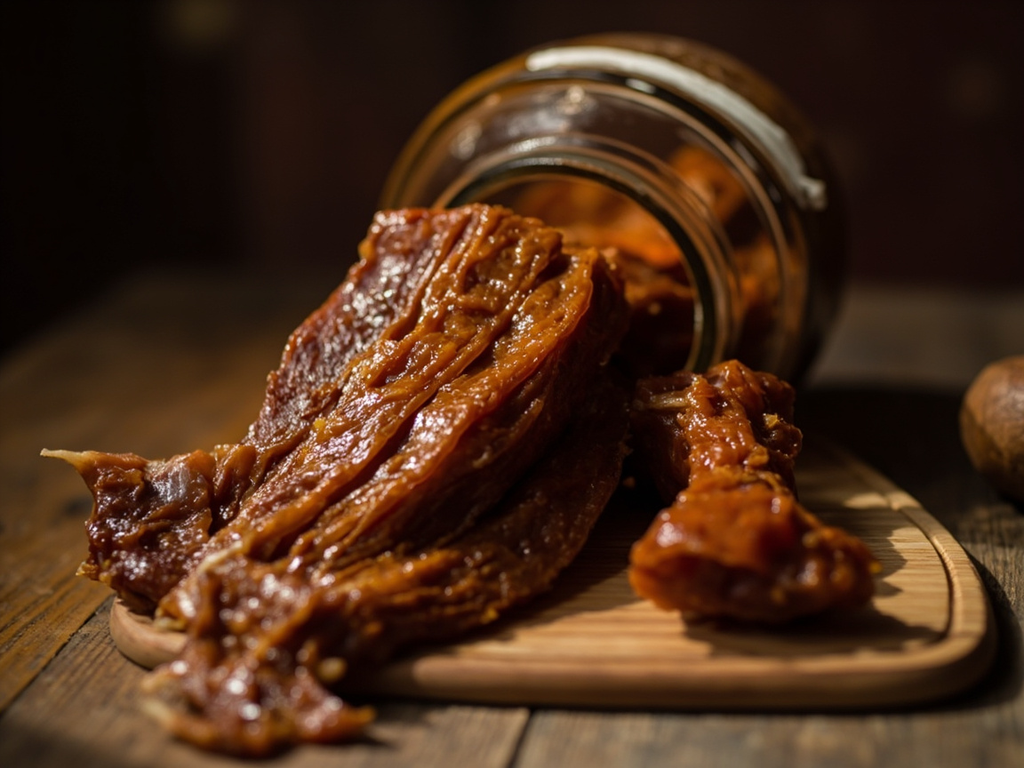
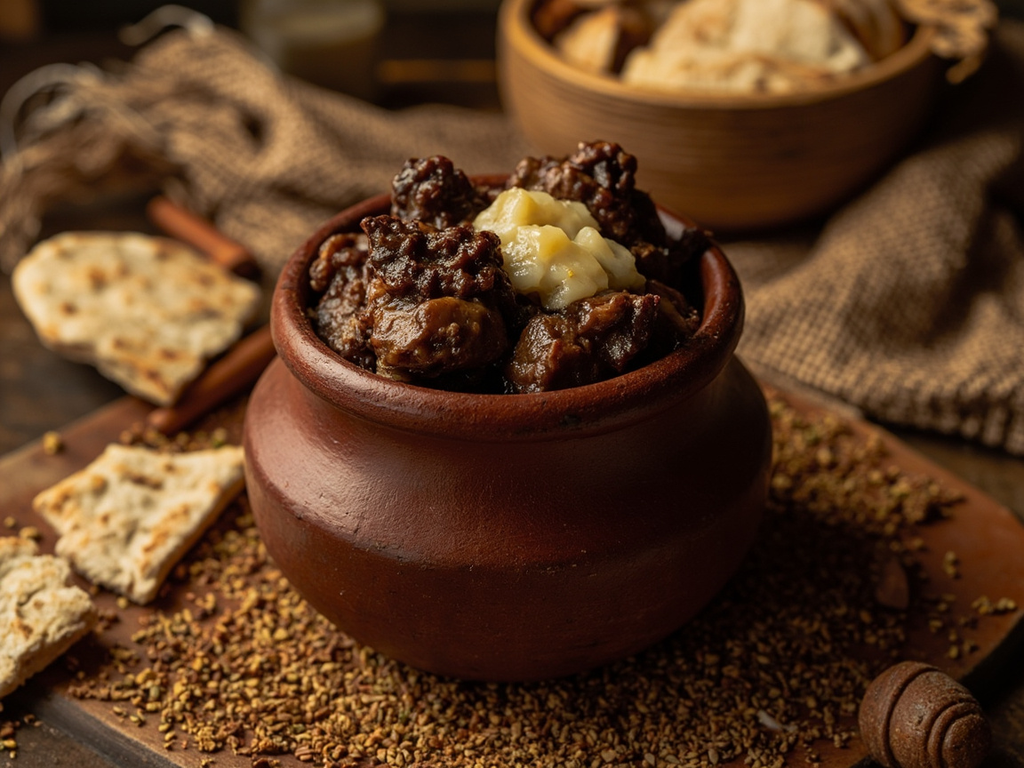
Mutton pieces cooked long with cumin, coriander, and salt, then confited in rendered tail fat which seals and preserves them for several weeks. They were reheated on the road in a little of the same fat, with flatbread. This is the quintessential preservation technique of Central Asian nomads and travelers.
The road from Samarkand to Bukhara is long, and a prince cannot stop at every caravanserai. Before each journey, my cooks prepare qotirma: they cut the meat into pieces, cook it with cumin and salt until all the water is gone, then seal it under dumba fat in earthenware jars. Thus preserved, it keeps for weeks. In the evening at camp, we take out a few pieces and warm them over the embers with non — a simple meal, but one that nourishes the body as the study of the stars nourishes the mind.
- •Mutton (shoulder or leg) — a good piece (Main meat)
- •Sheep-tail fat (dumba) — abundantly (Sealing and preservation)
- •Salt — generously (Preservation)
- •Cumin — a good measure (Spice and preservative)
- •Coriander seeds — a handful (Aroma)
- •Long pepper — a few grains (Pungency)
Qotirma (Spiced Dried Travel Meat)
Mutton pieces cooked long with cumin, coriander, and salt, then confited in rendered tail fat which seals and preserves them for several weeks. They were reheated on the road in a little of the same fat, with flatbread. This is the quintessential preservation technique of Central Asian nomads and travelers.
Why this dish? Ulugh Beg traveled between Samarkand, Bukhara, and Soltaniyeh, crossing semi-arid expanses. Travel provisions were essential for caravans and royal movements. Qotirma — meat preserved in its own fat, spiced and stored — was the ideal viaticum for the Timurid nobility on the move.
The road from Samarkand to Bukhara is long, and a prince cannot stop at every caravanserai. Before each journey, my cooks prepare qotirma: they cut the meat into pieces, cook it with cumin and salt until all the water is gone, then seal it under dumba fat in earthenware jars. Thus preserved, it keeps for weeks. In the evening at camp, we take out a few pieces and warm them over the embers with non — a simple meal, but one that nourishes the body as the study of the stars nourishes the mind.
Ingredients (period version)
- Mutton (shoulder or leg) — a good piece (Main meat)
- Sheep-tail fat (dumba) — abundantly (Sealing and preservation)
- Salt — generously (Preservation)
- Cumin — a good measure (Spice and preservative)
- Coriander seeds — a handful (Aroma)
- Long pepper — a few grains (Pungency)
Ingredients
- Boneless lamb shoulder — 800 g (Meat)
- Lamb fat or lard — 300 g (Confit and preservation)
- Coarse salt — 1 heaped tbsp (Preservation and flavor)
- Cumin seeds — 1 tbsp (Spice)
- Coriander seeds — 1 tbsp (Aroma)
- Black peppercorns — 1 tsp (Pungency)
- Bay leaves — 2 (Aroma)
Method
- Cut the lamb into 3 cm cubes. Coarsely crush the cumin, coriander, and pepper in a mortar.
- Melt the lamb fat over low heat in a heavy-bottomed pot.
- Add the meat pieces, salt, crushed spices, and bay leaves. Mix to coat well.
- Cook over very low heat, covered, for 2 to 3 hours, stirring occasionally. The meat should become very tender and all water should have evaporated.
- Check that the meat is completely submerged in fat. Add more melted fat if necessary.
- Transfer to a sterilized glass jar or earthenware pot, ensuring the fat covers the meat completely. Let cool: the fat solidifies and seals everything.
- Keep refrigerated for up to 3 weeks. To serve: take out pieces, reheat in a pan, and serve with warm flatbread.
How it was made : Preserving meat in animal fat is an ancestral technique of Turco-Mongol and Persian peoples, mentioned in medieval sources on daily life in Central Asia. Sheep-tail fat (dumba), rich and with a high melting point, served both as cooking fat and natural preservative. This technique is the Central Asian equivalent of French confit.
The contemporary twist : Crumble the reheated qotirma over grilled flatbread with fresh herbs and a drizzle of yogurt, as Timurid-inspired tapas.
Sources : Glenn R. Mack, Asele Surina, « Food Culture in Russia and Central Asia » (2005), Greenwood Press · Paul D. Buell, Eugene N. Anderson, « A Soup for the Qan » (2010), Brill — medieval Mongol and Turkic cuisine
Ulugh Beg · Charactorium