Roasted Thighs and Splánkhna, the Sacrificial Feast
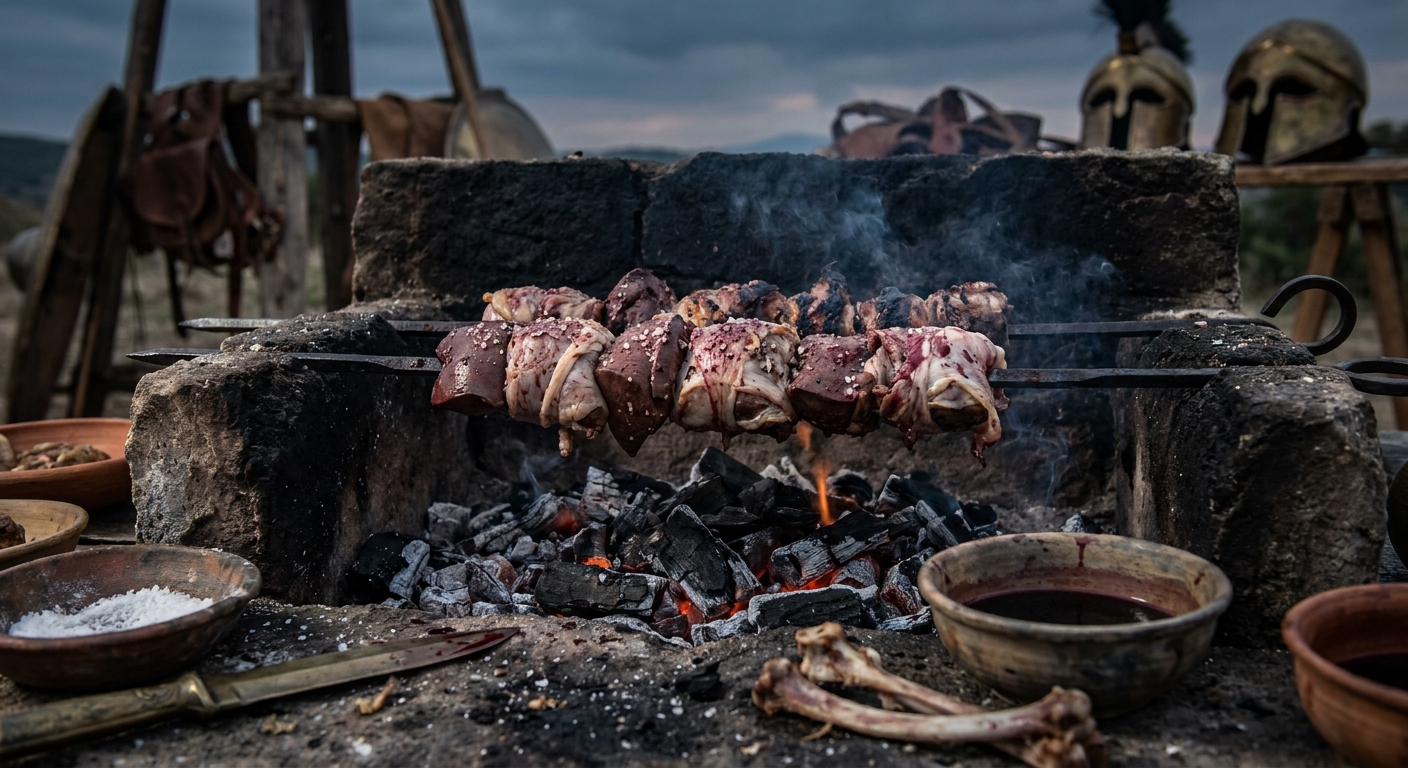
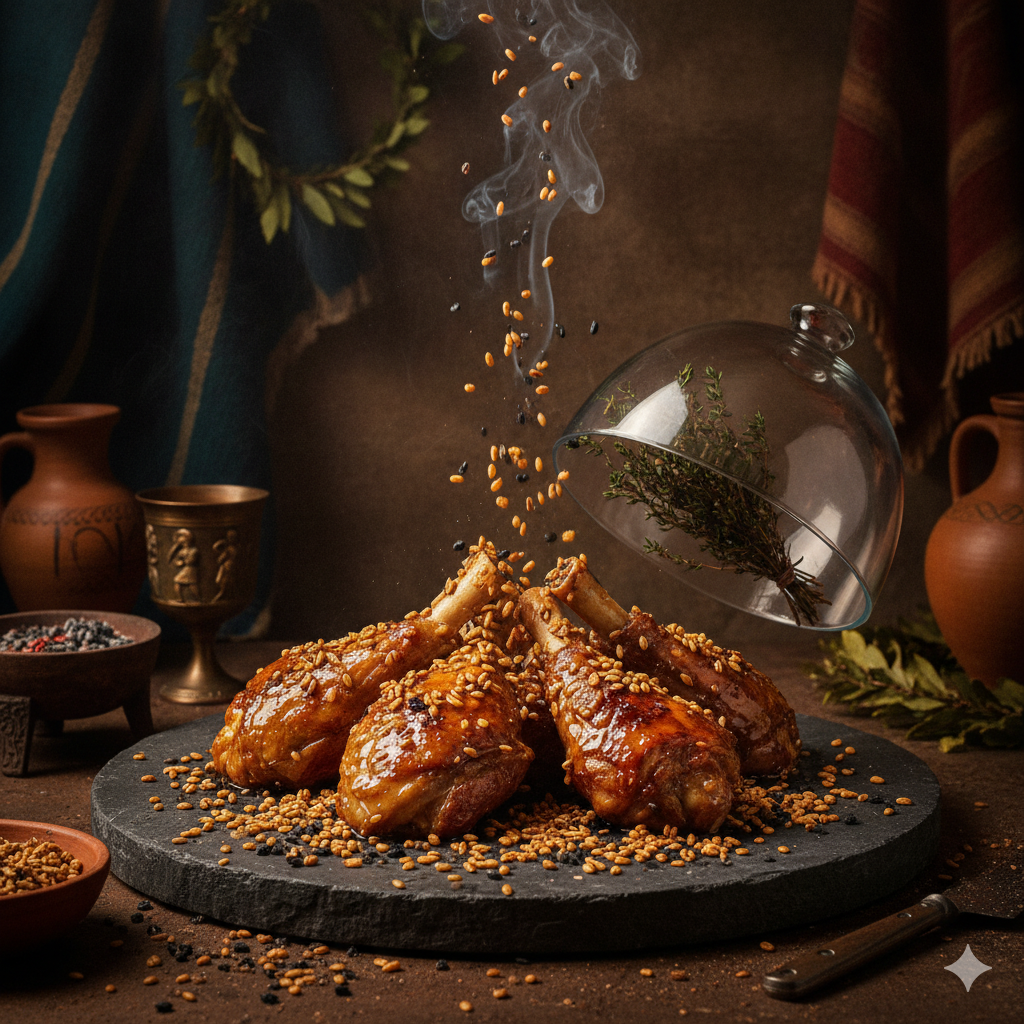
Sheep or goat meat skewered and grilled over a flame, rubbed with salt and herbs, accompanied by toasted barley thrown onto the fire as an offering. The dish of great days, shared in equal portions among all guests.
Sheep or goat meat skewered and grilled over a flame, rubbed with salt and herbs, accompanied by toasted barley thrown onto the fire as an offering. The dish of great days, shared in equal portions among all guests.
When the sea must take us again, stranger, one does not embark without honoring those above. We slaughter the beast, wrap the thighs in fat, burn them so that the smoke rises to Olympus — then we scatter the barley on the flames. What remains, the splánkhna, we prick onto spits over the embers, and each receives his equal share, from king to rower. I have seen men forget this duty and pay dearly for their hunger: remember this before you touch the grill.
- •Sheep or goat meat (leg, innards) — as much as the company requires (centerpiece)
- •Fat of the animal — as needed (offering and cooking)
- •Sea salt — generously (seasoning)
- •Toasted barley (for libation) — a handful (ritual offering)
- •Wine for libation — a cup (offering)
Roasted Thighs and Splánkhna, the Sacrificial Feast
Sheep or goat meat skewered and grilled over a flame, rubbed with salt and herbs, accompanied by toasted barley thrown onto the fire as an offering. The dish of great days, shared in equal portions among all guests.
Why this dish? Before every great voyage, Odysseus and his companions sacrifice to the gods and roast the meat: this is the very image of the Odyssey. The thighs wrapped in fat are burned for the Immortals, and the innards (splánkhna) are grilled on spits for the men — a rare, festive meal that seals the alliance between mortals and gods.
When the sea must take us again, stranger, one does not embark without honoring those above. We slaughter the beast, wrap the thighs in fat, burn them so that the smoke rises to Olympus — then we scatter the barley on the flames. What remains, the splánkhna, we prick onto spits over the embers, and each receives his equal share, from king to rower. I have seen men forget this duty and pay dearly for their hunger: remember this before you touch the grill.
Ingredients (period version)
- Sheep or goat meat (leg, innards) — as much as the company requires (centerpiece)
- Fat of the animal — as needed (offering and cooking)
- Sea salt — generously (seasoning)
- Toasted barley (for libation) — a handful (ritual offering)
- Wine for libation — a cup (offering)
Ingredients
- Boneless lamb shoulder or leg, cubed — 800 g (centerpiece)
- Olive oil — 3 tbsp (cooking)
- Salt and dried oregano — to taste (seasoning)
- Fresh thyme — a few sprigs (aroma)
- Grape juice or a little wine (for deglazing/basting) — 100 ml (flavor)
Method
- Cut the meat into large cubes and marinate for 1 hour in olive oil, oregano, thyme, and salt.
- Thread the pieces onto skewers (soaked wooden or metal).
- Cook over embers or a very hot grill, turning, for 12 to 15 minutes, until nicely browned and still juicy inside.
- Baste with a splash of wine or grape juice at the end of cooking for flavor.
- Serve immediately with maza (recipe r1) and fresh herbs; share the portions equally, in Homeric fashion.
How it was made : The Greek sacrifice followed a precise ritual: the thigh bones (mêria) wrapped in fat were burned for the gods, barley (oulai) was scattered, and wine poured, while the men consumed the grilled innards (splánkhna) and then the meat. Meat was almost exclusively eaten in this ritual and festive context, rarely on a daily basis.
The contemporary twist : Serve them as "Ithaca skewers" on a bed of fresh oregano with a lemon wedge — a citrus fruit already known later in the Mediterranean, offered as a knowing wink.
Sources : Homer, The Odyssey and The Iliad (sacrifice scenes) · Jean-Louis Durand & Marcel Detienne, The Cuisine of Sacrifice among the Greeks (1979)
Odysseus · Charactorium