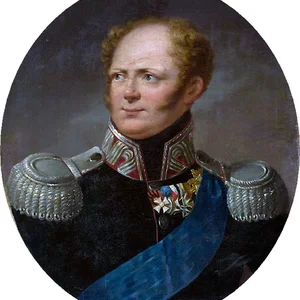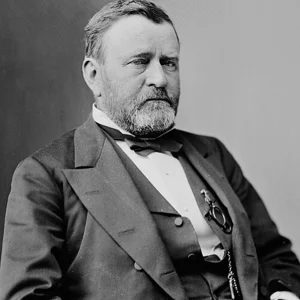

Commanding general of the Union armies during the American Civil War, Ulysses S. Grant secured the surrender of Confederate general Robert E. Lee at Appomattox in 1865. A military hero, he went on to become the 18th president of the United States from 1869 to 1877.
Ulysses S. Grant(1822 — 1885)
Ulysses S. Grant
États-Unis
7 min read
Frequently asked questions
Famous Quotes
« I propose to fight it out on this line if it takes all summer.»
« Let us have peace.»
Key Facts
- Graduated from the United States Military Academy at West Point in 1843
- Appointed commanding general of the Union armies in 1864 by Abraham Lincoln
- Received the surrender of General Robert E. Lee at Appomattox on April 9, 1865, ending the Civil War
- Elected 18th president of the United States in 1868, reelected in 1872 (terms 1869-1877)
- Supported the 15th Amendment (1870) guaranteeing the right to vote regardless of race
Works & Achievements
The Union's first major victory in the West, demanding an “unconditional surrender.” It opened Tennessee to Northern troops and made Grant's reputation.
A military campaign regarded as one of the most brilliant of the war. Control of the Mississippi split the Confederacy in two.
A war of attrition waged against Lee's army in Virginia. It exhausted the Confederacy and led to its surrender.
The act that ended the main Confederate army and the Civil War. Grant's generous terms fostered national reconciliation.
Federal laws protecting the civil rights of African Americans during Reconstruction. Grant deployed the army to dismantle the Klan in the South.
A diplomatic agreement that peacefully settled disputes between the United States and the United Kingdom (the Alabama Claims). A major foreign-policy success of his presidency.
An autobiography written during his final months, hailed as a masterpiece of American prose. Published by Mark Twain, it secured his family's financial future.
Anecdotes
His real first name was not Ulysses: he was named Hiram Ulysses Grant. When he enrolled at the West Point military academy, a member of Congress made a mistake and wrote "Ulysses S. Grant." The young man kept this name for the rest of his life, joking that the "S." stood for nothing at all.
Grant was renowned for his composure in battle but hated the sight of blood: he refused to eat rare meat and insisted that his own be very well done. This general who commanded hundreds of thousands of men could not bear hunting or wounded animals.
Passionate about horses since childhood, Grant was an exceptional rider. At West Point, he set a record for the high jump on horseback that remained unbeaten for years. It was said that he could tame the most stubborn mounts that no one else dared approach.
Stricken with throat cancer and ruined by bankruptcy, Grant wrote his Memoirs while battling pain during his final months. He completed his manuscript just days before his death in 1885; the book, published by Mark Twain, was an immense success and saved his family from destitution.
At Lee's surrender at Appomattox in 1865, Grant showed magnanimity: he allowed the Confederate soldiers to return home with their horses for working the fields and had rations distributed to them. He forbade his troops from celebrating loudly, declaring that the vanquished were now their countrymen once again.
Primary Sources
The terms were those I had proposed. I had no desire to humiliate further an enemy who was already beaten. I told Lee's men to take their horses, for they would need them for the spring planting.
The officers will give their individual paroles not to take up arms against the Government of the United States; arms, artillery, and public property are to be turned over and stacked.
No terms except an unconditional and immediate surrender can be accepted. I propose to move immediately upon your works.
Let us have peace. I will take the office of President only with the desire to faithfully execute the laws and to act for the best interests of the whole people.
Key Places
Ohio village where Ulysses S. Grant was born in 1822. The modest family home reflects his humble origins in frontier America.
The military academy in New York State where Grant trained between 1839 and 1843. There he gained his skills as an officer and his reputation as an exceptional horseman.
City besieged and captured by Grant in 1863, giving the Union complete control of the Mississippi River. This victory split the Confederacy in two and launched his national fame.
Site of General Lee's surrender to Grant on April 9, 1865, which marked the effective end of the Civil War. There Grant showed great magnanimity toward the defeated.
Residence and seat of power where Grant served his two presidential terms from 1869 to 1877. There he carried out the policy of Reconstruction and fought against the Ku Klux Klan.
Place where Grant, stricken with cancer, completed his Memoirs and died on July 23, 1885. His monumental tomb, Grant's Tomb, stands in New York City.
Typical Objects

Grant often wore a plain blue soldier's tunic, without the usual ornaments, distinguished only by the stars on his shoulders. This simplicity stood in sharp contrast to the elegance of his adversary Robert E. Lee.

A ceremonial weapon and symbol of command carried by Union officers. Grant himself preferred quiet action, but Lee's sword stood at the heart of the surrender at Appomattox.

Grant smoked up to twenty cigars a day, a habit reinforced after the victory at Fort Donelson, where admirers sent him thousands of them. This tobacco use contributed to the throat cancer that killed him.

An essential communication tool that allowed Grant to coordinate armies scattered across hundreds of kilometers. He was one of the first generals to fully exploit this network to wage war on a large scale.

An outstanding rider since childhood, Grant rode horses reputed to be untamable, including his famous Cincinnati. His mount was his tool for moving about and observing the battlefields.

The manuscript he wrote, sick and ruined, during the final months of his life. Published by Mark Twain, the book became a classic of American literature and a posthumous financial success.
School Curriculum
Vocabulary & Tags
Key Vocabulary
Tags
Daily Life
Morning
On campaign, Grant rose early and studied the maps and telegraphic dispatches that had come in during the night. Unflappable, he dictated his orders in a clear, precise hand, often with a cigar in hand.
Afternoon
He would ride along the lines on horseback to observe the terrain and the enemy positions, remaining calm under fire. During his presidency, his afternoons were devoted to interviews, appointments, and the affairs of Reconstruction.
Evening
In the evening, Grant gladly spent time with his family, to whom he was deeply attached, and his wife Julia. He preferred quiet conversations to society receptions, which he found tiresome.
Food
Grant ate simply and detested rare meat, which he insisted be cooked very well done. He enjoyed modest dishes and coffee, and smoked a great many cigars over the course of the day.
Clothing
Unlike many generals, he scorned lavish uniforms and wore an ordinary soldier's coat, recognizable only by its stars. This plainness reflected his unassuming temperament.
Housing
Born into a modest Ohio family, Grant lived in simple lodgings before the war. As president, he resided in the White House, then suffered financial reversals before ending his days in the countryside, at Mount McGregor.
Historical Timeline
Period Vocabulary
Liens externes & ressources
Références
Œuvres
Prise de Fort Donelson
1862
Siège et prise de Vicksburg
1863
Campagne de l'Overland et siège de Petersburg
1864-1865
Reddition d'Appomattox
1865
Enforcement Acts et lutte contre le Ku Klux Klan
1870-1871
Traité de Washington
1871
Personal Memoirs of U. S. Grant
1885