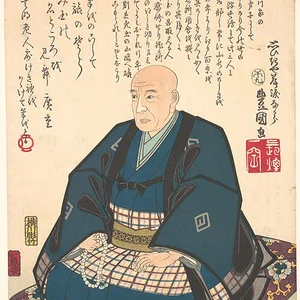

Utagawa Hiroshige is one of the greatest Japanese masters of the woodblock print (ukiyo-e). Famous for his landscapes and travel scenes, he profoundly influenced European Impressionists and Post-Impressionists such as Van Gogh and Monet.
Utagawa Hiroshige(1797 — 1858)
Hiroshige
Japon
6 min read
Frequently asked questions
Key Facts
- Born in 1797 in Edo (present-day Tokyo) into a family of modest-ranking samurai
- Created around 1833-1834 his famous series “The Fifty-three Stations of the Tōkaidō,” depicting the stages of the road linking Edo to Kyoto
- Produced between 1856 and 1858 the series “One Hundred Famous Views of Edo,” one of his best-known works
- Died in 1858 in Edo, probably during a cholera epidemic
- His prints, circulated in Europe, inspired the Impressionists; Van Gogh copied some of his works
Works & Achievements
His most famous series, depicting the post stations along the great highway between Edo and Kyoto. It established him as the master of landscape.
A late suite of more than one hundred vertical prints on the life and seasons of Edo. Several were copied by Van Gogh.
A series of mountain landscapes created with the artist Keisai Eisen, along an inland route of Japan.
A series devoted to the sacred volcano, echoing that of Hokusai. It is among his final works.
Poetic landscapes around Lake Biwa, inspired by a classic theme of Chinese and Japanese painting.
A print from the “One Hundred Views of Edo” showing a plum tree in the foreground. Van Gogh made a famous oil copy of it.
Anecdotes
Hiroshige was born into a family of low-ranking samurai: his father was an official firefighter in the service of the shogunate in Edo (present-day Tokyo). At just twelve years old, when his parents died, the young boy inherited this firefighting post, which he carried out while training as a painter.
His masterpiece, *The Fifty-three Stations of the Tōkaidō*, grew out of a real journey: in 1832, Hiroshige is said to have travelled the great highway linking Edo to Kyoto, officially accompanying a delegation. Along the way he sketched the post stations, the inns, the rain, the snow and the travellers, giving his landscapes a freshness captured straight from life.
Hiroshige's prints crossed the seas in an unexpected way: they are said to have sometimes been used as wrapping paper for the Japanese porcelain exported to Europe. This is how Western artists discovered them, sparking the craze for “Japonisme.”
Vincent van Gogh admired Hiroshige so much that he copied two of his prints in oil paint, including *The Plum Tree in Blossom*. He even tried to reproduce the Japanese characters that framed the original image, without understanding their meaning.
Toward the end of his life, Hiroshige became a Buddhist monk, as was common for elderly artists in Japan. He died in 1858, probably during a major cholera epidemic that ravaged Edo that year.
Primary Sources
“I leave my brush in the East, and set forth on a journey to the West, to behold the famous landscapes of the Pure Land.” (the journey to the West evokes the Buddhist paradise)
A series of fifty-five prints depicting the post stations along the Tōkaidō road between Edo and Kyoto, with their landscapes, travellers and weather conditions.
A set of one hundred and eighteen vertical prints showing the notable places of the city of Edo through the changing seasons.
Key Places
Capital of the shogunate and Hiroshige's birthplace, one of the largest cities in the world at the time. He lived, worked, and died here.
A major coastal road linking Edo to Kyoto, dotted with fifty-three post stations. Hiroshige's journey along this road inspired his most famous series.
The former imperial capital and the arrival point of the Tōkaidō Road. A major cultural center of traditional Japan.
A bridge in central Edo that marked the official starting point of the Tōkaidō Road and the country's kilometer zero. Hiroshige depicted it several times.
A sacred volcano and symbol of Japan, a recurring motif in Hiroshige's landscapes. It appears on the horizon of many prints.
Liens externes & ressources
Références
Œuvres
Les Cinquante-trois Stations du Tōkaidō
1833-1834
Cent vues célèbres d'Edo
1856-1858
Soixante-neuf Stations de la route du Kiso (Kisokaidō)
1835-1842
Trente-six vues du mont Fuji
1858
Le Prunier en fleurs (jardin de Kameido)
1857