 flip
flipThe Everyday Pot-au-Feu
The Everyday Pot-au-Feu
Why this dish? An emblematic dish of the 19th-century French table, pot-au-feu nourished both the bourgeoisie and the common people whose cause Hugo championed. Its simple generosity — meat, broth, vegetables — matches the ‘substantial meals’ of the writer and the popular world of Les Misérables.
A piece of beef slowly simmered with winter vegetables, yielding both a clear, comforting broth and tender meat. The dish for Sunday as well as everyday, perfuming the whole house.
Never despise the pot that sings on the fire: there lies all of France simmering. I have seen, in the garrets of Paris, entire families waiting for this broth as one waits for justice. One puts in the beef, the marrow bone, the leek and the carrot, and one lets time do its work — for patience, my friends, is the first of all cooking methods. The broth first, the meat after: one fire feeds twice.
- •Beef (shin, chuck, short ribs) — a fine piece (meat)
- •Marrow bones — a few pieces (richness of broth)
- •Carrots — a bunch (vegetable)
- •Leeks — a few (vegetable)
- •Turnips — a handful (vegetable)
- •Onion studded with cloves — one (aromatic)
- •Bouquet garni — one (aromatic)
- •Coarse salt — as needed (seasoning)
The Everyday Pot-au-Feu
A piece of beef slowly simmered with winter vegetables, yielding both a clear, comforting broth and tender meat. The dish for Sunday as well as everyday, perfuming the whole house.
Why this dish? An emblematic dish of the 19th-century French table, pot-au-feu nourished both the bourgeoisie and the common people whose cause Hugo championed. Its simple generosity — meat, broth, vegetables — matches the ‘substantial meals’ of the writer and the popular world of Les Misérables.
Never despise the pot that sings on the fire: there lies all of France simmering. I have seen, in the garrets of Paris, entire families waiting for this broth as one waits for justice. One puts in the beef, the marrow bone, the leek and the carrot, and one lets time do its work — for patience, my friends, is the first of all cooking methods. The broth first, the meat after: one fire feeds twice.
Ingredients (period version)
- Beef (shin, chuck, short ribs) — a fine piece (meat)
- Marrow bones — a few pieces (richness of broth)
- Carrots — a bunch (vegetable)
- Leeks — a few (vegetable)
- Turnips — a handful (vegetable)
- Onion studded with cloves — one (aromatic)
- Bouquet garni — one (aromatic)
- Coarse salt — as needed (seasoning)
Ingredients
- Beef for braising (chuck + shin + short ribs) — 1.2 kg (meat)
- Marrow bones — 2 pieces (richness of broth)
- Carrots — 4 (vegetable)
- Leeks — 3 (vegetable)
- Turnips — 3 (vegetable)
- Onion studded with 2 cloves — 1 (aromatic)
- Bouquet garni (thyme, bay leaf, parsley) — 1 (aromatic)
- Coarse salt — 1 tbsp (seasoning)
Method
- Place the meat in a large pot, cover with cold water, and bring slowly to a simmer.
- Skim off the gray foam that rises during the first few minutes.
- Add the clove-studded onion, bouquet garni, and coarse salt; simmer (never boil vigorously) covered for 2.5 hours.
- Add carrots, leeks, and turnips, continue cooking for 45 minutes until everything is tender.
- Add the marrow bones 15 minutes before the end.
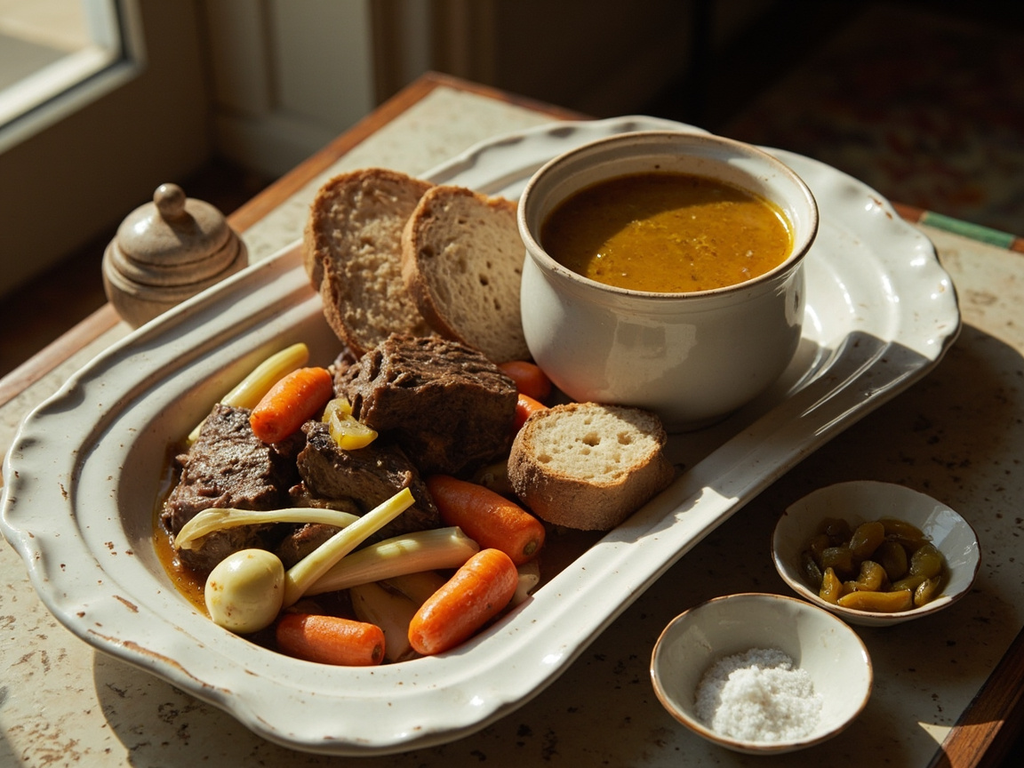
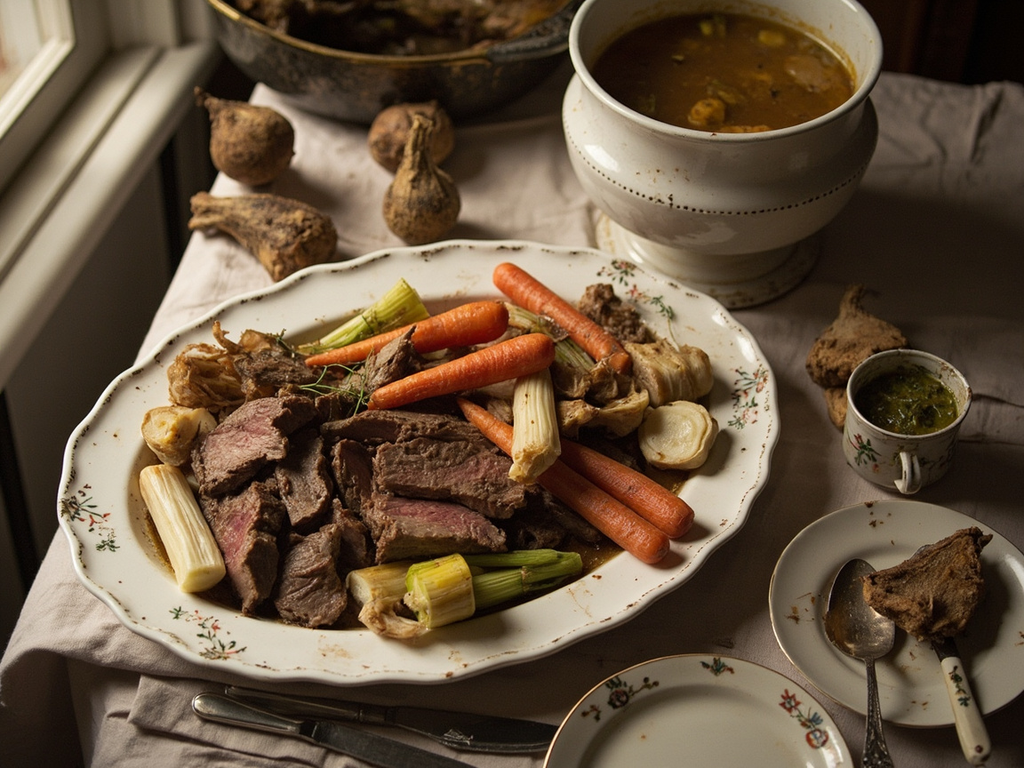
- Serve the broth first in bowls, then the sliced meat with vegetables, coarse salt, pickles, and mustard.
How it was made : In the 19th century, pot-au-feu often simmered all day at the corner of the hearth or on the stove. Two meals were drawn from it: the broth served as soup, then the ‘bouilli’ (meat) with vegetables. It was the dish of domestic regularity, celebrated by the cooks of the time as the very foundation of French bourgeois cuisine.
The contemporary twist : Serve the marrow spread on toasted bread sprinkled with fleur de sel, as an opening bite before the broth.
Victor Hugo · Charactorium