
Vidar is a god of Norse mythology, son of Odin and the giantess Grid. Known for his silence and colossal strength, he is destined to avenge his father's death by slaying the wolf Fenrir at Ragnarök.
Vidar
Vidar
10 min read
Frequently asked questions
Key Facts
- Vidar is the son of Odin and the giantess Grid, renowned for a strength rivaling that of Thor
- He is called the “silent god” (hinn þögli ás) in the Eddas
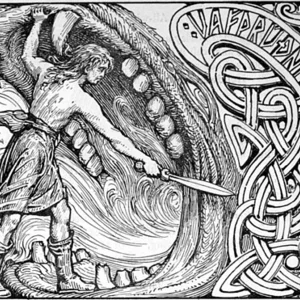
- At Ragnarök, he will avenge Odin by slaying Fenrir, either by piercing his palate or by tearing his jaws apart
- Vidar is one of the few gods to survive Ragnarök and inherit the renewed world
- He is mentioned in the Völuspá and in the Gylfaginning by Snorri Sturluson (13th century)
Works & Achievements
Vidar's defining act: after Fenrir devours his father Odin, Vidar slays the wolf with his sword by forcing its jaws apart. This feat of filial vengeance is the crowning moment of his divine existence, described in detail in the Völuspá and the Prose Edda.
Vidar is one of the very few gods to survive the universal destruction of Ragnarök. Together with Váli, he repopulates and rebuilds the world of Gimlé, embodying divine continuity and the hope of a new age rising from the chaos.
This major Eddic poem tracing the Norse cosmogony from creation to destruction explicitly names Vidar as the avenger of Odin. It is the oldest and most authoritative poetic source attesting his eschatological role.
An Eddic poem describing the domains of each Norse god, devoting a stanza to Vidar's wild territory. It is one of the only texts offering details about where he dwells, and confirms his standing as a full-fledged member of the Aesir.
Snorri Sturluson devotes several passages of his work to Vidar, describing his shoe, his superhuman strength, his silence, and his role at Ragnarök. This text is the most complete and systematic source for understanding the mythological figure.
Anecdotes
Vidar is nicknamed the 'silent god' (þögull áss) in the Eddic texts: he is described as the most taciturn of the Aesir, almost never intervening in divine quarrels or debates. This silence is not a weakness but a concentrated strength, comparable to a warrior who saves all his energy for the decisive moment he knows is inevitable.
Vidar possesses a shoe of extraordinary thickness, made from all the leather scraps accumulated by cobblers since the dawn of time. According to the Prose Edda, it is with this divine sole that he will pin Fenrir's jaws shut during Ragnarök. This is why Scandinavians customarily offered their unused leather offcuts: by doing so, they believed they were helping to arm the god for his ultimate mission.
During Ragnarök, the twilight of the gods, Vidar fulfills the task for which he was born: after Fenrir has devoured Odin his father, he faces the monstrous wolf, pins its jaws shut with his thick shoe, and runs it through with his sword. This act of filial vengeance makes him one of the only gods to fully carry out his mission during the final cataclysm.
Vidar is one of the very few Norse gods to survive Ragnarök. Alongside Váli, Thor (through his sons), and Baldr and Höðr returned from the dead, he inhabits the reborn world of Gimlé, described as more beautiful than the sun. His survival symbolizes continuity and rebirth after total destruction — a fundamental idea in the cyclical Norse cosmology.
His mother, the giantess Grid, is known for having lent Thor her belt of strength, iron gloves, and magic staff during his confrontation with the giant Geirröð. Vidar thus inherits a dual nature: Odin's divine wisdom and the physical might of the Jötunn (giants). The Prose Edda even designates him as the strongest god after Thor.
Primary Sources
Þá kømr inn mæri mögr Sigföður, Víðarr, vega at valdýri. Lætr hann megi Hveðrungs mund of standa hjör til hjarta. (Then comes the great son of the Father-of-Victory, Vidar, to fight the savage beast. He drives his sword into the heart of the son of Hveðrungr.)
Víðarr ok Váli munu vé goða byggja, þá er slöknir Surta logi. (Vidar and Váli will inhabit the sanctuaries of the gods when Surtr's fire is extinguished.)
Víðars land heiter Víðir, víðar þornar ok há gras — þar mun Víðarr stíga á hest þegar hann vill fara at hefna föður síns. (Vidar's land is called Víðir, thick thorns and tall grasses — there, Vidar will mount his horse when he sets out to avenge his father.)
Víðarr er nefndr þögull áss. Hann hefir þykka skó. Hann er næst sterkr Þór. Af honum eigu goðin mikit traust í öllum háska. (Vidar is called the silent god. He possesses a thick shoe. He is the strongest after Thor. The gods place great trust in him in all dangers.)
Hvernig skal kenna Víðar? Svá at kalla hann son Óðins, bróður ásanna, þögul ás, hefnigoð Fenrisúlfs, íbúa Víðis, hinn þykkskoða ás. (How should one refer to Vidar? By calling him son of Odin, brother of the Æsir, the silent god, avenger upon Fenrir, dweller of Víðir, the thick-shoed god.)
Key Places
Vidar's personal domain in Ásgarðr, described in the Grímnismál as a vast forest of thorns and tall wild grasses. This solitary, untouched territory reflects the god's taciturn and powerful nature, far removed from the splendor of the great divine halls.
The celestial city of the Aesir gods, Vidar's home among the other Norse deities. It is here that he dwells in his legendary silence, ever preparing for the final confrontation of Ragnarök.
A cosmic plain described in the Edda as stretching a hundred leagues in every direction — the site of the final battle where Vidar confronts and slays Fenrir. This mythic battlefield is the stage for the most defining act of Vidar's existence.
After the total destruction of Ragnarök, Vidar is one of the few survivors to take his place in the new world of Gimlé, described as more beautiful than the sun and roofed with gold. His survival makes him a symbol of renewal and hope.
It was at this Icelandic farm that Snorri Sturluson composed the *Prose Edda* around 1220, codifying for all time the Norse mythological narratives — including those concerning Vidar. This place is therefore, indirectly, the written birthplace of Vidar's memory.
Typical Objects

Vidar's most distinctive mythological attribute, this shoe — made from leather scraps accumulated by cobblers since the creation of the world — allows him to force open Fenrir's jaws during Ragnarök. It symbolizes both long-term preparation and the collective contribution of humans to divine protection.

After pinning Fenrir down with his shoe, Vidar drives a sword through the wolf's heart. This weapon embodies just vengeance and the end of the chaos Fenrir represents, casting Vidar as the archetypal divine avenger in Norse tradition.

His mother Grid, a giantess allied with the Aesir, is renowned for having lent Thor her magical staff, iron gloves, and belt of strength. Vidar symbolically inherits this giant-born power and the tradition of enchanted objects associated with his mother's lineage.

Vidar's personal domain, described in the *Grímnismál* as a land of dense brambles and tall wild grasses. It is no palace but raw, primordial nature — a reflection of the god's silent and solitary character.

The offcuts of leather left behind by Scandinavian cobblers were ritually linked to Vidar's sandal. Offering them represented each craftsman's tangible contribution to arming the god for his apocalyptic mission — a rare bridge between everyday craft and Norse eschatology.
School Curriculum
Vocabulary & Tags
Key Vocabulary
Daily Life
Morning
In his wild domain of Víðir, Vidar begins his day in near-total silence, surrounded by dense forests and tangled brambles. Unlike Thor, who sets out to slay giants, or Odin, who roams the worlds in search of wisdom, Vidar stays within his territory — motionless and focused, like a warrior in a state of permanent meditation. His morning is a time of inward vigilance, of attention to the cosmic signs that herald Ragnarök.
Afternoon
Vidar trains in the arts of combat amid the solitude of his forests, honing the colossal strength he was given at birth. Norse tradition credits him with mastery of both unarmed combat and bladed weapons — skills he will need to defeat Fenrir. He also patrols the edges of Víðir, keeping watch over his territory with the silent vigilance of a colossal sentinel.
Evening
In the evening, Vidar sometimes joins the Aesir feasts at Valhöll, where warriors slain in battle banquet each night as they await Ragnarök. He is present, but unobtrusive — never taking part in verbal jousting or divine quarrels. Skalds describe him seated as an attentive observer, his heavy gaze commanding respect even from the most talkative of gods.
Food
Like the other Aesir, Vidar takes part in the immortal feasts of Ásgarðr: the boar Sæhrímnir, resurrected each morning, is roasted each evening to feed the gods and the Einherjar (the chosen warriors). Mead flows from the udders of the goat Heiðrún, who grazes on the leaves of the great ash Yggdrasil. Vidar eats at these banquets without Thor's exuberance or the warriors' frenzy — soberly, and without excess.
Clothing
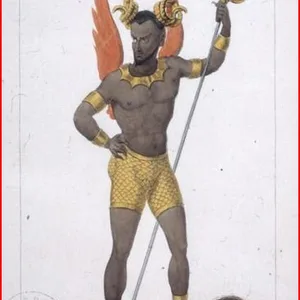
Vidar is depicted in medieval Norse iconography as an unadorned warrior: a wool tunic, a fur cloak fastened with a fibula, a sword at his side, and a round shield. His most distinctive attribute is his thick shoe or sandal (þykkr skór), fashioned from cobblers' leather accumulated over centuries, which forms an integral part of his divine gear. His appearance is that of a functional fighter — no superfluous ornament in sight.
Housing
Vidar dwells in his domain of Víðir, described in the Grímnismál as a territory of dense brambles and tall wild grasses — far from the great, lavish halls of Norse mythology. It is neither the golden palace with five hundred and forty doors of Valhöll, nor the gleaming hall of Thor at Bilskirnir, but a raw and primordial natural space. This dwelling mirrors his character: powerful yet unassuming, rooted in nature rather than grandeur.
Historical Timeline
Period Vocabulary
Liens externes & ressources
Références
Œuvres
La vengeance d'Odin : mort de Fenrir lors du Ragnarök
Temps mythique
Survie au Ragnarök et participation à la renaissance du monde
Temps mythique (après Ragnarök)
Völuspá — mention du rôle de Vidar
Vers 1000 (oral antérieur)
Grímnismál — description du domaine Víðir
Vers 900-1000
Gylfaginning — portrait encyclopédique de Vidar
Vers 1220