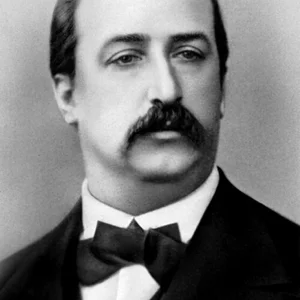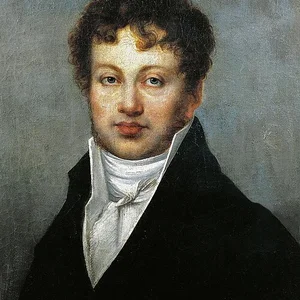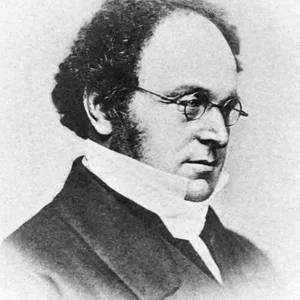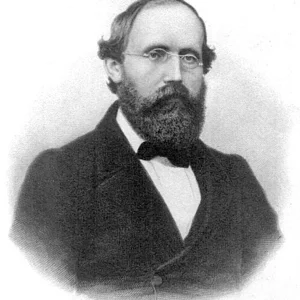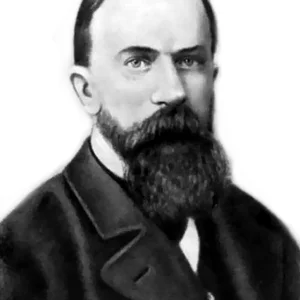

Vladimir Kovalevski was a Russian paleontologist, considered one of the founders of evolutionary paleontology. He notably studied the evolution of hoofed mammals from fossils, drawing on the theories of Darwin.
Vladimir Kovalevski(1842 — 1883)
Vladimir Kovalevski
Empire russe
5 min read
Frequently asked questions
Key Facts
- Born in 1842 in the Russian Empire and died in 1883
- Pioneer of evolutionary paleontology, applying Darwin's theories to the study of fossils
- Studied the evolution of hoofed mammals, notably the ancestor of the horse, from fossil series
- Translated major scientific works into Russian, including works by Darwin
- Husband of the mathematician Sofia Kovalevskaya, a pioneering figure in 19th-century science
Works & Achievements
A major study showing, from fossils, the gradual evolution of equids; a classic of evolutionary palaeontology.
A vast “natural” classification of fossil ungulates, based on their evolutionary descent rather than on mere resemblances.
A detailed anatomical description of a large fossil mammal, demonstrating his method of comparative anatomy applied to evolution.
A series of studies linking families of extinct mammals to their descendants, founding the evolutionary palaeontology of ungulates.
The dissemination in Russia of works by Darwin, Huxley and other scholars, helping to introduce evolution into the country.
Anecdotes
Vladimir Kovalevsky married Sofia Kovalevskaya in 1868; she would go on to become one of the greatest mathematicians of her century. Their union was at first a marriage of convenience in name only: at the time, Russian women could study abroad only if accompanied by a husband, and this marriage allowed Sofia to leave and attend courses in Germany.
His elder brother, Alexander Kovalevsky, was a great embryologist. The two brothers are sometimes confused, but they explored two complementary sides of Darwinism: Alexander the evolution of embryos, Vladimir that of fossils.
Before becoming a paleontologist, Kovalevsky was an editor and translator. He published European scientific works in Russian, including texts by Darwin and Huxley, helping to make evolution known in imperial Russia.
To reconstruct the history of the horse, Kovalevsky carefully studied the leg bones and teeth of extinct mammals such as *Anchitherium*. He showed that the modern horse descends from animals with several toes, whose side bones gradually shrank away: a famous demonstration of evolution read in the skeletons.
His life ended tragically: ruined by bad real-estate and financial ventures, and worn down by depression, Vladimir Kovalevsky took his own life in 1883, at just 41, shortly before his scientific work was fully recognized.
Primary Sources
Drawing on fossils, Kovalevsky traces the gradual transformation of the limb and teeth of equids, read as an evolutionary adaptation to open environments.
A monumental study of the fossil genus Anthracotherium, proposing a “natural” classification of ungulates based on their evolutionary history rather than on mere resemblances.
A detailed osteological description of a large fossil mammal, illustrating Kovalevsky’s comparative method for linking extinct species to their descendants.
Key Places
Major scientific city of the Russian Empire where Kovalevsky was educated and frequented intellectual and progressive circles.
British capital where he encountered Darwinian circles and was able to consult collections and scholars such as Huxley.
Home of Charles Darwin, whose correspondent and disciple Kovalevsky was, spreading his ideas in Russia.
German city where Kovalevsky worked on paleontological collections and published several of his monographs.
City where he held a university post at the end of his life and where he died in 1883.
Liens externes & ressources
Références
Œuvres
Sur l'Anchitherium aurelianense et l'histoire paléontologique des chevaux
1873
Monographie du genre Anthracotherium
1873-1874
Ostéologie du genre Entelodon
1876
Travaux sur les Hyopotamidés et les ongulés tertiaires
1870s
Traductions et éditions scientifiques en russe
1860s