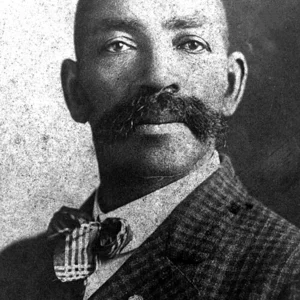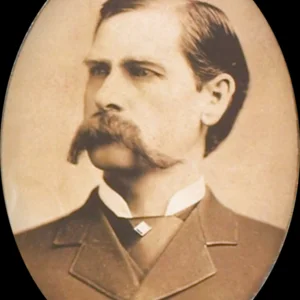

Wyatt Earp (1848-1929) is an iconic figure of the American conquest of the West. A roving lawman, gambler, and entrepreneur, he owes his fame to the Gunfight at the O.K. Corral in 1881, which became a founding myth of the Wild West.
Wyatt Earp(1848 — 1929)
Wyatt Earp
États-Unis
6 min read
Frequently asked questions
Key Facts
- Born on March 19, 1848 in Monmouth (Illinois), he grew up in an America expanding rapidly westward.
- A lawman in Dodge City (Kansas) in the 1870s, a cattle town renowned for its violence.
- October 26, 1881: took part in the Gunfight at the O.K. Corral in Tombstone (Arizona) alongside his brothers and Doc Holliday.
- In 1882, led a revenge expedition after the murder of his brother Morgan (the “Vendetta Ride”).
- Died on January 13, 1929 in Los Angeles, having become a legend in his own lifetime, popularized by the press and later by cinema.
Works & Achievements
Here Wyatt built his reputation as a lawman able to keep order in a cattle town known for its violence.
A thirty-second showdown in Tombstone that sealed the legend of the Earp brothers and Doc Holliday.
A punitive expedition led by Wyatt after the murder of his brother Morgan, which itself became a mythical episode of the Wild West.
A controversial referee's decision during a major boxing match in San Francisco that caused a scandal across the press.
An establishment run by the Earps during the gold rush that earned them a small fortune.
Accounts gathered at the end of his life that served as the basis for the 1931 biography that founded his myth.
Anecdotes
On October 26, 1881, in Tombstone, Arizona, Wyatt Earp, his brothers Virgil and Morgan, and their friend Doc Holliday faced off against a group of outlaws near the O.K. Corral. The shootout lasted only about thirty seconds and left three men dead, yet Wyatt walked away without a single scratch.
Before becoming a lawman, Wyatt Earp earned his living as a buffalo hunter on the plains of Kansas. He also drove stagecoaches and hauled freight — rough, dangerous trades typical of the West in the 1870s.
After his brother Morgan was murdered in 1882, Wyatt gathered a few men and hunted down those he believed responsible across Arizona. This vengeful expedition, remembered in history as the “Vendetta Ride,” made him an outlaw himself, and he was forced to flee the territory.
In December 1896, in San Francisco, Wyatt Earp was chosen to referee a major boxing match between Bob Fitzsimmons and Tom Sharkey. His controversial decision — disqualifying Fitzsimmons for a low blow — set off an enormous scandal across the American press.
Wyatt Earp died almost forgotten in Los Angeles in 1929. Two famous Western film stars, William S. Hart and Tom Mix, attended his funeral. It was only with a biography published in 1931 that he became the legend of the Wild West that we know today.
Primary Sources
Three men hurled into eternity in the duration of a moment.
The first two shots were fired by Billy Clanton and myself, he shooting at me, and I shooting at Frank McLaury.
Throw up your hands! I have come to disarm you!
Key Places
Small town in Illinois where Wyatt Earp was born in 1848, into a family of farmers and former soldiers.
Boomtown that sprang up from the cattle trade, where Wyatt Earp served as assistant marshal in the late 1870s.
Silver mining town that was the scene of the Gunfight at the O.K. Corral in 1881, the event that made Wyatt Earp famous.
Arctic gold rush town where Wyatt Earp and his wife Josephine ran the Dexter saloon around 1900.
City where Wyatt Earp spent his final years and died in 1929, all but forgotten by the general public.
Typical Objects

Nicknamed the "Peacemaker," this six-shot revolver produced from 1873 onward was the iconic handgun of the West. Lawmen and outlaws alike wore it on their belts.

A lever-action rifle that could fire several cartridges without reloading. It was nicknamed "the gun that won the West."

A metal badge, often star-shaped, pinned to the chest to signal the authority of a lawman. Wyatt Earp wore several over the course of his career.

A wide felt hat with upturned brim, created by John B. Stetson, which shielded its wearer from sun and rain. It became the signature garment of the Western man.

Faro was the most popular card game in the saloons of the West. Wyatt Earp earned part of his living as a dealer and professional gambler.

A powerful single-shot, large-caliber rifle used by buffalo hunters. Wyatt Earp used one during his years hunting on the plains of Kansas.

A Colt revolver with an extra-long barrel that legend attributes to Wyatt Earp. In reality this weapon was probably invented by his biographer in 1931: a fine example of a Wild West myth.
School Curriculum
Vocabulary & Tags
Key Vocabulary
Tags
Daily Life
Morning
In the morning, a Western lawman like Wyatt Earp would make his rounds, check that firearms had been properly deposited at the edge of town, and patrol the streets while they were still quiet. He would eat a hearty breakfast at the hotel or restaurant.
Afternoon
The afternoon was spent handling everyday business: keeping an eye on the saloons, collecting fines, escorting prisoners, but also tending to his own interests — horses, mining claims, and gambling tables.
Evening
The evening, the liveliest time, often found him behind a faro table in a smoky saloon. It was also the most dangerous moment, when alcohol and gambling stirred up the tempers of cowboys and miners.
Food
Food in the West was simple and meat-heavy: beef or bison, beans, hardtack, and cornbread, all washed down with very strong coffee. In prosperous towns, a few restaurants served more varied dishes.
Clothing
Wyatt most often wore a plain town suit, shirt, and vest rather than the full cowboy getup. But the wide-brimmed hat, leather boots, and long coat were still standard, with the revolver always within reach.
Housing
In boomtowns, people lodged in hotel rooms or hastily built wooden houses. Comfort was minimal, and these plank buildings, packed tightly against one another, caught fire easily.
Historical Timeline
Period Vocabulary
Liens externes & ressources
Références
Œuvres
Adjoint au marshal de Dodge City
1876-1879
Fusillade d'O.K. Corral
26 octobre 1881
Earp Vendetta Ride
mars-avril 1882
Arbitrage du combat Fitzsimmons-Sharkey
1896
Saloon Dexter à Nome (Alaska)
1899-1901
Mémoires dictés à Stuart Lake
années 1920