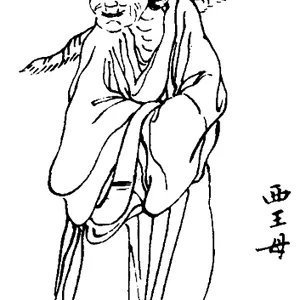

Xiwangmu, the Queen Mother of the West, is one of the great deities of Chinese mythology and religion. Guardian of the peaches of immortality, she reigns over Mount Kunlun and presides over the fate of immortals. Her cult, attested as early as the Shang dynasty, spans the entire religious history of China.
Xiwangmu
Xiwangmu
dynastie Zhou
9 min read
Frequently asked questions
Key Facts
- First mentioned in the Shanhaijing (Classic of Mountains and Seas), a text compiled between the 4th and 1st centuries BCE.
- Guardian of the peaches of immortality that ripen every 3,000 years on Mount Kunlun.
- Associated with the popular religion of the Han dynasty (206 BCE – 220 CE), where she was venerated as a bestower of longevity.
- A central figure of religious Taoism, incorporated into the official pantheon from the Han period onward.
- The legend of her meeting with King Mu of Zhou (10th century BCE) is recorded in the Muwangzhuan.
Works & Achievements
The central mythological creation of Xiwangmu: the celestial orchard on Mount Kunlun where the peaches of longevity grow, the source of immortality granted to gods and saints of the Taoist pantheon.
A cosmic feast organized by Xiwangmu to gather all the Immortals of the Taoist pantheon, made famous by the novel Journey to the West by Wu Cheng'en (16th century), in which the Monkey King disrupts the proceedings.
According to the Liezi, Xiwangmu transmitted to the Yellow Emperor the teachings of the Tao and the secrets of longevity, making her the mythical source of all Taoist medicine and philosophy.
After shooting down nine of the ten suns that were scorching the Earth, Hou Yi received from Xiwangmu an elixir of immortality as a reward; his wife Chang'e took it and flew to the Moon, giving rise to the myth of the Moon Festival.
One of the most celebrated mythological encounters in Chinese literature, recounted in the Mu Tianzi zhuan; the goddess and the king exchanged poems and gifts, symbolizing the possibility of dialogue between the human world and the divine.
According to the Han Wudi neizhuan, Xiwangmu visited Emperor Wu, revealed to him the secrets of longevity, and offered him her celestial peaches, permanently establishing the imperial cult of the goddess under the Han dynasty.
Anecdotes
The earliest mentions of Xiwangmu date back to oracle inscriptions of the Shang dynasty (c. 1300 BCE), carved on bones and tortoise shells. These texts describe her as a fearsome power associated with omens and natural disasters, far removed from the benevolent image she would later acquire.
The *Mu Tianzi zhuan* (Chronicle of the Son of Heaven Mu), a text from the late Zhou period, recounts the legendary encounter of King Mu with Xiwangmu near the Jade Lake (Yaochi). The king offered her precious gifts, they feasted together and composed poems — a founding episode that, for the first time, links the goddess to the human quest for immortality.
In the *Shanhaijing* (Classic of Mountains and Seas), Xiwangmu is described with tiger's teeth, a leopard's tail, and tangled hair, attended by three blue birds in her service. This terrifying portrait, rooted in archaic shamanic traditions, shows that the goddess was originally a figure of death and disease before being transformed into a bestower of immortality.
According to the *Han Wudi neizhuan* (Inner Biography of Emperor Wu of Han), Xiwangmu visited Emperor Wu (r. 141–87 BCE) and offered him seven peaches of immortality the size of an egg. When the Emperor wished to keep the pits to plant them, the goddess replied that these trees only bear fruit once every three thousand years — an anecdote illustrating the unbridgeable gap between human ambition and divine eternity.
Xiwangmu's celestial orchard on Mount Kunlun houses peaches of immortality arranged in three rows according to their potency: the first grant three thousand years of life, the second six thousand years, and the third life eternal. Every three thousand years, the goddess hosts a grand banquet (the Pantao Hui) for all the Immortals — a tale that became one of the most celebrated episodes in the sixteenth-century novel *Journey to the West*.
Primary Sources
The Queen Mother of the West resembles a human being but has the tail of a leopard and the teeth of a tiger. She is skilled at whistling and her hair is disheveled. She wears a headdress and presides over celestial calamities and the five penalties.
The Son of Heaven presented the Queen Mother of the West with one hundred bolts of white silk. The Queen Mother sang for the Son of Heaven, and the Son of Heaven sang in return. Then the Queen Mother planted trees on the shore of the Jade Lake.
The Queen Mother of the West attained the Tao and settled at Shao Guang. No one knows her beginning; no one knows her end.
The Queen Mother of the West drew from her sleeve a box of peaches the size of hen's eggs and offered seven of them to the Emperor. The Emperor wished to keep the pits to plant them; the Queen Mother told him: these peach trees only bear fruit once every three thousand years.
In ancient times, the Queen Mother of the West visited the Yellow Emperor twice on Mount Kunlun. She transmitted to him the teachings of the Tao and the arts of longevity.
Key Places
Mythological dwelling of Xiwangmu and *axis mundi* of Chinese cosmology, the pillar connecting Earth to Heaven. This is where her jade palace and her orchard of immortality peaches are located.
Sacred lake of emerald waters on the slopes of Mount Kunlun, site of the great banquet of the Immortals and the setting of the legendary meeting between Xiwangmu and King Mu of Zhou.
Archaeological site of the Shang dynasty capital where oracle bones mentioning Xiwangmu were discovered for the first time (c. 1300 BCE), making them the oldest known written attestation of the goddess.
Sacred Taoist mountain where the cult of Xiwangmu was particularly venerated, with temples dedicated to her, symbolizing the goddess's deep roots in medieval Taoist practice.
Major center of Shangqing Taoism where revelations concerning Xiwangmu were elaborated in the 4th–5th centuries CE; the Shangqing texts describe her as the dispenser of celestial scriptures.
Typical Objects

The emblematic fruits of Xiwangmu, growing in her orchard on Mount Kunlun and ripening only once every three thousand years. Eating one of these peaches grants extraordinary longevity or complete immortality.

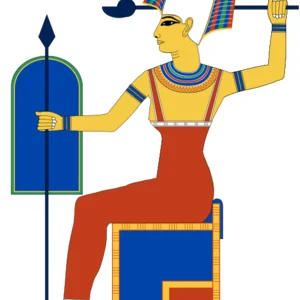
A characteristic headdress ornament of Xiwangmu in Han-period iconographic representations, symbolizing her divine royalty and celestial nature, and distinguishing the goddess from other figures in the pantheon.

The three blue birds that serve as Xiwangmu's messengers, bringing her food and carrying her messages to mortals; they symbolize the link between the divine world and the human world.

The sacred lake with turquoise waters located on Mount Kunlun, the setting of the great Banquet of the Immortals and the site of the legendary meeting between Xiwangmu and King Mu of Zhou.

Animals associated with Xiwangmu in her archaic representations — she bears tiger's teeth and a leopard's tail in the Shanhaijing — recalling her origins as a fearsome deity of the wild western regions before her transformation into a benevolent goddess.

The divine preparation that Xiwangmu jealously guards on Mount Kunlun; in the myth of Chang'e, the archer Hou Yi received this elixir from the goddess before it was stolen by his wife, who then fled to the Moon.

In certain ancient traditions, Xiwangmu is associated with cosmic weaving, symbolizing the order of the world and the fate of all beings, connecting her to the great weaving goddesses of ancient Asia.
School Curriculum
Vocabulary & Tags
Key Vocabulary
Daily Life
Morning
At the break of the cosmic dawn, Xiwangmu presides from her jade throne on Mount Kunlun over the reverences of Immortals and celestial spirits who come to pay her homage. She inspects her peach orchard accompanied by her blue birds, checking on the millennial growth of the sacred fruits.
Afternoon
During the divine afternoon, Xiwangmu receives the deserving souls who have achieved immortality and guides them in their new celestial functions. She consults the registers of fate and determines the lifespan of exceptional mortals, sometimes granting her grace in the form of additional years or a portion of the elixir.
Evening
At dusk, the goddess retreats to her palace by the Jade Lake, where she plays the qin (zither) in the company of fairies and celestial musicians. These evenings, bathed in starlight, are devoted to the arts, poetry, and spiritual teachings meant for the immortals of her entourage.
Food
Xiwangmu feeds exclusively on celestial foods: the sacred peaches from her orchard, the morning dew gathered on Mount Kunlun, and alchemical preparations made from jade and cinnabar. She never consumes the ordinary food of the human world, which preserves her absolute immortality and divine nature.
Clothing
The goddess is depicted in Han art wearing wide-sleeved robes adorned with clouds and phoenixes, with an elaborate headdress of jade and peacock feathers. In the ancient texts of the Shanhaijing, she instead displays fierce attributes — tiger's teeth, leopard's tail — evidence of her archaic aspect as a wild and formidable deity.
Housing
Xiwangmu resides in a jade palace with turquoise-covered roofs, perched atop Mount Kunlun, which rises up to the nine heavens. Her domain encompasses the orchard of immortality peaches, the Jade Lake with its emerald waters, and gardens populated by mythical creatures — phoenixes, golden deer, jade hares — that guard the gateways to the celestial paradise.
Historical Timeline
Period Vocabulary
Liens externes & ressources
Références
Œuvres
Le Jardin des pêches d'immortalité (蟠桃园)
Mythologique
Le Grand Banquet des Immortels (蟠桃会, Pántáo Huì)
Tous les 3 000 ans (mythologique)
Transmission des arts de la longévité à l'Empereur Jaune
Mythologique (ère de Huangdi, vers -2700)
Don de l'élixir d'immortalité à l'archer Hou Yi
Mythologique
Rencontre avec le roi Mu de Zhou au Lac de Jade
vers -950 (légendaire)
Apparition à l'Empereur Wu des Han
vers -110 (légendaire)