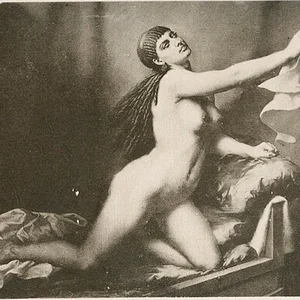

Zulaikha is the wife of Potiphar, a high Egyptian dignitary, famous in the Bible (Genesis 39) and the Quran (Surah Yusuf) for attempting to seduce Joseph. Joseph's refusal and her false accusation lead him to prison. She has become a major literary figure, particularly in classical Persian poetry.
Zulaikha
Zulaikha
10 min read
Frequently asked questions
Key Facts
- Mentioned in Genesis (chapter 39) as the wife of Potiphar, captain of Pharaoh's guard
- Attempts to seduce Joseph; after his refusal, falsely accuses him of assault, having him imprisoned
- In the Quran (Surah 12, Yusuf), she is named Zulaikha and her story is developed in depth
- The Persian poet Jami (15th century) devoted the epic 'Yusuf and Zulaikha' to her, in which she repents and is forgiven
- Her character has inspired numerous literary and artistic works across the three monotheistic faiths
Works & Achievements
The foundational canonical narrative in which Zulaikha appears, though unnamed. This seminal text establishes the key elements of the legend: the seduction, the refusal, the false accusation, and Joseph's imprisonment.
The most fully developed Quranic version of the story, giving Zulaikha a more complex role. The banquet scene and her eventual acknowledgment of guilt are present here, making her a morally ambivalent figure capable of redemption.
An early Persian epic version introducing the motif of the premonitory dream — Zulaikha sees Yusuf's face in a dream before meeting him, falling in love with a heavenly vision. This motif would go on to influence the entire subsequent literary tradition.
A masterpiece of Persian Sufi mystical poetry. Zulaikha is reinterpreted here as a symbol of the soul's quest for God, and her love for Yusuf becomes an allegory of the search for the divine — the most influential work on the worldwide literary tradition.
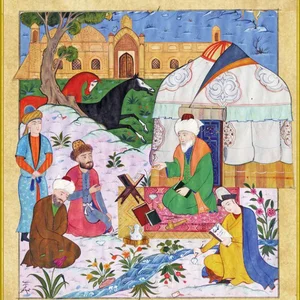
A body of pictorial works produced at the courts of Iran, Mughal India, and Central Asia, depicting the key scenes of the story. These miniatures represent the richest visual testimony to Zulaikha's cultural significance within Islamic civilization.
Rabbinic commentaries that enrich the biblical narrative with details absent from the original text, including repeated seduction attempts accompanied by daily changes of clothing. These texts nourished the imagination of the medieval Jewish tradition.
Anecdotes
In the Bible (Genesis 39), Zuleikha is not named — she is referred to simply as 'Potiphar's wife'. She notices the beauty of Joseph, a Hebrew slave purchased from Ishmaelite merchants, and attempts to seduce him day after day. Joseph refuses each time, citing his master's trust in him and his faithfulness to God.
The scene of the torn garment is one of the most dramatic in the narrative: fleeing from Zuleikha, Joseph leaves his cloak in her hands. She seizes it as evidence and accuses Joseph before her husband. But the Quran specifies that a witness — according to some commentators, a child gifted with miraculous speech — reveals the truth: if the garment is torn from the front, Joseph is guilty; from the back, he is innocent. Potiphar concludes that his wife is the guilty one.
The Quran (Surah 12, Yusuf, verses 30–31) recounts a scene absent from the Bible: mocked by the noblewomen of the city for her shameful love, Zuleikha organizes a banquet. She distributes knives and citrons, then has Joseph brought in. The women, struck by his supernatural beauty, cut their hands without realizing it, crying out: “He is not a human being — he is a noble angel!” Zuleikha thus triumphs over their mockery.
In Persian mystical poetry, most notably Jami's masterpiece entitled *Yusuf va Zulaikha* (1483), Zuleikha's love is reinterpreted as an allegory of the human soul desperately in love with divine Beauty. In this version, Zulaikha is said to have seen Yusuf's face in a dream long before meeting him, falling in love with a celestial vision. After her husband's death and Joseph's liberation, she sincerely repents and Joseph marries her, their union symbolizing the reunion of the soul with God.
The figure of Zuleikha has crossed centuries and cultures: she appears in Persian and Mughal miniatures among the most refined works of art in medieval Islam, always depicted facing Joseph, whose radiant beauty is symbolized by a luminous glow. Her name has become synonymous with uncontrollable passionate love in Arabic, Persian, and Turkish literature, making an anonymous biblical figure one of the most celebrated heroines in world literature.
Primary Sources
His master's wife cast her eyes upon Joseph, and she said, "Lie with me." But he refused and said to his master's wife: "My master has entrusted everything he owns to me, and he has no concern about anything in the house… How then can I do this great wickedness and sin against God?"
The woman in whose house he lived sought to seduce him. She bolted the doors and said: "Come!" He said: "God forbid! My Lord has given me the best abode. Truly, the wrongdoers do not succeed." She desired him, and he would have desired her had he not seen the sign of his Lord.
Zulaikha was a queen whose beauty rivaled that of the moon, yet it was her love for Yusuf that consumed her like a flame consuming wax. She built in his honor a palace of seven rooms, each adorned with his portrait, so that wherever he looked he could not avoid seeing his face.
The sages recount that Zuleikha tempted Joseph over a long period of time, changing her garments every day to seduce him. She even had an idol made for her, which she veiled so that Joseph could not call upon God's watchful gaze upon them.
The poet describes how Yusuf's beauty was such that even the angels were dazzled by it, and that Zulaikha, having seen his face in a dream before ever meeting him, fell hopelessly in love with that divine vision before any human contact had taken place.
Key Places
The main residence of Zuleikha, where most of the story unfolds. It is here that she attempts to seduce Joseph, falsely accuses him, and the central drama of the legend plays out.
The place where Joseph is imprisoned following Zuleikha's false accusation. In the Quranic tradition, Joseph remains there for several years before being released to interpret the Pharaoh's dreams.
The region from which Joseph originates, sold into slavery by his brothers. The connection between Canaan and Egypt forms the geographical and spiritual backdrop of both the biblical and Quranic narrative.
In Jami's poetic version, Zuleikha has a magnificent palace built with seven halls adorned with portraits of Yusuf. This legendary place symbolizes her obsessive love and the spiritual journey toward divine beauty.
A sacred Egyptian city associated in the Bible with Joseph's sojourn in Egypt. According to Genesis 41:45, Joseph marries Asenath, daughter of the high priest of On, providing the religious and social context in which Zuleikha lived.
Typical Objects

The mantle of Joseph, ripped away during his flight, is the central piece of evidence in the story. Its condition — torn from the front or from the back — becomes in the Quran the material proof of Joseph's innocence and Zulaikha's guilt.

During the famous Quranic banquet, Zulaikha distributes knives and citrons to her guests. Struck by Joseph's supernatural beauty, the women cut their hands without even noticing — a symbol of the devastating power of divine beauty.

In Jami's Persian poetic tradition, Zulaikha has Joseph's portrait painted in every room of her seven-chambered palace. These images symbolize her obsessive love and the omnipresence of the divine in her inner life.

A feminine attribute of the elite in the ancient Near East, the veil is associated with Zulaikha as a symbol of concealment and secrecy — she hides her forbidden love behind the outward appearance of honor and respectability.

By locking all the doors of the house before attempting to seduce Joseph (Quran 12:23), Zulaikha manipulates the domestic space over which she holds control. The keys symbolize her power in the private sphere and the confinement she tries to impose on Joseph.

A symbol of contemplation and self-awareness in Sufi literature, the mirror appears in the allegorical tales of Zulaikha as the object of her inner reflection — in it she perceives her own moral state before her final spiritual redemption.
School Curriculum
Vocabulary & Tags
Key Vocabulary
Tags
Daily Life
Morning
As the wife of a high Egyptian dignitary, Zuleikha began her day in the apartments reserved for elite women. Servants helped her adorn herself: ointments of perfumed oils, makeup with kohl and red ochre, an elaborate hairstyle adorned with beads and gold. The morning was devoted to domestic rituals and to overseeing the household's many servants.
Afternoon
The afternoon was dedicated to managing the vast affairs of Potiphar's estate and receiving visitors. In the literary tradition, it is during these hours that Zuleikha sought to draw near to Joseph, taking advantage of her husband's absences to attempt to seduce him in the inner chambers. The noble women of the city would visit one another, and Zuleikha was sometimes mocked among them for her passion.
Evening
In the evenings, Zuleikha attended the banquets and festivities of the Egyptian aristocracy alongside Potiphar. In the Persian tradition, her nights were haunted by her impossible love for Joseph: she would gaze at his portraits by the flickering light of oil lamps, weeping over a passion she could not satisfy and that slowly consumed her.
Food
The Egyptian elite of the time ate fine wheat breads, roasted meats (beef, poultry, and game), dried or pickled Nile fish, vegetables (onions, leeks, lentils, cucumbers), and fruits (figs, grapes, pomegranates, dates). Palm wine and spelt beer accompanied meals. Aristocratic banquets featured rare delicacies and spices imported from the Levant and Arabia.
Clothing
Zuleikha, wife of a senior officer of the Pharaoh, wore finely pleated white linen robes adorned with colorful embroideries and golden trim. Necklaces of gold, lapis lazuli, and carnelian, along with bracelets, rings, and earrings, completed her adornment. In the Midrash, the rabbis note that she changed her outfit every day to seduce Joseph — a sign of both her wealth and her obsession.
Housing
Potiphar's residence was a grand Egyptian villa with an interior courtyard, columns painted in vivid colors, fresh water pools, and tree-lined gardens. The women's quarters were separated from the reception halls. The walls were decorated with frescoes depicting scenes of life on the Nile and Egyptian deities. In Persian poetry, Zuleikha is said to have had an entire palace built, each of its rooms adorned with a portrait of Joseph.
Historical Timeline
Period Vocabulary
Liens externes & ressources
Références
Œuvres
Genèse 39 (Bible hébraïque / Torah)
Xe–VIe siècle avant J.-C.
Sourate Yusuf, Coran (chapitre 12)
~610–632 après J.-C.
Yusuf et Zulaikha de Firdausi
Xe–XIe siècle après J.-C.
Yusuf va Zulaikha de Jami
1483 après J.-C.
Miniatures persanes et mogholes illustrant Yusuf et Zulaikha
XIVe–XVIIe siècle après J.-C.
Midrash Bereshit Rabbah (commentaires rabbiniques)
IVe–Ve siècle après J.-C.