Imaginary interview with Auguste Rodin
by Charactorium · Auguste Rodin (1840 — 1917) · Visual Arts · 5 min read
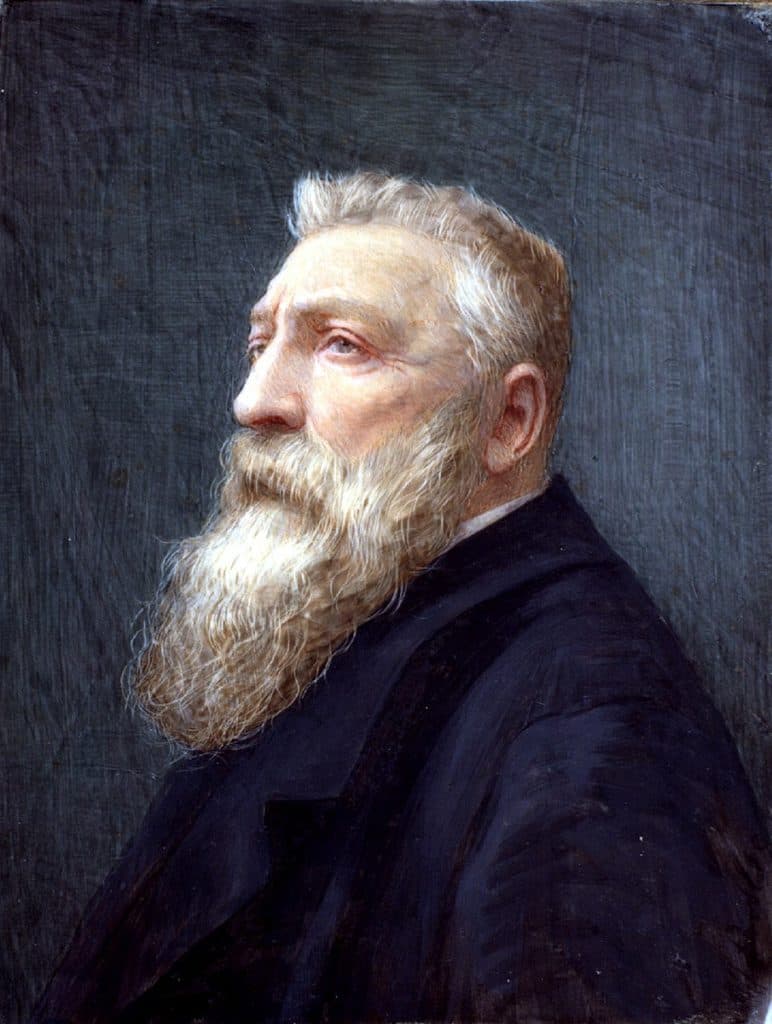
Meudon, a winter morning in 1913. The Villa des Brillants smells of wet clay and fresh plaster; outside, the fog drowns the Seine valley. The master, stained smock and gray beard, turns a turntable with a mechanical gesture, as if the conversation too must be viewed from all angles.
—How does one live, at seventeen, being turned away three times from the gates of the Beaux-Arts?
One lives it like a slap, then like a chance — but it takes years to understand the latter. Between 1857 and 1859, three times I presented myself for the exam, three times I was rejected. The jury wanted smooth surfaces, pastry gods, what I call academicism: rules before flesh. I had only my hands and my hunger. So I went where life was real, to the studio of Antoine-Louis Barye, at the Museum, among stuffed wild animals and skeletons. I learned anatomy on carcasses, not from antique casts. Today I thank that jury: by closing the School to me, it opened nature.
By closing the School to me, that jury opened nature.
—What would you say to a young sculptor whom the Academy has just rejected?
I would tell him not to weep for the Salon. The rule taught on Rue Bonaparte is a gilded prison: you learn to finish, never to feel. Let him take his modelling tool, let him knead the clay until his nails are full of it, and let him watch a living body move rather than a motionless Greek statue. The truth of a shoulder that stretches, there is the School. I myself have never ceased to be that hungry self-taught man from the Mouffetard neighborhood; every morning still, I begin by drawing models who walk freely in the studio, without imposed pose. Talent needs no diploma — it needs eyes that do not lie.
The rule taught is a gilded prison: you learn to finish, never to feel.
—In 1877, you were accused of having cast a living man. Do you remember that shock?
I remember it like a burn. I had brought back from Brussels a nude male figure — The Age of Bronze — modelled after a young Belgian soldier, Auguste Neyt. It breathed so much that they cried scandal: this Rodin poured plaster over a living body, it's not sculpture, it's cheating, life casting! They refused me my own work. I had to write to the Under-Secretary of State, show my studies, have colleagues testify. I protested vigorously against this accusation of life casting: I had modelled that figure entirely from my studies and the sole aid of my model. What irony: they condemned me precisely for what I sought — life.
They condemned me precisely for what I sought: life.
—Why care so much that the work appear alive, at the risk of being taken for a cheater?
Because a dead sculpture is a polite lie. When I sculpted that soldier in Brussels, where I earned my bread as an ornamentalist from 1871 to 1877, I did not want a bronze hero: I wanted the man awakening, the shiver under the skin. I once told Paul Gsell that the artist worthy of the name must express all the truth of nature, not only the outer truth, but also and above all the inner truth. That sums up my whole trial. The accusation of 1877 hurt me, but it proved one thing: my clay was so true that they believed it stolen from a body. What finer verdict for a sculptor?
A dead sculpture is a polite lie.
—You worked for nearly forty years on a door you never finished. Why?
Because Dante's Hell has no end, and neither do I. In 1880, the State commissioned a monumental door for a museum of decorative arts. I put all of Dante into it, whom I reread in the evenings by lamplight: the damned, the lovers, the fall. From that matrix were born my most famous children — The Thinker, which was to crown the tympanum, The Kiss, torn from Paolo and Francesca. At the Dépôt des Marbres, on Rue de l'Université, I shaped hundreds of figures that swarmed over that bronze. But a door of this kind, you understand, is a world; and a world, you do not finish. Thirty-seven years later, it still awaits me, unfinished like life.
Dante's Hell has no end, and neither do I.
—The Thinker has become the very image of thought. Did you intend it to be so great?
Not at all. Originally, it was just a small seated figure meant to dominate The Gates of Hell: a poet, perhaps Dante, meditating on the souls parading at his feet. I conceived it in 1880, bent, muscles knotted, because for me a man does not think only with his skull — he thinks with his back, his clenched toes, his loins. Then it was enlarged, isolated, cast in bronze, and left my door to travel the world. Today it even watches over my future tomb, in Meudon, in the garden. Strange fate for a detail: this fragment of Hell has become the portrait of all questioning humanity.
A man does not think only with his skull: he thinks with his back.
—One enters your studio and sees hands, torsos, feet without bodies everywhere. What do you seek in these fragments?
I seek the whole in the part. I have kept hundreds of plaster casts — hands especially, torsos, legs — arranged like an alphabet. When I compose, I draw from them, I assemble, I graft: a hand from yesterday onto a bust from today. A fragment of flesh, well seen, already tells all the suffering or all the grace of a being. My practitioners then transpose into marble what I have modelled in clay; I turn the turntable, I look from all angles, sometimes I leave the raw stone around the figure — that non finito which makes the body emerge from matter as from a dream. The fragment is not debris: it is a complete sentence.
The fragment is not debris: it is a complete sentence.
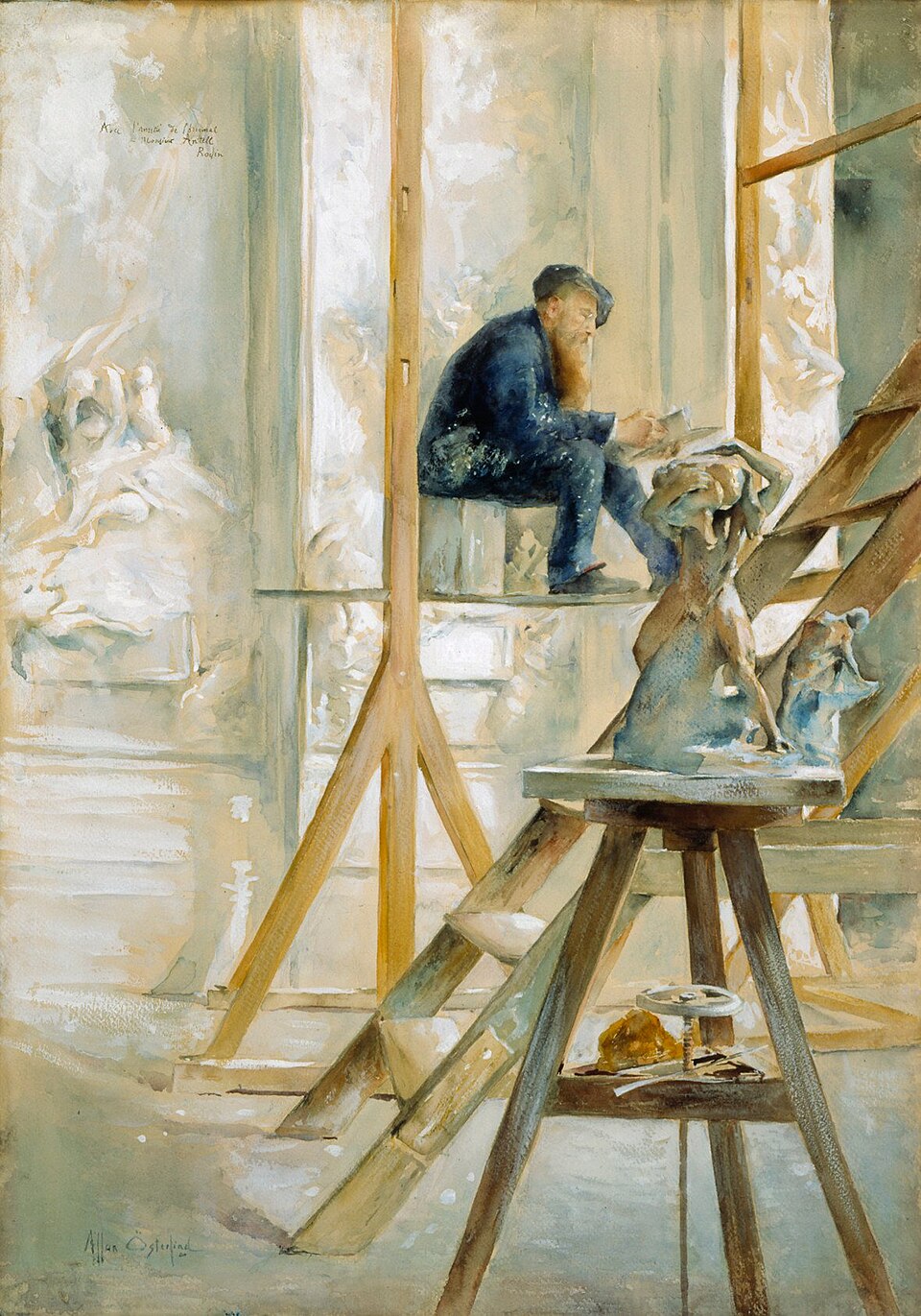
—What does an ordinary day in this studio look like?
It begins before daybreak. I rise at dawn and rush to the studio, notebook in hand, to draw my models who move freely — I often sketch without even looking at my paper, my eye fixed on the movement. The afternoon belongs to clay and to my practitioners, whom I supervise like an orchestra conductor; in between, I receive collectors and critics who come seeking an opinion. In the evening, in Meudon, I dine simply with Rose Beuret, my lifelong companion, I reread Dante or Baudelaire, and I draw again by lamplight. Under my town frock coat, the plaster-stained smock is always hidden. Deep down, I have never ceased to be a worker of form.
Under my town frock coat, the plaster-stained smock is always hidden.
—In 1898, your Balzac was rejected, deemed shapeless. How did you experience that rejection?
With cold anger, then with certainty. The Société des Gens de Lettres had commissioned a Balzac from me; they no doubt expected a well-groomed notable on his pedestal. I gave them the whole man, draped in his dressing gown like a menhir, head thrown back, visionary. They cried 'sack of plaster', 'abortion'. Rejected! It was 1898, France was already tearing itself apart over the Dreyfus Affair, minds were bent on hatred. I took back my statue and kept it. I knew it would outlive me. One does not sculpt a genius with a measuring tape — one sculpts it with a storm.
One does not sculpt a genius with a measuring tape — one sculpts it with a storm.
—What do you reply to those who demand the pedestal, the noble pose, the statue that looks at the sky?
I reply: come down from your pedestal. When I was commissioned for The Burghers of Calais, those six notables who offered themselves to the English in 1347, they wanted a heroic monument, perched high. I, instead, wanted to place them at ground level, among passersby, barefoot in the rope, faces undone by anguish — not bronze heroes but men who are afraid and who move forward anyway. The pedestal lies: it puts grandeur out of reach. My Balzac in a dressing gown, my Calaisians at street level, it is the same quest — to make the sublime human, and the human sublime. True nobility does not need one to look up to see it.
The pedestal lies: it puts grandeur out of reach.
This imaginary interview was generated by artificial intelligence from sources documented in Auguste Rodin's profile. It dramatises what the figure might have said based on what we know about them, but does not constitute attested historical testimony. For primary sources and factual documentation, refer to the full profile.