Kids interview Auguste Rodin
by Charactorium · Auguste Rodin (1840 — 1917) · Visual Arts · 5 min read
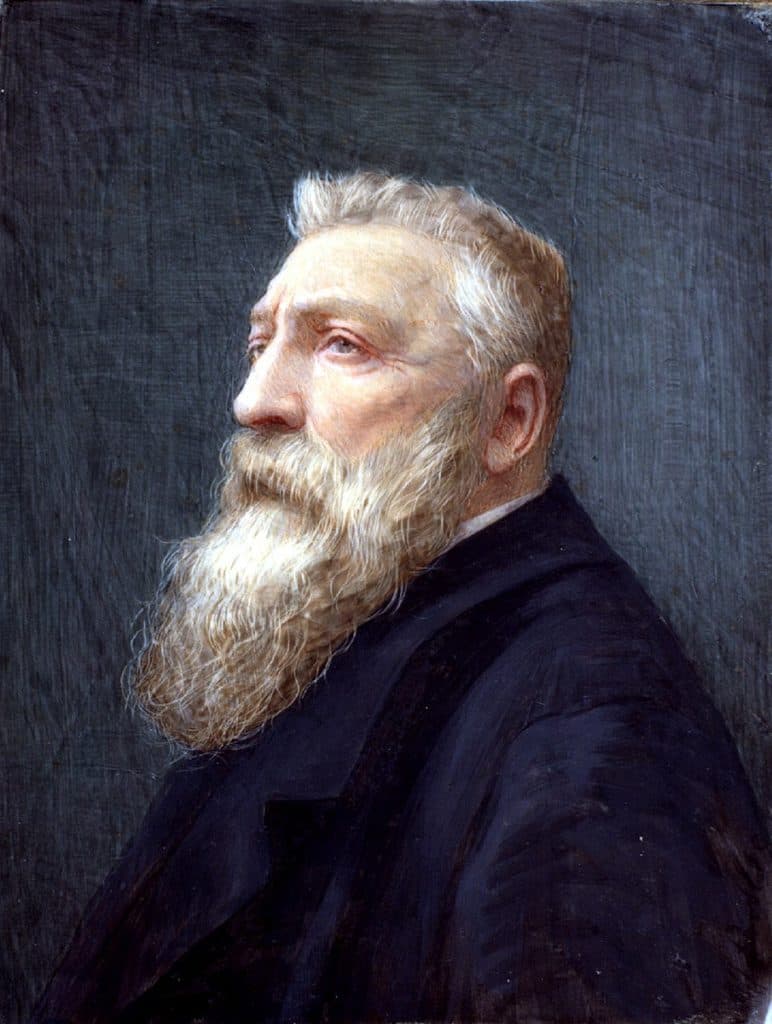
That morning, a school discovery class pushes open the gate of the Hôtel Biron in Paris. Two young visitors stop in front of an old man with a big beard, his hands full of plaster. It's Auguste Rodin, and he has agreed to answer all their questions.
—Is it true you were accused of cheating with your first major statue?
Yes, my child, and it hurt me deeply. In 1877, I showed The Age of Bronze, a naked man so lifelike that people swore he was about to move. And then critics cried scandal: they said I had poured plaster directly onto the body of my model, a young Belgian soldier named Auguste Neyt. They called it a "life cast" — a real cheat for a sculptor. Imagine being accused of copying when you did everything yourself! I had to show my sketches, bring in artists to testify. It was humiliating. But you know what? That scandal made my name famous.
They thought I was a cheat; in truth, I was just too real.
—Were you angry or rather sad when they said that about you?
Both, you know. I had worked months on that figure, modeling it with my own hands, and they called me a liar. So I wrote an official letter to the State to defend myself. I protested with all my might against that accusation. Imagine you turn in a beautiful drawing and the teacher says, "You didn't do this." You'd want to cry and shout at the same time. But I learned one thing: when your work disturbs people, it's sometimes because it's too alive for their habits. The anger, I put it into the clay.
—They say you worked your whole life on a single door. Is that possible?
Almost my whole life, yes! In 1880, the State commissioned a large bronze door for a museum. I named it The Gates of Hell, inspired by an old poem by Dante that describes the damned souls. I wanted to swarm it with hundreds of tiny figures twisted in pain. And you know how long I spent on it? Nearly 37 years! I never finished it in my lifetime. Imagine a project you start as a child and that isn't finished when you're a grandfather. That door was my secret laboratory: almost all my famous sculptures came out of it.
I spent thirty-seven years in front of a door I never managed to close.
—Your famous Thinker, did it really come from that door?
Yes indeed! At the very beginning, The Thinker was just a little seated figure at the top of The Gates of Hell, around 1882. He looked down at all those suffering souls and thought. Then I found him so powerful that I enlarged him and set him apart. Today the whole world knows him: a naked man, chin on hand, lost in thought. The Kiss was also born there, that embracing couple captured in marble. Imagine a single seed that yields a whole garden: my door was that seed.
—What was a normal day like in your studio?
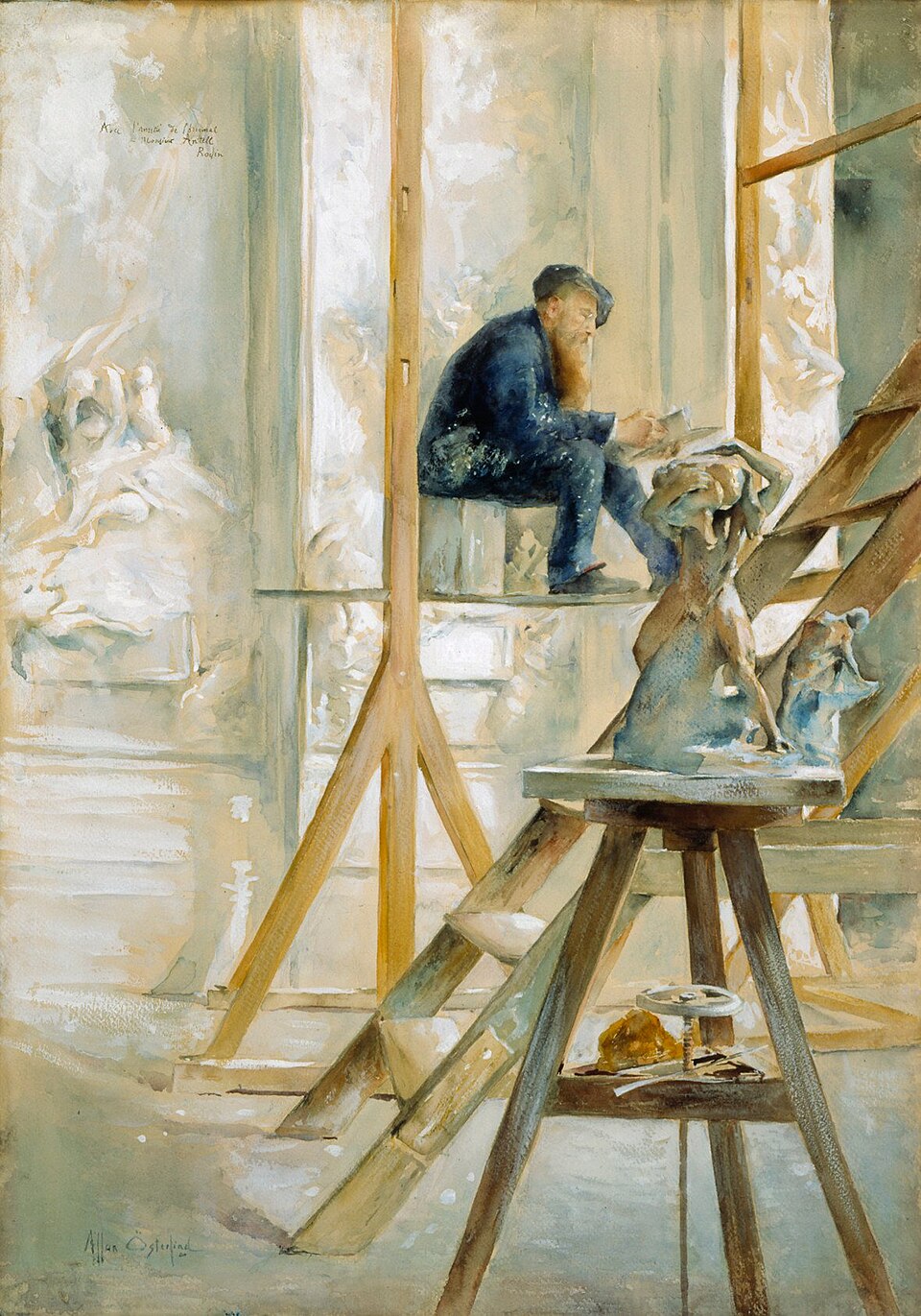
I got up at dawn, my child, and almost ran to my studio. In the morning, I brought in live models. But careful: I didn't tell them to stay still! They walked, stretched, moved freely, and I drew at top speed, sometimes without even looking at my paper. In the afternoon, I plunged my hands into clay to model. Imagine a soft, gray paste, cool, that obeys your fingers. Around me, my assistants — we called them practitioners — carved the marble from my models. It smelled of wet clay, plaster, and stone dust.
With me, the hand knew before the head.
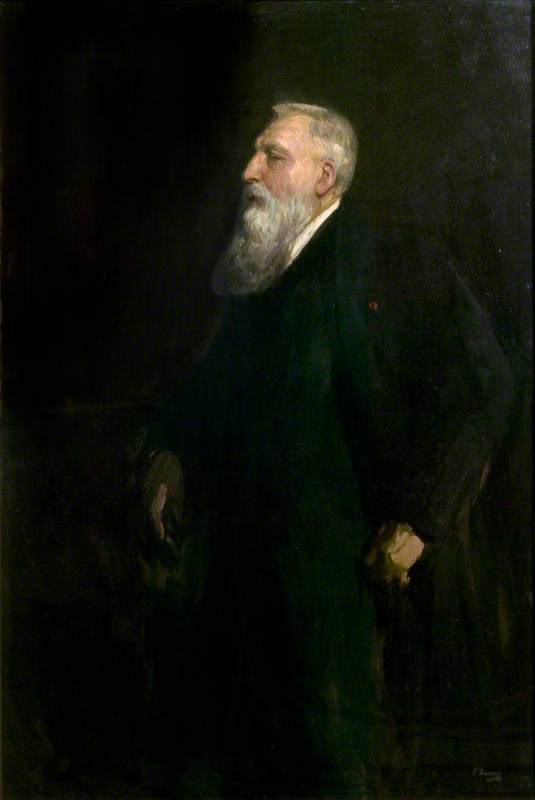
—What are all those plaster bits of arms and feet on the shelf?
Ah, you have a good eye! Those are my treasures. I kept hundreds of plaster casts: hands, torsos, feet, body parts. And I had fun recombining them like a construction game to invent new figures. An arm from here, a leg from there, and presto, a new character! My favorite tool was the modelling tool, a small wooden spatula for digging and smoothing the clay. Imagine a cook who keeps lots of ingredients in jars and composes a different dish each day. My studio was my kitchen, except I cooked human bodies.
—Is it true your statue of the writer Balzac was rejected?
Rejected, yes, and with a bang! Around 1898, I was commissioned to make a statue of the great writer Balzac. Instead of sculpting him upright and noble, I showed him standing, wrapped in his big dressing gown, like a mysterious mountain emerging from the night. The committee howled: they found it "shapeless," unfinished, unworthy. Imagine you give your finest gift and they hand it back saying "it's ugly." It stings. But I didn't give in. Today, they say that statue opened the door to modern sculpture.
They found it shapeless; I saw a soul in it.
—Why didn't you make statues as smooth as the others?
Good question, my child! In my time, people loved academicism: smooth, perfect statues, polished like pebbles, with heroes on high pedestals. I found that boring. I sometimes left the stone half-rough, barely emerging from its block — we call that non finito, "the unfinished." I also liked to leave fingerprints, bumps, hollows. Why? Because light catches on them and the statue seems alive, quivering. Imagine the difference between a plastic cheek and real skin that breathes. I wanted the skin that breathes.
—Who was Camille Claudel, who is often mentioned alongside you?
Camille... a dazzling artist, you know. From 1884, she arrived as my student, then became my collaborator and companion. She sculpted with incredible talent, sometimes stronger than mine in certain figures. For about fifteen years, we worked side by side, our hands in the same clay. Scholars still argue: who influenced whom? The truth is, we nourished each other. But our story was passionate and stormy, full of quarrels. Imagine two fires that warm each other and end up burning each other. It ended badly, and I still carry the pain.
We mixed our hands in the same earth.
—And at home in the evening, who did you live with? What did you eat?
In the evening, I returned to the Villa des Brillants in Meudon, my house surrounded by a garden. I lived there with Rose Beuret, my lifelong companion, faithful for fifty years. We dined simply: a good soup, roast meat, vegetables from the garden, a glass of wine without excess. Nothing luxurious, I had peasant tastes. Afterwards I often read Dante or poets by lamplight, and sometimes I still drew. Imagine a quiet house, no motor noise, just the crackling of wood. Rose died a few weeks before me, in 1917. I did not long outlive her.
This imaginary interview was generated by artificial intelligence from sources documented in Auguste Rodin's profile. It dramatises what the figure might have said based on what we know about them, but does not constitute attested historical testimony. For primary sources and factual documentation, refer to the full profile.