Imaginary dialogue between Voltaire and Catherine II of Russia
by Charactorium · Catherine II of Russia (1729 — 1796) · Politics · 6 min read
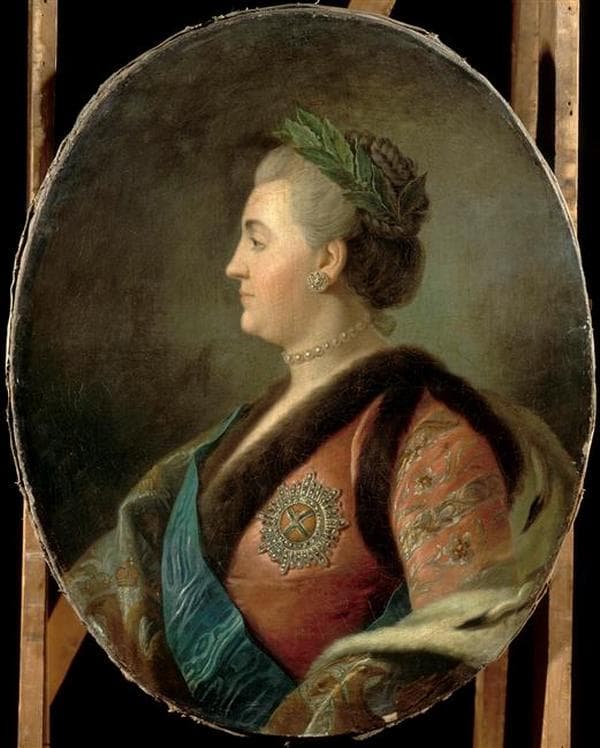
It is in the still-fresh galleries of the Hermitage, among the Flemish canvases the tsarina has just bought in Berlin, that Voltaire — come in thought from Ferney — meets again the one he calls the North Star, in this autumn of 1774. Snow falls on the Neva, candles make the gold of the Winter Palace gleam, and the rural revolt has barely died out. They have been writing to each other for nearly ten years without ever meeting; the old philosopher finally comes to press his royal pupil with questions that the prudence of letters forbade him.
—Your Majesty, I have been told that in 1762 you appeared on horseback before the Guard, in a green uniform. Tell me: were you afraid that morning?
Afraid, my dear master? I had no time for that. Consider that at daybreak, everything had to be decided by noon, or I would perish. I put on the green uniform of a Guard regiment, because those soldiers would not have followed a woman in a court gown — they wanted a leader. When they acclaimed me, I understood that the Empire was slipping from Peter III to me like a cloak one lets fall. My manifesto said it bluntly: the danger of the dismemberment of Russia obliged me to take the government into my own hands. People think me ambitious; I was above all in a hurry. Hesitation that day would have been a death sentence.
The Empire was slipping from Peter III to me like a cloak one lets fall.
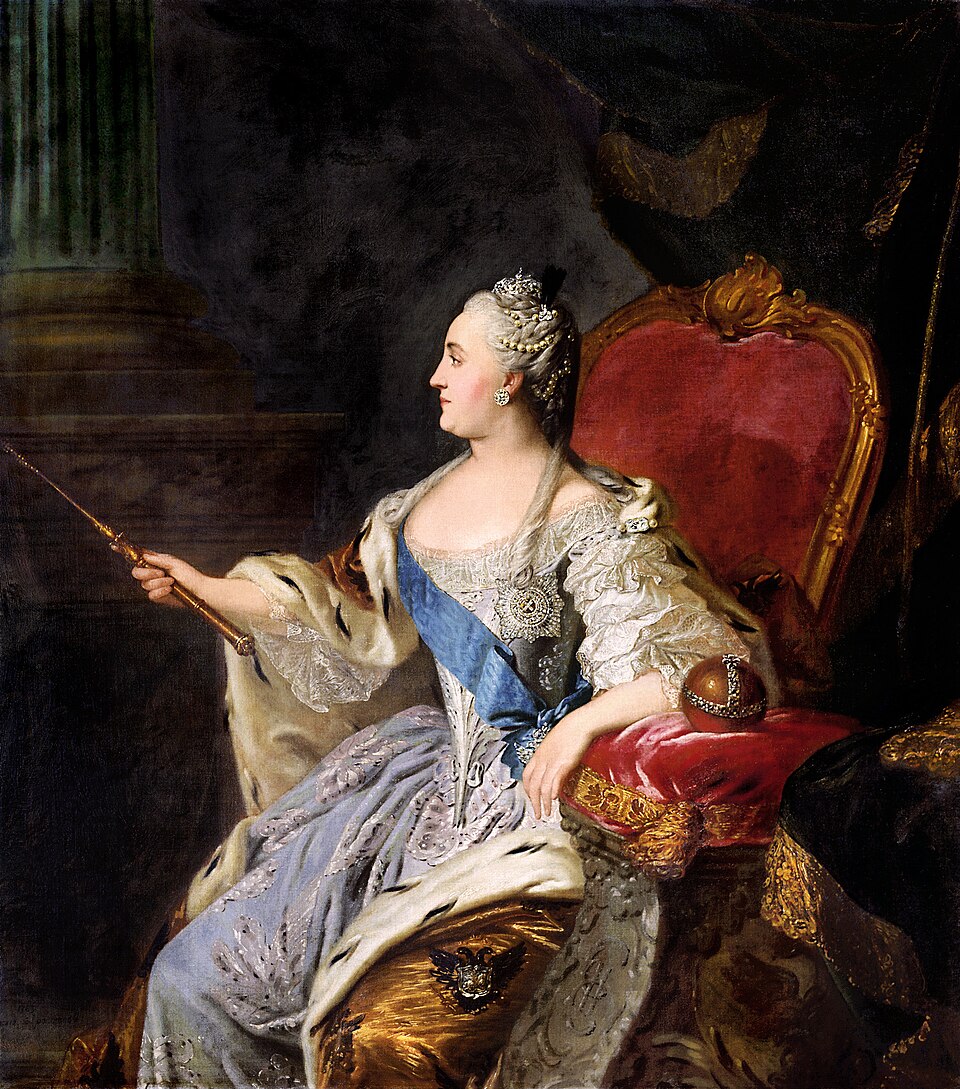
—And that scepter you hold at audiences, that famous diamond — is it not the gift of a man who brought you to the throne?
You touch on a delicate point, and you know it. The Orlov diamond that adorns my scepter came to me from Grigory, who was among those without whom I could have done nothing. A throne taken by surprise requires devoted arms, and his were such. But do not think that a gift buys an empress: I kept the man as long as he served me, and the diamond forever. That is the difference between power and friendship. I wear this scepter not as a tender memory, but as the brilliant proof that a conquered crown is worth as much as an inherited one. My enemies whisper that I owe everything to my favorites; I answer that I owe my Empire only to myself.
A throne taken by surprise requires devoted arms.
—You have written to me for so many years that you are my most devoted pupil. But frankly, what do you expect from an old man in Ferney?
Do not play modest, you who formed my mind from my youth. When I write to you that I am your most devoted pupil, it is no court flattery: your books were my true tutors, while my official teachers taught me only curtsies. From you I expect what no minister brings me — the free gaze of a man who owes me nothing and whom I can neither appoint nor disgrace. You tell me the truth because you are beyond my reach. A sovereign is surrounded by mirrors that reflect her own face embellished; you, my dear master, are the only window. That is why I keep your letters as one keeps a treasure.
My courtiers are mirrors; you, my dear master, are the only window.
—I have learned that you brought Diderot to St. Petersburg and bought back his library. Is that the generosity of a patron, or the calculation of a sovereign?
Both, and why should I blush for it? Our friend Diderot was struggling in poverty; I bought his library last year, leaving him his books and the title of librarian, with a salary. Thus a philosopher of Europe could work in peace — and all Europe knew that Russia nourished those whom Paris starved. You see, I own the Encyclopédie, I financed its distribution: these volumes do not decorate my shelves, they enlighten my Council. When Diderot came to visit me, he scolded me like a schoolboy, striking my table with his hand. I listened smiling: he reasoned on paper, and I governed on human skin, which chafes at the slightest erasure.
Diderot reasoned on paper; I govern on human skin.
—Let us speak of your great work, the Nakaz of 1767. You mix Montesquieu and Beccaria in it — can a sovereign truly legislate as a philosopher?
I attempted it, and I remain proud of it, whatever is said. My Instruction contains more than five hundred articles, and I confess without shame to having plundered Montesquieu like a traveler takes provisions. I proclaim there that Russia is a European state, and that liberty is the right to do everything that the laws allow. Understand this sentence well, you who weigh words: liberty is not the absence of law, but obedience to it. I convened a great Commission to reform our law; alas, my deputies debated much and concluded nothing. A text of reason is not enough to bend an empire of customs. I sowed principles; the harvest will be slow, and perhaps I will not see it.
Liberty is the right to do everything that the laws allow.
—Yet, Madame, you reign as an autocrat, without an assembly to limit you. How do you reconcile the philosopher and the absolute master within you?
Ah, there is the question that only you dare to ask me! Today people speak of enlightened despotism, as if one could be half a master. Hear the truth of a woman who governs fifteen million subjects over thousands of leagues: without the power of an autocrat, my ukases would not cross the gates of the capital. An empire so vast, so diverse, is not led by debate but by a single will. I desire the good of my peoples; but I desire it in my own way, because they themselves still do not know what suits them. You will find that arrogant. I call it, myself, the very condition of government. The philosopher proposes; the autocrat alone can execute. And I prefer to execute little than to propose nothing.
The philosopher proposes; the autocrat alone can execute.
—But these humane principles, Madame — do they extend to your peasants? I am told the Russian serf is treated almost like a slave.
You put your finger on my most painful wound, and I will not lie to you. The serf, bound to the soil of his lord, is the dark reverse of my reign. I would like, while reading your friends the philosophers, to ease his condition; but I reign through the nobility, and it is they who own these men. To touch serfdom would be to saw off the branch on which my throne rests. You see, I overthrew an emperor in one morning; I would not overturn the rural order without losing my crown. I will be judged on this, I know, and harshly. I prefer to be called powerless rather than imprudent. A monarch who wants to reform everything at once reforms nothing, and ends up under the rubble of his own momentum.
To touch serfdom would be to saw off the branch on which my throne rests.
—And this Pugachev who stirred up your countryside these last years, pretending to be Peter III? Did that fire make you tremble?
Tremble? No — but lose many nights' sleep, yes. This Pugachev, a Cossack impostor, had the audacity to call himself my dead husband resurrected, and thousands of peasants believed him. That is what ignorance produces: a ghost is enough to set whole provinces ablaze. My armies crushed him, he was taken to Moscow in an iron cage, and justice took its course. But do not think I triumph foolishly. This revolt showed me the abyss that separates my enlightened court from the cottages where people can neither read nor hope. I build academies and museums; and out there, they follow the first brigand who promises freedom. That is the Russia I must govern: one and the other at once.
A ghost is enough to set whole provinces ablaze: that is what ignorance produces.
—Much has been said in Europe, Madame, about this inoculation you underwent in 1768. Why expose your sacred person thus?
Because example is worth a thousand edicts, my dear master! Smallpox was ravaging my provinces, and my subjects fled inoculation like poison. So I sent for the English doctor Dimsdale, and I offered myself first to his lancet, first in secret, then in broad daylight. The next day, my son Paul was inoculated in turn. How can I demand of others what I would refuse for myself? A sovereign does not command only through fear; she leads by example. All the North spoke of it, you yourself wrote to me about it. I admit I found a double profit: saving lives, and showing Europe that an empress can be bolder before science than many doctors before their prejudices.
How can I demand of others what I would refuse for myself?
—One last indiscretion, Madame. Behind the empress who gets inoculated and legislates, what is an ordinary day at your court like?
You want to see the woman beneath the purple? So be it, to you I confide it. I rise at six o'clock, winter included, and I light my own fire so as not to wake anyone; then I prepare my coffee, so strong that my secretaries, they say, cannot stand a sip. I then write twenty letters before the court stirs — including yours, often. The afternoon belongs to ministers and audiences; the evening, to the opera, cards, a few chosen minds. I eat boiled beef like a soldier, and wear simple gowns in private, keeping gold for ceremonial days. That is my secret, my dear Voltaire: I govern an empire of splendor with the habits of a German housewife. And perhaps that is why I have never lost my head.
I govern an empire of splendor with the habits of a German housewife.
Read further
This imaginary interview was generated by artificial intelligence from sources documented in Catherine II of Russia's profile. It dramatises what the figure might have said based on what we know about them, but does not constitute attested historical testimony. For primary sources and factual documentation, refer to the full profile.