Imaginary interview with Catherine II of Russia
by Charactorium · Catherine II of Russia (1729 — 1796) · Politics · 6 min read
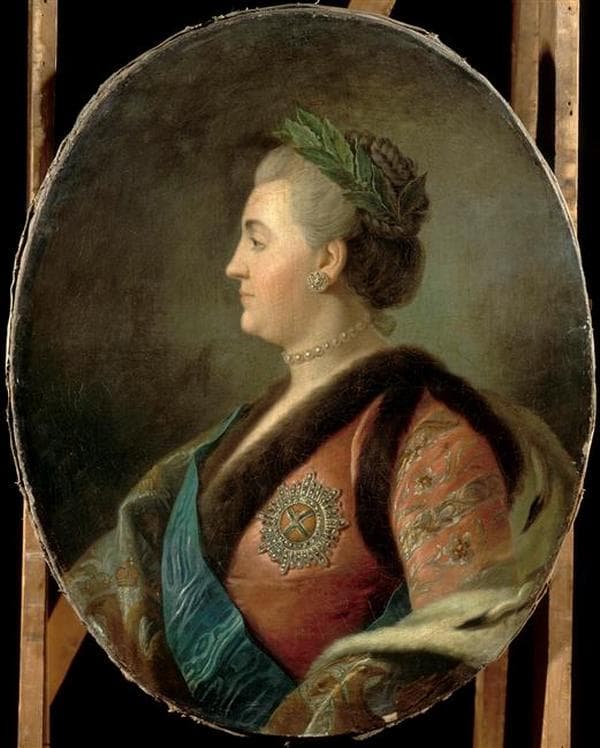
St. Petersburg, winter. In a study adjoining the Hermitage, where the Rembrandt canvases she has just acquired are piled up, the Empress of All the Russias receives us after her morning coffee, already scalding and already drunk. Past sixty, she speaks quickly, in French, with the slight accent of a German princess who conquered an empire.
—How did that day in June 1762 begin for you?
It began with fear, and ended with a crown. Peter III, my husband, was multiplying follies: he insulted the Guard, despised Orthodoxy, adored his dear King of Prussia. When I learned that one of our conspirators had been arrested, there was no more waiting. I put on the green uniform of the Imperial Guard, mounted a horse, and presented myself to the regiments. They acclaimed me. Understand: I did not seize power, it was offered to me, and I had the wisdom not to refuse it. My manifesto said it bluntly — the danger of dismemberment of the Empire obliged us to take the government in hand. A few days later, Peter abdicated. The rest, his death, remains obscure, and I prefer it that way.
I did not seize power, it was offered to me, and I had the wisdom not to refuse it.
—What do you say to those who judge you illegitimate, you, the German who became empress?
Let them look at what I have done with this land. I was born Sophie of Anhalt-Zerbst, in Stettin, in a principality so small it is forgotten on maps. At fifteen, I was brought here to produce an heir, nothing more. I learned Russian with such fury that I got up at night to recite my lessons — I caught pneumonia from it that nearly killed me. Legitimacy, you see, is not received by blood alone: it is earned through work. I wrote in my memoirs that I worked to make myself worthy of the crown I wore. The scepter that Orlov offered me, topped with its diamond, I did not inherit: I earned it, ukase after ukase.
Legitimacy is not received by blood alone: it is earned through work.
—Do you remember what drew you to the French philosophers?
I loved them even before reigning, in the icy solitude of my youth at court. When you are a neglected grand duchess, books become your only faithful courtiers. Montesquieu, Voltaire, Diderot's Encyclopédie — they were my true council of state, long before the ministers. To Voltaire I wrote without blushing that I am your most devoted schoolgirl, and I meant it. Understand: these men offered me what no boyar could give, the delightful illusion that one could govern an empire with reason. I exchanged more than six thousand letters with them. I was reproached for this intellectual coquetry. But a sovereign who does not read is but a gilded statue on a throne.
When you are a neglected grand duchess, books become your only faithful courtiers.
—Why did you bring Diderot all the way to St. Petersburg, and buy back his library?
Because one does not abandon a man of wit to poverty. Diderot wanted to sell his books to dower his daughter — I found the procedure unworthy of France and flattering for Russia. I bought his library in 1773, while leaving him the use of it until his death, and I appointed him my salaried librarian. What a charming arrangement: he kept his books, I became their owner, and all Europe learned that the money came from the North. When he came here, he discoursed with such fire that in his animation he would slap my knees black and blue! I listened to him with rapture, then did exactly what Russia required. Ideas are one thing; governing millions of serfs is another.
Ideas are one thing; governing millions of serfs is another.
—Your Nakaz proclaimed principles of humanity. What did you really hope to achieve with it?
Everything, and I obtained almost nothing. The Nakaz, my Instruction of 1767, I composed myself, five hundred and twenty-six articles drawn from Montesquieu and Beccaria. I engraved in it that liberty is the right to do whatever the laws permit — a phrase I am still proud of. I convened a great Commission of all the orders of the Empire to reform our laws. And then? The deputies quarreled, the Turkish war came, and my beautiful code remained a dead letter in a drawer. One learns, while reigning, that nations are not reformed as one rewrites a page. But the text remains, and it says what an enlightened Russia might have become if reason alone governed.
One learns, while reigning, that nations are not reformed as one rewrites a page.
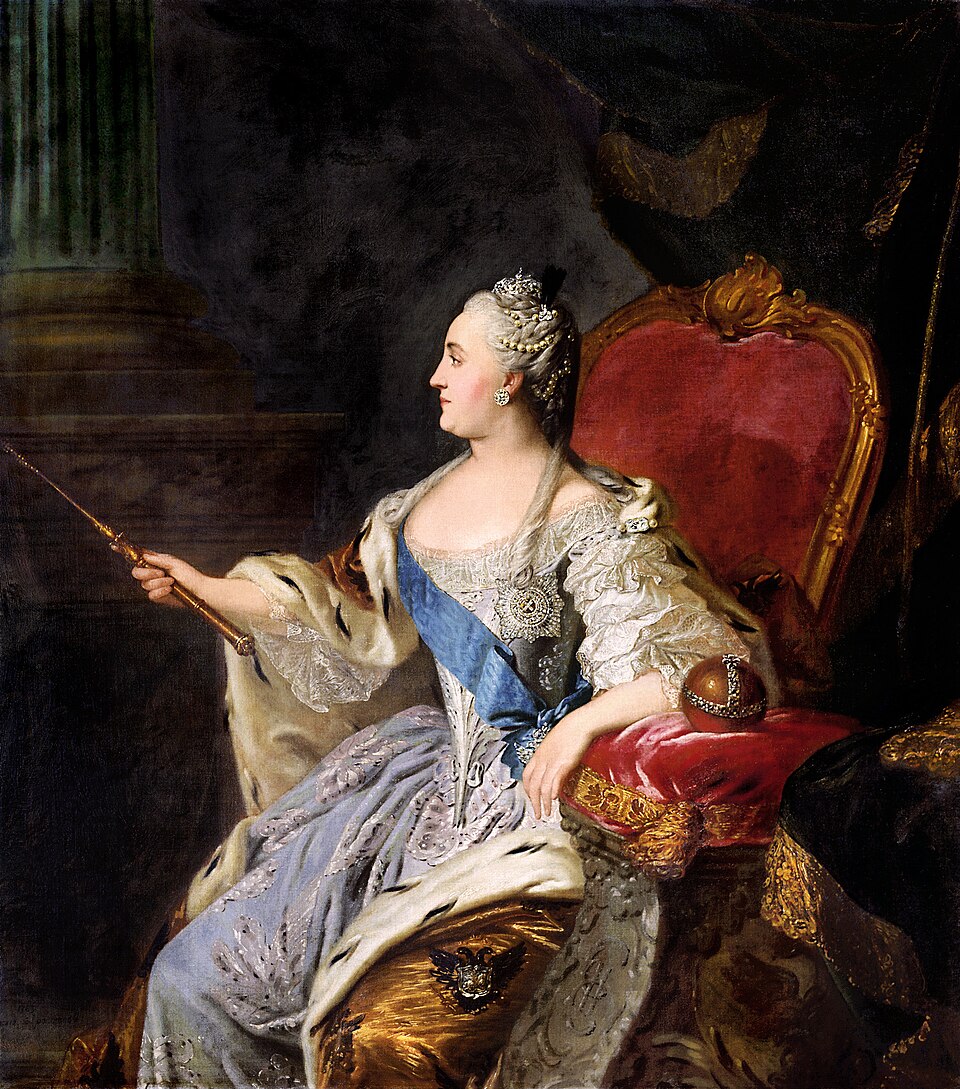
—You were called enlightened, yet serfdom hardened under your reign. How do you reconcile that?
I do not reconcile it; I endure it. That is the truth none of my philosopher friends want to hear. My title is autocrat — I govern without a constitution, without an assembly to restrain me, and this absolute power I must defend. Now it rests on the nobility. My Charter of the Nobility of 1785 confirmed all their privileges, and thus their grip on the serfs. When Pugachev's revolt set the Volga ablaze, I saw with my own eyes what becomes of an empire whose foundations crack: I crushed it without trembling. I am called an enlightened despot. I accept the epithet, but I insist on the noun: first sovereign, enlightened second, never the reverse.
First sovereign, enlightened second, never the reverse.
—In 1768, you offered your own body to Doctor Dimsdale's needle. What decided you?
Smallpox was mowing down my subjects by the thousands, and superstition forbade them the only remedy. One does not convince a people by decree in such matters — one convinces them by example. I brought from England Doctor Thomas Dimsdale, and I had myself inoculated first, in secret at first, for fear of failure, then in broad daylight. The next day, my son Paul underwent the needle in turn. If the empress herself risked her arm, what peasant could still shrink away? Dimsdale, cautious, kept saddled horses in case I died and the Guard grew furious. I did not die. And all Europe knew that in St. Petersburg, they did not merely read the Enlightenment: they got inoculated from it.
One does not convince a people by decree: one convinces them by example.
—What would you say to those who see in this gesture more political calculation than health concern?
That they are right, and that diminishes nothing. Why oppose calculation to good? A prince who does not know how to make what is useful virtuous is but a draft of a sovereign. Yes, the public inoculation served my glory as much as the health of my peoples — it told Voltaire, Vienna, Versailles, that Russia marched at the forefront of progress while France still hesitated. But look at the result: thousands of arms extended after mine, lives spared. I rise every morning at six to govern; I do not have the luxury of pure intentions. An empress who waited to have a perfectly clear heart before acting would never do anything great.
A prince who does not know how to make what is useful virtuous is but a draft of a sovereign.
—You opened to Russia the gates of the Black Sea. Why did that sea matter so much to you?
Because an empire without a warm sea is a giant being strangled. My predecessors had won the Baltic; to me fell the South. Two wars against the Turks, long and costly, gave me what I wanted: the Treaty of Küçük-Kaïnardji, in 1774, finally opened to us the Black Sea. Then, in 1783, I annexed Crimea, that peninsula I coveted as one covets a key. Four years later, I made a triumphal journey there, through provinces that Potemkin, my favorite, had taken care to deck out for my eyes. Much was mocked about those décors. But behind the pomp, there were ports, fleets, new towns — Russia was becoming a power that no one could ignore.
An empire without a warm sea is a giant being strangled.
—After thirty-four years of reign, what do you think will survive you?
The borders, first — they do not lie. I received an empire and I leave it larger, from Crimea to the lands torn from Poland in its partitions. But stones speak as much as maps. I built the Hermitage, where three thousand paintings I assembled one by one sleep, from Rembrandt to Raphael; it is there, in my apartments in the Winter Palace, that I was most myself, pen in hand, at six in the morning. If I am read in a century — and I like to believe so — let this be said: a German princess made Russia a European state, without ever forgetting that she reigned over Russians. The rest, my weaknesses, my favorites, people will gossip about; I accept it. Greatness is always paid for in gossip.
Greatness is always paid for in gossip.
Read further
This imaginary interview was generated by artificial intelligence from sources documented in Catherine II of Russia's profile. It dramatises what the figure might have said based on what we know about them, but does not constitute attested historical testimony. For primary sources and factual documentation, refer to the full profile.