Kids interview Colette
by Charactorium · Colette (1873 — 1954) · Literature · 4 min read
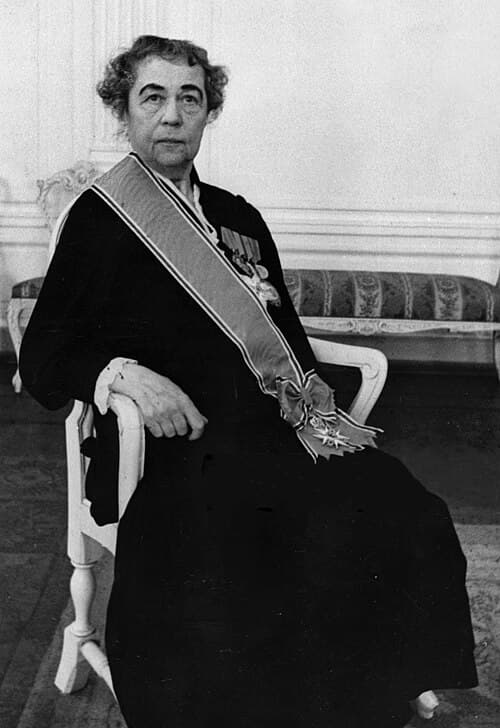
That morning, two middle-school students on a field trip push open the door of an apartment at the Palais-Royal in Paris. An old woman is waiting for them, seated on a large sofa by the window. She smiles at them and invites them to ask all their questions.
—What was your childhood like? Did you live in the countryside?
You know, my child, I was born in Saint-Sauveur-en-Puisaye, a small village in Burgundy. Imagine dirt roads, passing horses, and a big garden full of flowers and fruit. I spent my days outside, climbing trees, running, watching animals. It was a simple happiness, in touch with nature. Later, I told all those memories in a book, My Mother's House. Believe me, a happy childhood is a treasure you keep all your life, warm inside.
—What was your mother like?
My mother was named Sido, and I loved her so much that I dedicated an entire book to her, Sido, in 1930. How to describe her? She loved everything, passionately. I wrote of her: 'Sido, my mother, could not see a flower without touching it, nor a child without caressing it, nor a fruit without biting into it.' You see the type? A free woman, greedy for life. She taught me to look at a rose, to listen to a bird. Everything I know about beauty, I owe to her.
—Is it true that your husband signed your books for you?
Oh yes, it's true, and it hurt me a lot. My first husband was named Willy. When I wrote Claudine at School in 1900, it was his name that was printed on the cover! The book was a huge success, but no one knew it was me. At the time, they called it a 'ghostwriter': someone who writes in the shadows while another reaps all the glory. I was locked away to work, like a little word-worker. That teaches you something important, you see.
You have to fight so that your work bears your name.
—And after, how did you get your name back?
We had to wait until our separation in 1906 for me to finally become myself again. Can you imagine the situation? No money, no name on my books, nothing at all. So I started over from scratch, courageously. In 1910, I published The Vagabond, and this time, only one name shone on the cover: mine, Colette. What joy! It was like being reborn. Many women artists in my time wrote without ever being recognized. I was lucky to get my words back. And I never let them go again.
—Why did you dance in a cabaret? That's weird for a writer!
After my separation, I had to earn a living, my child! A woman alone, with no money... it wasn't easy in my time. So I went up on the music-hall stages, those venues where dance and mime shows were performed. I performed pantomime: it's theater without words, where you tell a whole story with your body and gestures. At the Moulin Rouge, I danced, and people came to watch me. Some were shocked that a lady would do that. But I earned my freedom, and that was worth a few disapproving looks.
—Is it true that one night there was a huge scandal because of you?
Ah, the famous night of 1907! I was performing a pantomime called Rêve d'Égypte at the Moulin Rouge. On stage, I exchanged a kiss with a friend, the Marquise de Belbeuf. Well, you can't imagine the uproar! The audience shouted, and the newspapers talked about it for weeks. In my time, a woman who surprised, who disturbed, was a huge scandal. But you know what? I never liked being told how to live. I preferred to make noise rather than hide in a corner.
I preferred to disturb rather than hide.
—How did you write? On what, at what time?
With pleasure, come closer! I had a habit all my own: I always wrote on blue paper. Always! It became my little trademark. I often worked at night, by the soft light of a lamp, in the great silence. My apartment overlooked the gardens of the Palais-Royal. Writing, for me, was not a hobby: it was a demanding profession. I crossed out, I started over, I searched for the right word for hours. A book, you see, is not magic. It's patient work, line after line, day after day.
—Did you have pain somewhere when you were old?
Alas yes, my child. In my later years, my body betrayed me. Arthritis — a disease that makes joints very painful — pinned me to my sofa. I could barely walk! So I set up a large sofa-bed by the window, and I called it my 'raft,' like a boat in the middle of the room. From there, I still wrote. I even wrote to my friend Marguerite: 'I still write, because it's the only thing I know how to do a little better every day.' Even immobile, I refused to stop.
—Did you receive important honors during your life?
Fancy that: in 1949, I became the very first woman president of the Académie Goncourt! It's a very respected society of writers that awards the best books each year. The first woman, can you imagine? Me, the little girl from Burgundy who was mocked because she dared to write. In my time, they said 'bluestocking' with contempt to put down a woman who held a pen. Well, I proved that a woman could rise to the very top. And that, you see, opens the door wide for all those who will come after me.
—And when you died, what happened?
When I died, in 1954, something extraordinary happened. The Church refused me a religious burial because I had divorced twice. But the Republic gave me a state funeral — it was the first time for a woman in France! My coffin was laid out in the courtyard of honor of the Palais-Royal, and thousands of Parisians came to say goodbye. I had lived my whole life breaking the rules. Yet in the end, an entire country rose to salute me.
I lived breaking the rules, and an entire country saluted me.
This imaginary interview was generated by artificial intelligence from sources documented in Colette's profile. It dramatises what the figure might have said based on what we know about them, but does not constitute attested historical testimony. For primary sources and factual documentation, refer to the full profile.