Imaginary interview with Cúchulainn
by Charactorium · Cúchulainn · Mythology · 6 min read
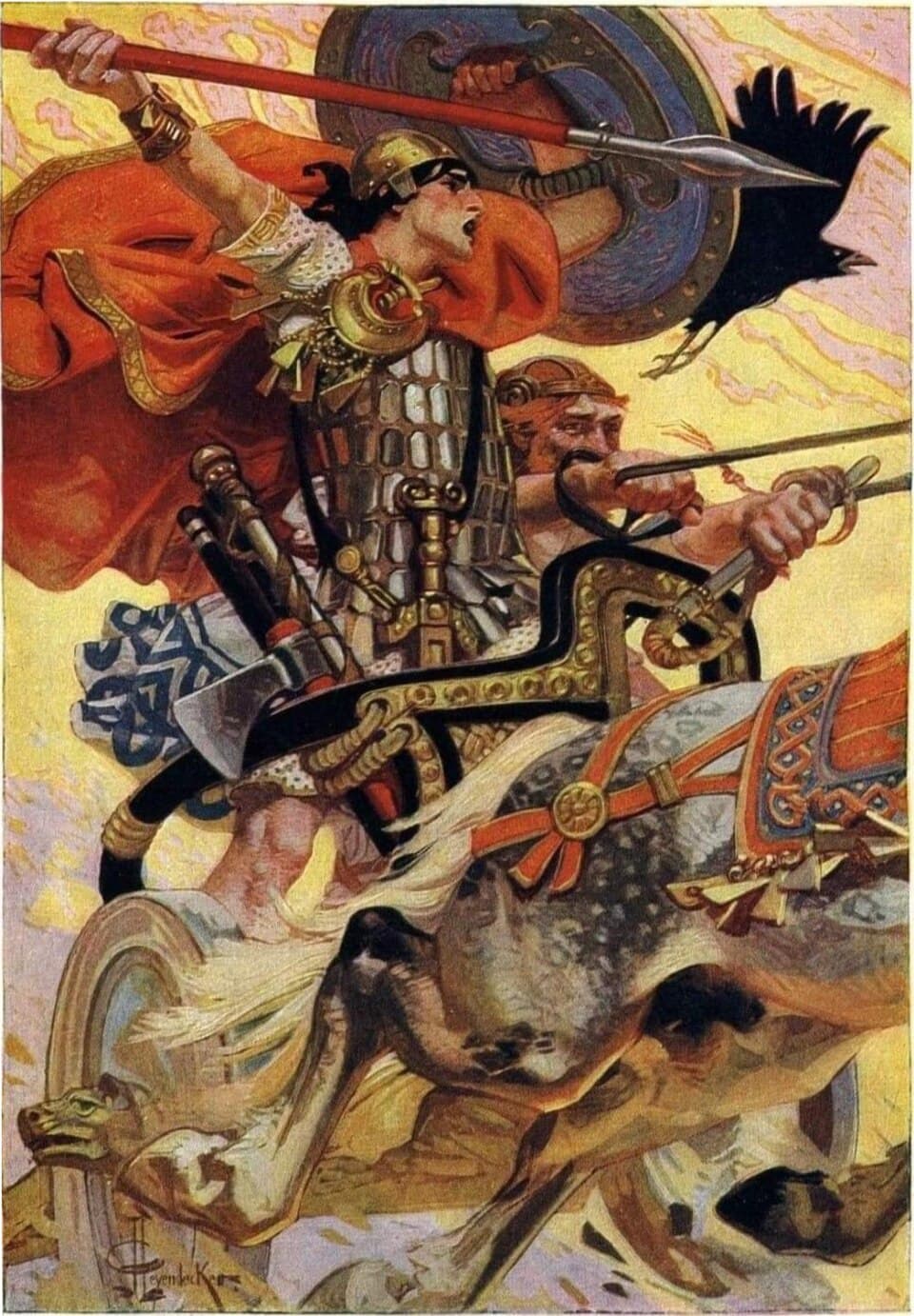
At the edge of the plain of Muirthemne, where chariots leave their ruts in the frozen mud, a young warrior with flaming hair sharpens his blade near a ford. He says his name is Cúchulainn, champion of Ulster. He has agreed to lay down his arms for an interview — but his eyes never leave the horizon where the army of Connacht may appear.
—How did you end up alone defending an entire kingdom against Queen Medb's army?
When Medb of Connacht crossed our borders to steal the bull of Cooley, the men of Ulster lay stricken with a languor, unable to lift a shield. I alone remained standing. So I took my post at the ford and imposed my law: one single combat per day. As long as a champion stepped forward, the whole army had to wait. That is how one man can hold back a tide — not by mass, but by the honor of the duel, which no Celtic warrior dares refuse. Day after day, I emptied Medb's ranks, one opponent at a time, the water of the ford reddening at my feet. Such is the heart of the Táin Bó Cúailnge: not a battle, but a long patience of blades.
One man can hold back a tide — not by mass, but by the honor of the duel.
—Why do you place such importance on this ritual of single combat rather than on pitched battle?
Because the melee is blind, and death there is anonymous. At the ford, I look my adversary in the eyes, I know his name, his lineage, his deeds before he falls. That is the warrior's law: you do not kill a man like you slaughter a beast. Medb may line up the peoples of Connacht and their allies, but she must send her champions one by one, and each knows as he advances that he walks toward me. This rule I dictated, and the army submitted because the shame of breaking it is worse than death. That is why the defense of Ulster rests on a word of honor more than on the strength of my arm.
—They say that in the fury of battle, your very body transforms. What happens to you at that moment?
It is called the riastrad, the warp-spasm. When rage takes me, my body turns inside its own skin: my muscles knot, one eye sinks and the other bulges, a burning halo rises from my skull. I am no longer a man one recognizes, but a thing that even my comrades from Emain Macha fear to approach until the fire leaves me. It is not madness: it is the power that overflows from me when the enemy is too numerous. The wise say that warriors of old would enter such a trance before carnage. For me, it is the moment when the champion gives way to something more ancient, and more terrible.
I am no longer a man one recognizes, but a thing that even my comrades fear to approach.
—Does this transformation frighten you as much as it frightens those around you?
After the riastrad, I must be brought back to reason like calming a runaway horse. They plunge me into vats of cold water to quench the fire of my body — the first boils, the second steams, and only the third holds. As long as the warp-spasm possesses me, I cannot tell friend from foe; that is what weighs on me. A champion of Ulster must be able to release his fury without striking his own king. Superhuman strength is a gift, but a gift that only half belongs to me: it comes from elsewhere, and it leaves without asking my leave. That is the price of the warrior that tradition has made me.
—You left young to learn combat in distant lands. What did the warrior woman Scáthach teach you?
I crossed the sea to Scotland, to the fortress of Scáthach, mistress of martial arts that no man could equal. She taught me the leaps, the salmon leaps over ramparts, the handling of weapons that no one else could tame. From her I have the gae bolg, and the secrets that make me the champion I am. But the most precious thing I gained with her was not a technique: it was a brother-in-arms, Fer Diad, who learned at my side. We slept under the same roof, we fought shoulder to shoulder. No master warned us that this friendship would one day become our curse.
—Speaking of that, how could you raise your weapon against Fer Diad, your dearest companion?
Medb knew: to break me, she had to pit me against the one I loved. She covered Fer Diad with gifts and threats until he agreed to come to the ford against me. We fought for three days. Each evening, we exchanged our food and remedies across the water, like the brothers we were at Scáthach's. And each morning, we had to begin again. When at last I struck him with the blow that only our mistress had taught me, I carried him out of the ford in my arms so that he would not fall on the enemy's side. The heaviest victory is not the one that costs the most blood, but the one that costs a brother.
The heaviest victory is not the one that costs the most blood, but the one that costs a brother.
—Tell us about your weapons. They say your spear has a power that no other equals.
My spear does not strike like others. When it enters the enemy's flesh, it opens inside into a thousand barbed points, so that it cannot be pulled out without tearing the whole body. It is the weapon that Scáthach entrusted to me, and no one survives its wound. At my belt, I also carry my sword, whose blade never chips and cuts through iron like wood. These weapons are not mere tools: they are part of me like the arm that holds them. A champion is recognized by what he carries as much as by what he accomplishes, and at the ford, it is my spear that has written half my legend.
—Beyond weapons, what does the gold torque you wear around your neck mean?
The torque is not a vanity jewel. It is the champion's insignia, the sign that the men of Ulster have recognized me as the first among their warriors. When I advance, crown on my brow and gold chains entwined around my neck, the enemy knows who he faces before I even open my mouth. Among us, gold is worn like a word: it speaks of rank, honor, accumulated deeds. It is not received; it is earned through single combats. And whoever wears it without having won it by the edge of his blade will soon give it back, with his head. My gold, I have paid for with the blood spilled at the ford.
Among us, gold is worn like a word: it speaks of rank, honor, accumulated deeds.
—People often speak of the sacred prohibitions that weigh on you, the geasa. What weight do they have in your life?
Every champion bears his geasa, those prohibitions he cannot transgress without inviting misfortune. Mine are woven from contradictions, for fate is cunning: I am forbidden to refuse an offered meal, and also forbidden to eat the flesh of the dog whose name I bear. A day will come when both traps are laid before me at once, and whatever I choose, I will have broken a geis. Thus goes the hero's fate: it is not the enemy's weapons that kill him first, but the invisible thread of prohibitions. I know it, and I advance anyway. To renounce honoring one geis for fear of another would already be to cease being Cúchulainn.
—You bear the name of Culann's Hound, and you are said to be linked to the god Lugh. What does this divine kinship represent?
I am said to be the son of Lugh, the god of the long arm, master of arts and light. In my worst battles, when exhaustion overwhelms me, tradition says he descends to watch over me and tend my wounds while I sleep. This kinship is not a pride: it is a burden. To be the child of a god is to have to die like a god, standing, without bending. I already know how it will end: when my hour comes, I will tie myself to a standing stone to give my last breath with my face turned toward the enemy, so that no one can say Cúchulainn fell. A raven will perch on my shoulder, and only then will they dare approach me.
To be the child of a god is to have to die like a god, standing, without bending.
—When you look back on all those days spent at the ford, what allowed you to hold out alone for so long?
What kept me standing was not my strength alone, but the idea that behind me slept all of Ulster defenseless. Every champion of Medb I sent to nothingness was one more day gained for my people, time for the men to rise from their languor. At night, my charioteer washed my wounds and I barely slept, my ear tuned to the ford. One wonders where a man finds such endurance: I found it in the shame I would not have survived my own flight. The glory of a champion is measured not by what he gains, but by what he refuses to abandon.
This imaginary interview was generated by artificial intelligence from sources documented in Cúchulainn's profile. It dramatises what the figure might have said based on what we know about them, but does not constitute attested historical testimony. For primary sources and factual documentation, refer to the full profile.