Imaginary dialogue between Fer Diad and Cúchulainn
by Charactorium · Cúchulainn · Mythology · 6 min read
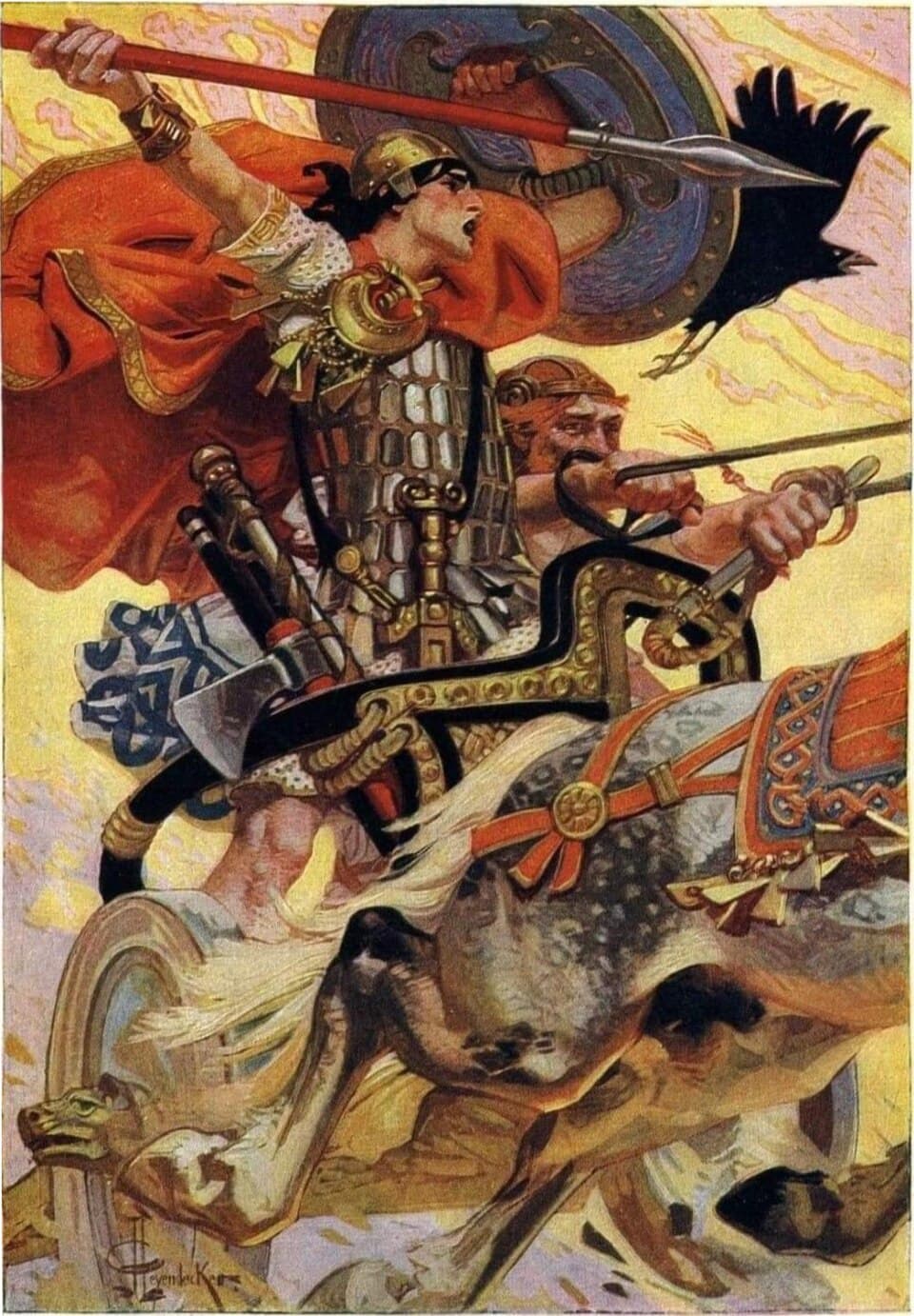
It is at the river ford, on the marches of Ulster, that Fer Diad joins Cúchulainn one evening of the invasion, before the armies of Medb decide their duel. Mist rises from the water, the chariot horses trample the mud, and the smell of dried blood still hangs over the weapons. They have known each other since Scotland, where they trained together under Scáthach, sharing the same bed and the same shield. Fer Diad comes to speak one last time as a brother, before honor separates them.
—My brother, you alone hold this ford against all of Medb's army. Why did you accept these one-on-one duels, rather than flee north?
You who bore arms at my side, Fer Diad, you know I could do no other. The men of Ulster sleep, struck by their weakness, and I stand alone before the Táin Bó Cúailnge. I demanded single combat because it is the warrior's law: one man against one man, at the ford, where none can cheat. Each day I cut down a champion, each night I dress my wounds in the cold water. Medb wears me down, but I hold her entire army at this pass in Cooley. As long as I hold the ford, Muirthemne breathes. I would rather die here than let it be said that a single enemy step trod my land without paying.
As long as I hold the ford, Muirthemne breathes.
—Do you remember Scáthach, in Scotland, when we slept under the same cloak? Today Medb sends me against you. Why would you force me to raise my weapon?
How could I forget, Fer Diad? We learned the same secret moves, the same salmon leap, the same shield guard. Scáthach forged us together like two blades from a single smithy. It is not I who forces you: it is Medb, with her promises of land and the shame she poured into your ear. I did not ask for this duel; I dread it more than all the others. When you come to the ford, I will see the companion in your eyes, not the enemy. But if you advance, I must answer, for my honor knows no exception, even for one I have loved as a brother.
Scáthach forged us together like two blades from a single smithy.
—I have seen you change in battle, friend. Your body twists, your face becomes a fearsome thing. What happens to you in those moments?
It is the ríastrad, Fer Diad, the distortion that takes me when fury rises. You have seen it from afar and feared it, and you were right. My body turns inside its skin, one eye sinks into my skull and the other bulges like a cauldron, a column of black blood shoots from my head. I am no longer quite a man in those moments: I become the weapon that battle demands. The ancients say Celtic warriors know this frenzy, and the Romans themselves speak of it with dread. But I tell you as a close one: this rage does not exalt me, it consumes me. Afterwards, I tremble, and I fear I will not recognize my own.
I am no longer quite a man: I become the weapon that battle demands.
—Everyone speaks of your weapons, brother. That spear that opens in the flesh, it is feared even in Medb's camp. Will you tell me its secret?
You already know half of my weapons, Fer Diad, for having trained against them. My spear, the gáe bolga, I throw from my toe along the water's edge: it enters through a single wound then opens into thirty barbs inside the body, and none survive it. My sword, Caladcholg, bites iron as it does wood. But it is not the weapon that makes the champion; it is the hand and the charioteer who holds the chariot. I fight standing on my war chariot, adorned with my gold chains and my crown, not out of vanity, but because a champion must be seen. These weapons serve me; they do not save me. Before you, I fear, even the gáe bolga will feel heavy in my hand.
It is not the weapon that makes the champion; it is the hand and the charioteer who holds the chariot.
—You bear taboos, I know, those geasa the druids laid on you. Do you not fear they will eventually undo you?
My geasa are the thread on which I walk, Fer Diad. I am forbidden to refuse a feast offered, also forbidden to eat the flesh of the dog whose name I bear. The druids bound them to me at my birth, and Lugh, who watches over me like a father, knows one does not transgress them without paying. As long as I respect them, my strength holds. But I feel the taboos crossing; a day will come when honoring one will force me to break another. That day, neither my chariot nor my weapons will protect me. The Túatha Dé Danann do not save a man from his fate; they seal it. I walk toward my end with open eyes, and that is how a warrior must advance.
The Túatha Dé Danann do not save a man from his fate; they seal it.
—Each morning you stand alone at the ford, wounded from the day before. Where do you find the strength to begin again, with no army behind you?
From the land itself, Fer Diad, and from the duty entrusted to me. I am the watch-dog of Ulster, and a dog does not leave the threshold because it bleeds. In the morning I go down into the cold river water, let the current carry away the fatigue, and climb back up the bank ready to hold again. My charioteer reminds me of the names of those I protect, at Emain Macha, in the forts and fields. As long as King Conchobar and his men lie powerless, I am the only wall between them and Medb's spear. Solitude does not weigh on me as much as the thought of a single child of Ulster taken into slavery. That is what lifts me when my legs no longer want to.
I am the watch-dog of Ulster, and a dog does not leave the threshold because it bleeds.
—If tomorrow you fall under my spear, or I under yours, what will remain of what we were at Scáthach's?
The truth will remain, Fer Diad: that we loved each other until the final blow. I will not hate you when I strike you, and I know you will not hate me. That is all the cruelty of Medb: she does not pit us as enemies, she tears two brothers apart for her cattle. If you fall, I will carry your body from the ford in my own arms, and I will mourn you longer than any other. If I fall, I know you will do the same. Our friendship will not die in this duel; it is our honor that demands the fight, not our hearts. And that is why this ford will be the bitterest of all the Táin.
Medb does not pit us as enemies, she tears two brothers apart for her cattle.
—When the ríastrad takes you, do you fear striking me without recognizing me? I who have slept near you, I dread it for us both.
That is my greatest fear too, Fer Diad, and you are right to name it. In the distortion, I no longer distinguish friend from foe: there is only the heat of blood and the shape that stands before me. That is why I dread this duel more than any other. I asked that my weapons be held back the first days, that I be allowed to face you openly as long as I can, before the fury rises. But if you press me too hard, if the wound awakens the beast, I no longer answer for my hand. Promise me, as a brother, to keep yourself from my red eye. For it would not be I who kills you; it would be the ríastrad, and I would never forgive myself.
It would not be I who kills you; it would be the ríastrad.
—Before combat, you don gold and a crown. Is it to frighten the enemy, or for something else I do not understand?
You know me better than that, Fer Diad. When I take up arms, I gird the gold crown on my head and the four gold chains around my neck, not for the fear it inspires, but because a champion must honor the fight. He who may die presents himself adorned, as one presents oneself at a sacred feast. The torque at my neck declares my rank, my sword declares my hand, but the gold declares that I hold my life precious enough to wager it worthily. When you come to the ford, you will see me thus, and I want you to know it is out of respect for you as much as for myself. One does not offer a mediocre fight to a comrade-in-arms. I will adorn myself as for the greatest of duels, for that is what you are.
He who may die presents himself adorned, as one presents oneself at a sacred feast.
—They say you will die standing, tied to a stone. You who walk toward that fate, how do you want your end to be remembered?
I do not know the hour, Fer Diad, but I know the shape I want to give my death. Let me never be seen falling to the ground before my enemies. If my wounds must bring me down, I will tie myself to a standing stone, my sword Caladcholg in hand, to die standing, facing the fight, as a warrior should. Let my enemies not dare approach as long as they believe I still breathe. My geasa will have undone me, Lugh will have taken me back, but none shall say the hound of Ulster bent the knee. That is all I ask: not to be spared, but to stand upright until the end. Remember me thus, brother, if you survive me: standing at the edge of the ford, faithful to the last breath.
None shall say the hound of Ulster bent the knee.
This imaginary interview was generated by artificial intelligence from sources documented in Cúchulainn's profile. It dramatises what the figure might have said based on what we know about them, but does not constitute attested historical testimony. For primary sources and factual documentation, refer to the full profile.