Kids interview Cúchulainn
by Charactorium · Cúchulainn · Mythology · 5 min read
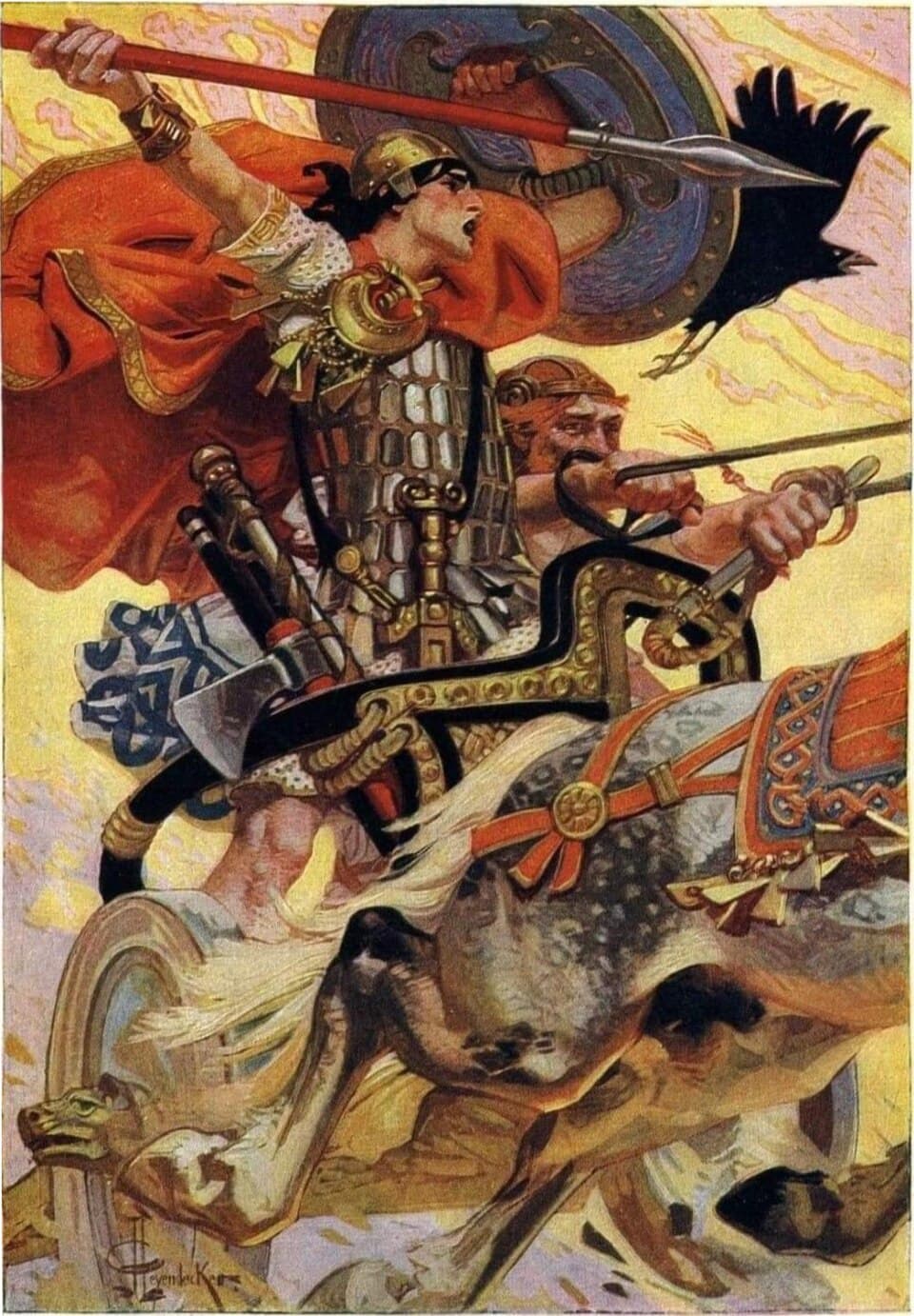
That morning, two middle school students on a field trip push open the door of a great Celtic feast hall. A small but radiant warrior awaits them, his flaming hair above a golden torque. He smiles and invites them to sit by the fire and listen to his stories.
—What was it like to find yourself alone against an entire army?
You know, my child, it was at Cooley, near a ford — a shallow place where you cross the river on foot. Queen Medb had brought her whole army to steal our great bull. And the men of Ulster were asleep under a curse. So who was left? Me. Imagine yourself alone before a crowd that wants to pass, and you say: no, not today. I proposed a rule: send me one warrior at a time, in single combat. Duel after duel. That's how I held back an army, one man against a thousand.
A single man at the ford can hold back a thousand swords, if he refuses to retreat.
—Weren't you afraid, all alone like that for days?
Of course I was. Fear is normal, never believe otherwise. I was exhausted, covered in wounds, and no one came to help me. This great adventure is called the Táin Bó Cúailnge, which means "the cattle raid of Cooley" — all this war for a herd! But I was defending Muirthemne, my land, my people. Imagine your home threatened and you are the only one standing. You would find a strength you didn't know you had. That's what it means to defend your people: you hold because you must, not because you are fearless.
Courage is not the absence of fear; it is standing firm with it.
—They say your body changed during battles. Was that true?
Yes, my child. It's called the riastrad, my battle transformation. When the rage of battle took me, my body twisted entirely, my muscles swelled, and I became terrible to behold. Imagine the water of a calm river suddenly turning into a furious torrent: that's what happened inside my body. This fury gave me a strength beyond that of men. You know, long after, Greek travelers like Diodorus Siculus told how Celtic warriors entered trances in battle. My riastrad is that battle flame, told as only storytellers know how.
When the river of my blood became a torrent, no army could stop me.
—Did it hurt to transform like that?
It was violent, yes. Imagine a storm passing through you: afterwards, you are drained, trembling. The riastrad made me invincible, but it was not gentle. The hardest part, you see, was returning afterwards among my people, calm, like an ordinary boy sitting down to feast. For this fury recognized neither friend nor foe: it only wanted to fight. The men of Ulster had to help me calm down after battle. A superhuman strength is both a gift and a burden. You carry it; you don't really choose it.
A strength too great is a gift you carry like a burden.
—How did you learn to fight so well in the beginning?
For that, my child, I had to travel far from home. I crossed the sea to Scotland, to an extraordinary woman: Scáthach, a warrior mistress of all the arts of combat. Imagine a school without walls, in harsh mountains, where you learn to jump, to leap, to wield the spear from morning to night. She taught me everything. And there, I met another young student, Fer Diad. We learned side by side, we laughed together. He became like a brother to me. You never know, child, what the future will make of our friendships.
Far from home, with Scáthach, I found my best friend.
—And did you really have to fight your friend Fer Diad?
Yes, and it is the greatest wound of my life. Fer Diad had joined Queen Medb's army, and they sent him against me at the ford. Imagine having to raise your weapon against the one you grew up and trained with. We fought for several days. At night, they say we still exchanged food and care across the river, like two brothers. Then, in the morning, we had to start again. In the end, I defeated him, and I wept over his body. Winning that fight gave me no joy, only sorrow.
I won the duel and lost my brother: there is no victory in that.
—Did you have special weapons? Did they have names?
Yes! A warrior loves his weapons like companions. My sword was called Caladcholg, with a blade said to be unbreakable. And I had a fearsome spear, the Brionglaid: they said it shattered into barbs inside the enemy. Imagine a weapon spoken of only in whispers, so terrifying is it. I also fought standing on my war chariot, a light two-wheeled vehicle pulled by horses, with my charioteer at my side. All this, you see, was not just for killing: it was the sign of my rank as champion.
A warrior names his weapons like friends: he entrusts them with his life.
—Why do you always talk about honor? Was it that important?
Ah, honor, my child, was everything to us. More precious than gold. At the feast called Fled Bricrenn, "Bricriu's Feast," the heroes of Ulster argued over who was the best. And it was I who was recognized as supreme champion. But honor was not about boasting. It was about respecting the rules of combat, never striking a fallen man, keeping your word even when it is hard. You see this gold torque around my neck? It shows my rank, but my conduct shows my worth. You can lose your possessions; your honor, you keep or lose forever.
You can take my gold, but never my honor: I guard it myself.
—What is a geis? I heard it brought you misfortune.
Good question, my child. A geis is a magical taboo, a sacred rule attached to a warrior. For me, for example, it was never to eat dog meat, because my name means "the Hound of Culann." Imagine a promise so strong that breaking it brings you misfortune, even death. But here is the terrible trap: sometimes two geasa contradict each other, and whatever you do, you break one. That's what happened to me in the end. They set a trap for me with my own taboos. It wasn't my enemies who first defeated me: it was my sacred rules.
It wasn't swords that got me, but my own oaths turned against me.
—Is it true you died standing, tied to a stone?
Yes, and that is how they like to remember me. Mortally wounded, I did not want to fall. So I tied myself to a great standing stone, to die upright, facing my enemies. They say my foes dared not approach until a raven landed on my shoulder: only then did they know the breath had left me. Near Dundalgan, they still show the place of my memory. You see, child, a hero rarely chooses when he dies. But he can choose how. I wanted to remain standing until my last breath.
You don't choose the hour of your death, but you can choose to die standing.
—How does it feel that people still talk about you centuries later?
It touches me more than you think. You know, in my lifetime, I could neither read nor write — our stories passed by word of mouth, in the evening, around the fire. It was storytellers, and much later monks, who preserved my deeds in great tales like the Táin Bó Cúailnge. Imagine your voice carried by others, again and again, to children you will never see. That two young people like you come to listen to me today, that is my true victory. A warrior always falls eventually. But a well-told story never dies.
A warrior always falls someday; a well-told story never dies.
This imaginary interview was generated by artificial intelligence from sources documented in Cúchulainn's profile. It dramatises what the figure might have said based on what we know about them, but does not constitute attested historical testimony. For primary sources and factual documentation, refer to the full profile.