Imaginary interview with David Hume
by Charactorium · David Hume (1711 — 1776) · Philosophy · 6 min read
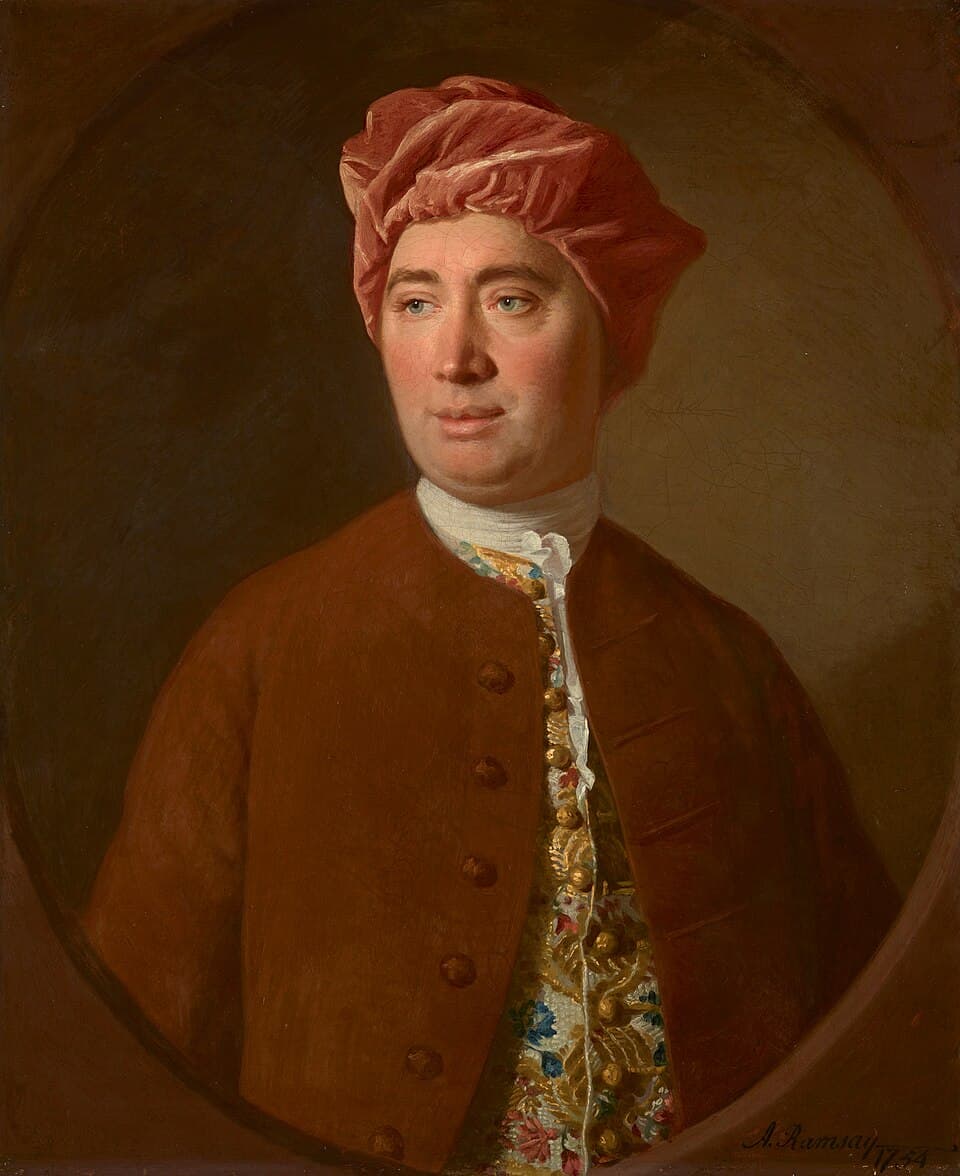
Edinburgh, an evening in 1776. In a brand-new house in the New Town, at the corner of the street that will soon bear his name, a jovial fat man welcomes us in his shirtsleeves, a glass of Bordeaux in hand. Gout afflicts him, but his mind remains as sharp as a blade: this is David Hume, whom Scotland did not want as a professor and whom all of Europe reads.
—How do you remember the reception of your very first book?
At twenty-three, I retired near La Flèche, in the quiet of the French countryside, a stone's throw from the Jesuit college where Descartes had worn out his breeches. It was there that I composed my Treatise of Human Nature. I expected a stir; there was only polite silence. The work fell from the press without any devotee deigning even to be outraged, which, for a young author, is the ultimate humiliation. I had nonetheless wanted to introduce the experimental method into the study of the mind, to treat understanding, passions, and morals as a naturalist treats his plants. Edinburgh shrugged. It took me thirty years for this unloved child to finally be regarded as my best work. The lesson? A philosopher must learn patience before metaphysics.
A philosopher must learn patience before metaphysics.
—What do you reply to those who accuse you of wanting to throw books into the fire?
I am credited with pyres that I do not light! In my An Enquiry Concerning Human Understanding, in 1748, I simply proposed a test. Take in hand a volume of scholastic theology or metaphysics and ask it: "Does it contain any abstract reasoning concerning quantity or number? No. Does it contain any experimental reasoning concerning matters of fact? No. Then commit it to the flames, for it contains nothing but sophistry and illusion." That is my entire crime. I do not condemn the curiosity of the mind; I dismiss the verbiage that parades under the fine name of knowledge. What cannot be measured or tested by experience is nothing but a smoke that men too often take for a flame.
A smoke that men too often take for a flame.
—Why do you maintain that causality is merely a habit of the mind?
Watch two billiard balls roll on the cloth of an Edinburgh tavern. One strikes another, and the second immediately moves. You say: the first impact caused this motion. But what did you actually see? A collision, then a displacement — never that secret link, that necessity that your mind imagines between them. Yet all our knowledge arises from what I call impressions, those vivid and immediate perceptions of which our ideas are only the faint copies. And no impression ever delivers causality itself to us. What we call cause and effect is therefore only the work of custom: having seen the impact followed by motion a hundred times, the mind glides mechanically from one to the other, and baptizes its own habituation as a "law of nature."
—What would you say about the reception you received in Parisian salons?
In 1763, Lord Hertford took me to Paris as embassy secretary, and there I experienced the strangest reversal of fortune. The country that passes for the most polite in Europe began to celebrate a heavy Scotsman whom his own compatriots regarded as an infidel. The ladies competed for my company in the salons; I supped with Diderot, I chatted with d'Alembert and all those gentlemen of the Encyclopédie. Imagine a man accustomed to claret and the rough conversations of taverns, suddenly paraded from boudoir to boudoir like a cabinet curiosity. I found it highly amusing, I admit without shame. But I never let this favor go to my head: I have always known that worldly glory is the most fragile of all impressions.
—Do you remember the moment your friendship with Rousseau turned to disaster?
Ah, the unfortunate Rousseau! In 1766, I took him in in England to shelter him from those who persecuted him on the continent. I obtained protection, lodging, even a king's pension for him. And how was I repaid for my troubles? That brilliant but tormented mind, seeing conspiracies everywhere, persuaded himself that I was the very head of the cabal hatched against him. He accused me publicly, by letter, of having lured him to England only to dishonor him. The scandal resounded throughout learned Europe, and I was pressed to reply. I admit that my philosophical tranquility was shaken for a time: one bears the blows of a declared enemy better than the ingratitude of a man one tried to save. I consider this affair the bitterest sorrow of my life.
One bears the blows of an enemy better than the ingratitude of a man one tried to save.
—Why did the man regarded as a great philosopher never obtain a chair?
A great philosopher? That is a title I leave to posterity, if it will lend it to me. The truth, more prosaic, is that in 1745 the chair of moral philosophy at Edinburgh was refused me, and likewise that of Glasgow later. The grievance? My ideas smelled of sulfur; I was judged irreligious, dangerous for studious youth. The country that saw me born never wanted to entrust its students to me. I consoled myself by becoming, in 1752, librarian of the Faculty of Advocates — a modest employment, but one that opened one of the finest collections in Scotland. It was in that sea of volumes that I was finally able to write my History of England. The devout had closed the chair to me; they had, without meaning to, opened a library.
The devout had closed the chair to me; they had, without meaning to, opened a library.
—You were nicknamed "Big David" — did you wear that sobriquet gladly?
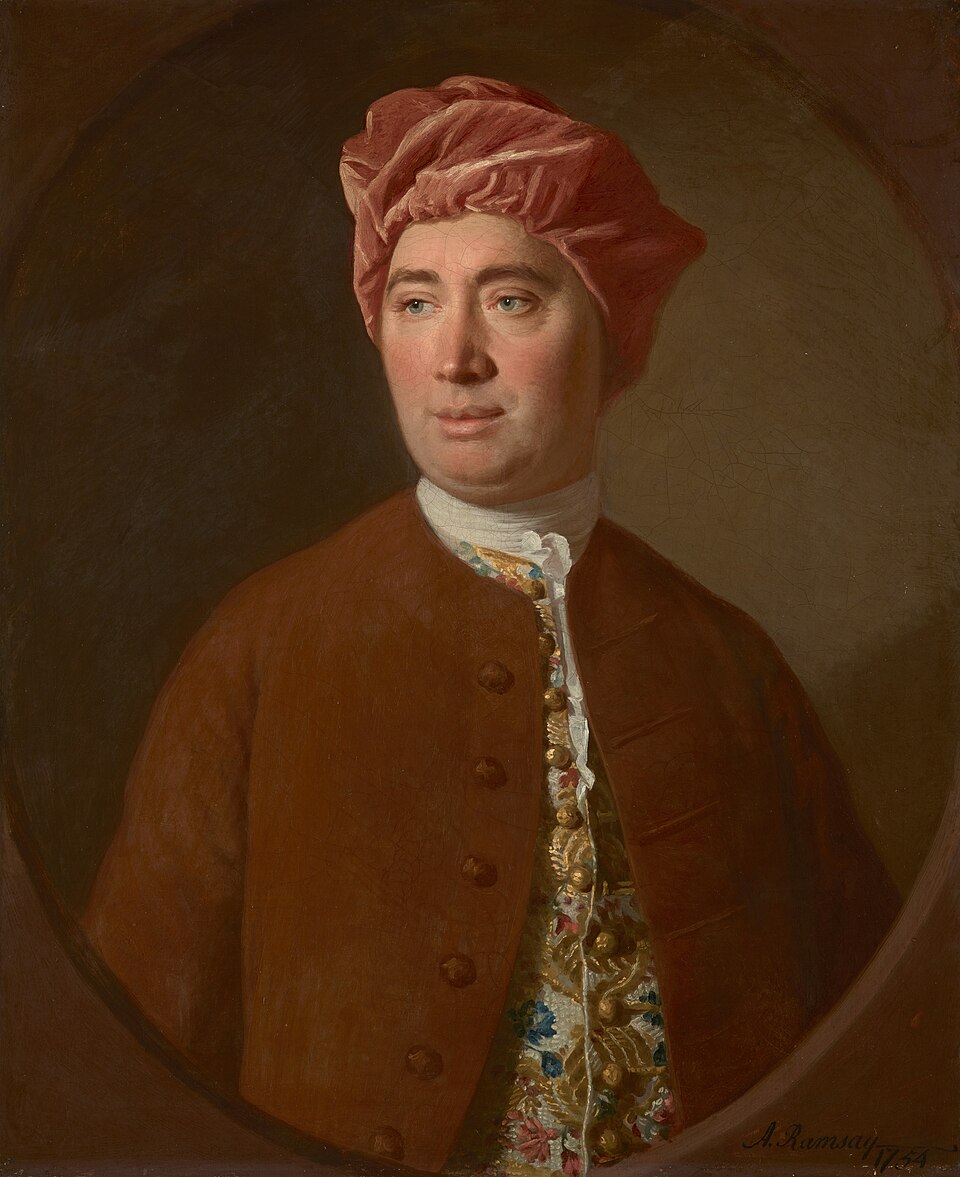
Very gladly! A French countess christened me "Big David," and I never thought to protest such a just observation. Nature made me skeptical of mind but generous of body, and I have always held that a philosophy that quarrels with the belly is a philosophy that lies. People readily believe me buried in my abstractions; yet I am a fairly good cook, and I esteem my skills at the stove as respectable as my pen. In Edinburgh, I receive my friends — Adam Smith, Ferguson, Robertson — and I cook supper for them myself, for no one, believe me, thinks well on a poorly served table. A corpulent and jovial philosopher will always do less harm in the world than an austere one who fasts out of virtue.
A philosophy that quarrels with the belly is a philosophy that lies.
—How did those famous suppers with the minds of the Scottish Enlightenment unfold?
When evening comes, when calm falls over the Old Town, that is the hour I prefer above all. Candles are lit, the claret is uncorked — that Bordeaux wine that the old Franco-Scottish alliance still brings to our tables — and conversation rises. We remake history, we dispute morals and commerce; Adam Smith unfolds before us his ideas on the wealth of nations long before putting them to paper. Edinburgh has become, I say without false modesty, a little Athens of the North, where one meets a man of wit on every close corner. I hold these prolonged suppers to be the true laboratory of philosophy: not the cold solitude of the study, but the lively and joyful commerce of minds around a good glass of wine.
—As death approached, they say you joked with Charon — where does this calm come from?
Calm? Let us rather say cheerfulness. I do not see why one must leave the table of life groaning. When I think of the crossing, I readily imagine my conversation with Charon, the ferryman of the underworld. I would ask him for a small delay: let me, good ferryman, see yet a few more of those superstitions that afflict the world fall. But the grumpy fellow would no doubt reply that I would not see the end of them for centuries, and that I must get into the boat. My friend Adam Smith is astonished that I spend my last days thus. The truth is that a man who has founded his life neither on the terrors nor on the consolations of religion has no reason to tremble when experience, his only mistress, finally comes to an end.
Let me, good ferryman, see yet a few more of those superstitions that afflict the world fall.
—Did this serenity without religious consolation not scandalize your contemporaries?
Deeply, and I knew it in advance. That is why my Dialogues Concerning Natural Religion, in which I coldly examine the arguments for the existence of God, will only appear after my death — I left express orders to that effect. One forgives a dead man what one would lynch in a living one. That a man can pass away peacefully without throwing himself into the arms of a priest — that is what terrifies my good compatriots; they see it as a scandal, almost a challenge thrown at Heaven. For me, the entire universe remains a curtain of mystery that no system, no hypothesis can tear, and I do not have the folly to pretend to read what my so limited faculties cannot grasp. To die a serene skeptic is still the most honest way to admit one's ignorance.
To die a serene skeptic is still the most honest way to admit one's ignorance.
Read further

This imaginary interview was generated by artificial intelligence from sources documented in David Hume's profile. It dramatises what the figure might have said based on what we know about them, but does not constitute attested historical testimony. For primary sources and factual documentation, refer to the full profile.