Kids interview David Hume
by Charactorium · David Hume (1711 — 1776) · Philosophy · 6 min read
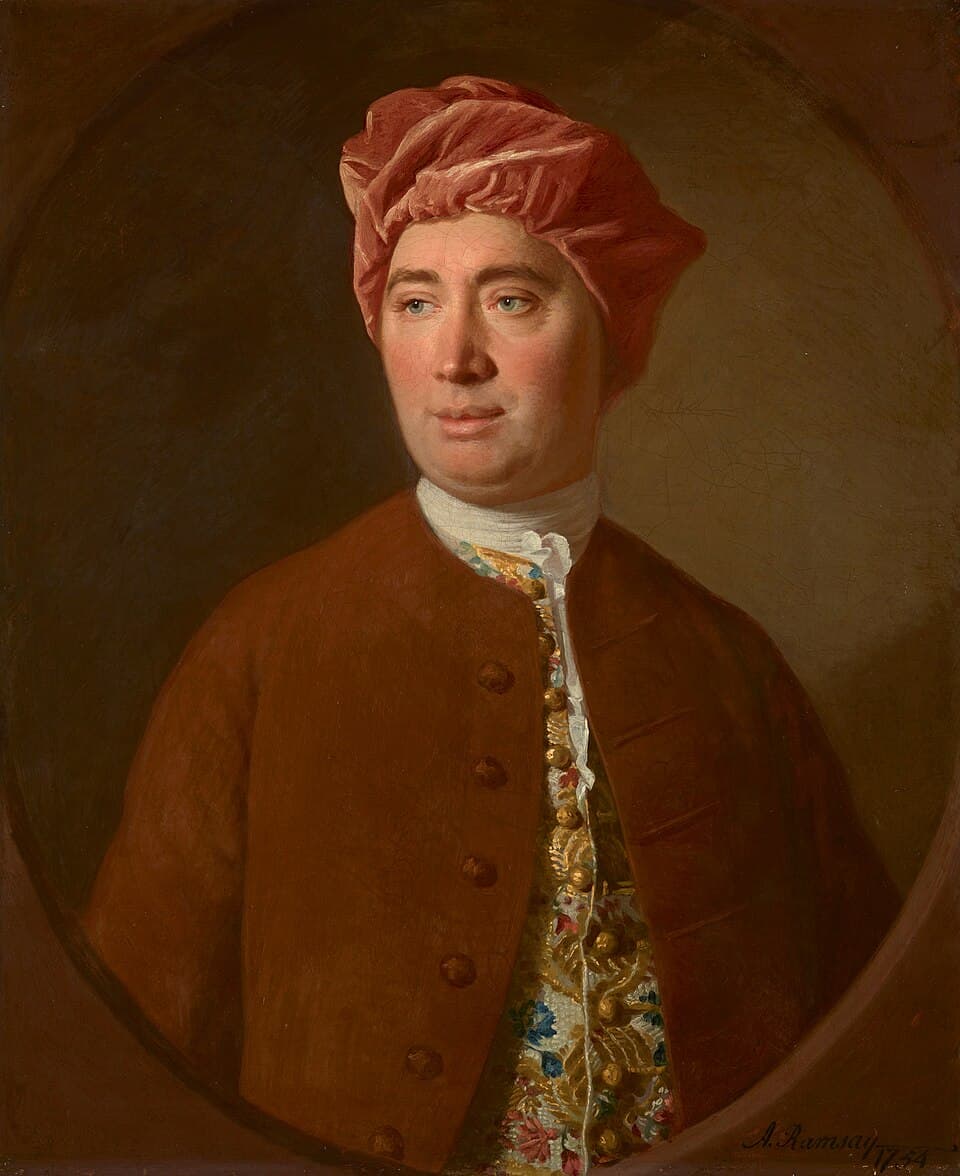
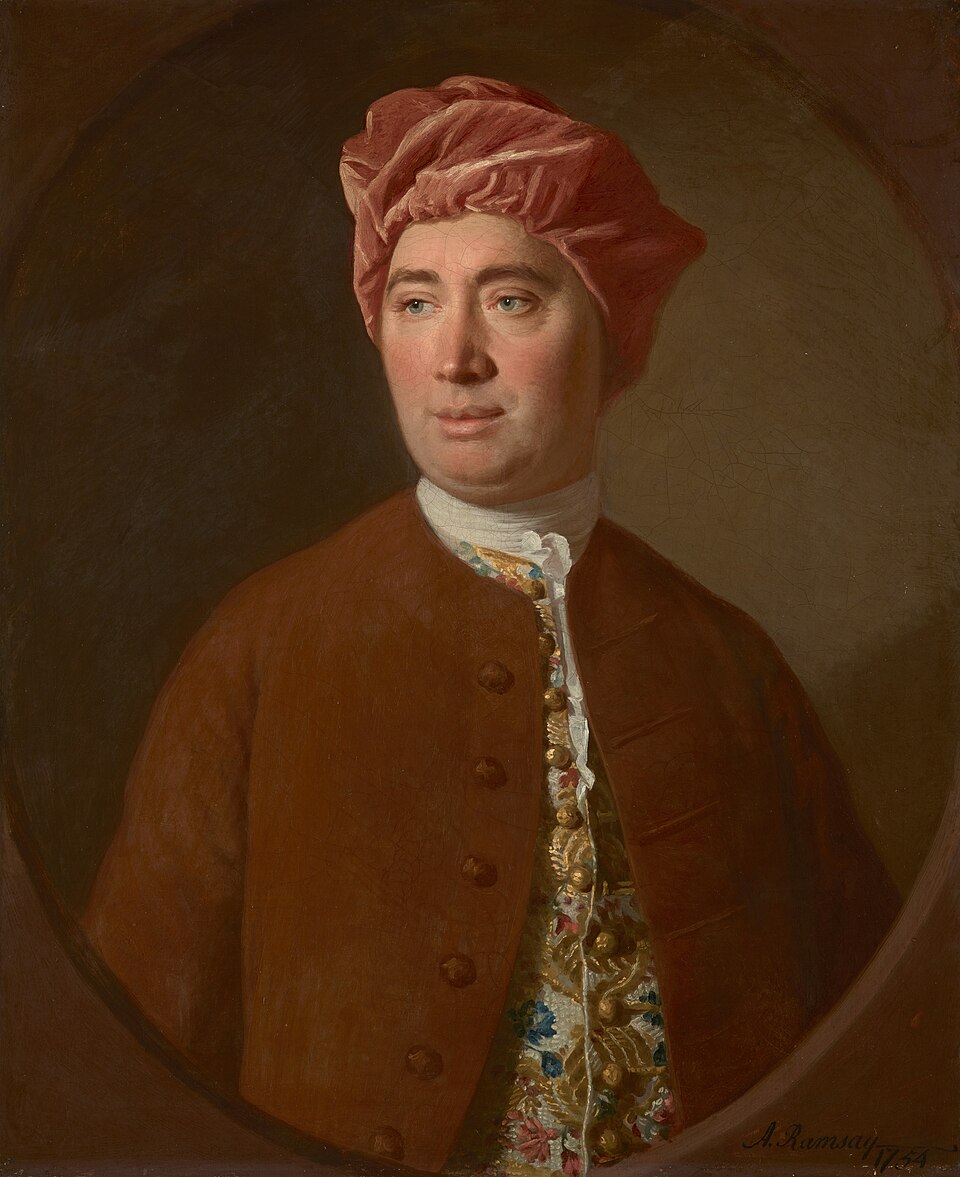
Two twelve-year-old visitors push open the door of an Edinburgh study that smells of ink and old leather. By the fire, a corpulent man with a round face waits for them with a smile. It is David Hume, and he looks delighted that someone is interested in him.
—Hello! What was a normal day like for you?
Hello to you, my child. You know, I was not one of those gloomy scholars locked up from morning to night. I got up late, around nine, with tea and a bit of bread. In the morning, I read and wrote letters to my friends all over Europe. In the afternoon, I would dash off to the taverns of Edinburgh to meet my friend Adam Smith. We would discuss everything while laughing loudly. And in the evening? I liked to cook myself for my guests. Imagine a warm table, dishes I had prepared, and a good glass of red wine from Bordeaux called claret. Philosophy, you see, is also done with a full belly.
Philosophy is also done with a full belly.
—They say you were a glutton. Is that nickname 'Fat David' true?
Ha! You heard right. Yes, I loved to eat, and I was not slim. A French countess nicknamed me 'Fat David', and believe it or not, it made me laugh. I accepted it cheerfully. Why get upset over so little? I was what they called a gentleman, that is, a well-educated, polite, and sociable man. But a gentleman who adored Scottish mutton, fish, and his glass of Bordeaux. You see, my child, you can think very deep thoughts and remain joyful. I even find that a lighthearted mind thinks better than a bitter one.
A joyful mind thinks better than a bitter one.
—How old were you when you wrote your first great book?
I was still very young, barely over twenty. I had gone to live in the French countryside, near a village called La Flèche, between 1735 and 1737. There, it was quiet: no noise, just the bells and the wind in the fields. I wrote my Treatise of Human Nature there. My idea was simple but bold. Instead of believing what the old books said, I wanted to build everything from what we see, what we touch, what we feel. That is called empiricism: grounding knowledge on experience. For a boy my age, it was a strange ambition.
I wanted to believe only what my senses could touch.
—Why did you say some books should be thrown into the fire?
Ah, that phrase made teeth grind! In my Enquiry Concerning Human Understanding, in 1748, I write that a book full of empty big words contains only 'sophistry and illusion', and that it should be committed to the flames. But careful, my child, I did not actually burn books! It was an image. I meant: beware of speeches that prove nothing and that cannot be seen or verified. Take causality, for example, the idea that one thing causes another. When one ball strikes another, we think we see the cause. In truth, we just see that it happens every time. It is our habit that invents the link.
Beware of big words that prove nothing.
—What is the difference between an impression and an idea?
Good question, and it is the heart of my thought. Imagine you burn your finger on a candle. That sharp, burning, immediate pain is what I call an impression. Now, close your eyes and think back to that burn. You remember it, but it no longer really hurts, right? That weakened memory is an idea. For me, all our thoughts are only pale copies of what we first felt. Our mind creates nothing from nothing: it copies what the senses have given it. That is why I repeated that we must always start from experience.
An idea is only the pale memory of a thing felt.
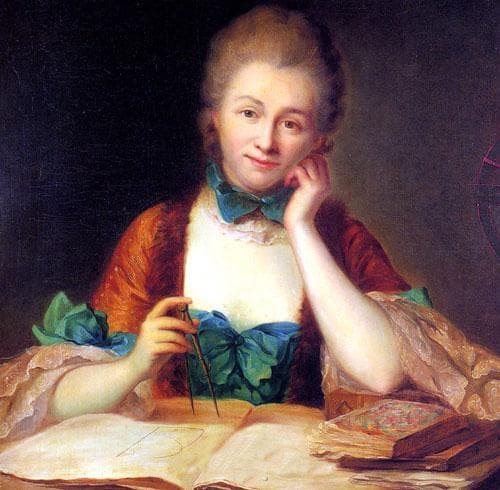
—Were you really a star in the Parisian salons?
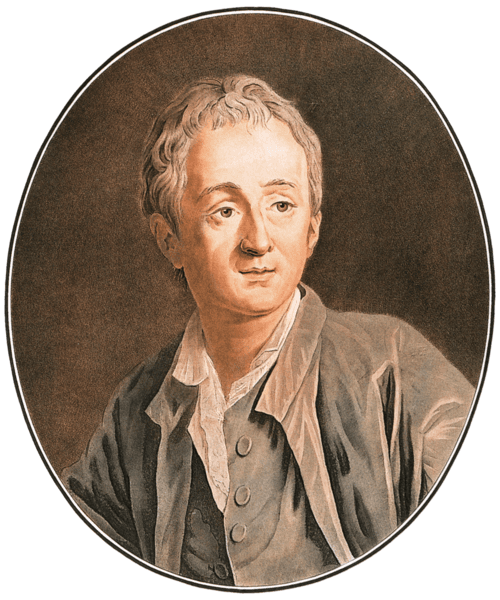
You'll laugh, but yes! In 1763, I went to Paris as embassy secretary. And there, surprise: I was welcomed like a celebrity! The great ladies vied for my company in what were called salons, those elegant gatherings where ideas were discussed at the homes of important people. Me, the corpulent and quiet philosopher, suddenly I was celebrated! I met Diderot and d'Alembert, the minds who were making the great Encyclopédie. Imagine the contrast: in my own country, I had been denied a professorship because my ideas were disturbing. And in Paris, I was lauded. Life sometimes has strange revenges.
Rejected at home, celebrated in Paris: life has its revenges.
—Is it true you were denied a teaching post?
Alas yes, and it hurt me at the time. In 1745, I wanted a professorship at the University of Edinburgh. I was denied. The reason? They found my ideas too irreligious, too bold on the question of God. Imagine: the one called a great philosopher today never got to teach in his own country. But you know what? That refusal may have done me a favor. Instead of teaching, I became a librarian, surrounded by thousands of books. And that is where I wrote my History of England, which finally made me famous. Sometimes a closed door opens a finer one.
Sometimes a closed door opens a finer one.
—I heard your friendship with Rousseau ended very badly. What happened?
Ah... this story still chokes me up. In 1766, Jean-Jacques Rousseau was persecuted, chased from everywhere. I wanted to help him. I welcomed him in England, found him a refuge, defended him. And then, overnight, everything changed. Rousseau, who saw enemies everywhere, began to accuse me publicly of conspiring against him! Imagine your surprise: you reach out to someone, and he screams that you want to harm him. The scandal erupted across Europe. I was wounded, truly. I learned that day that you cannot save someone who believes himself betrayed by everyone.
You cannot save someone who believes himself betrayed by all.
—And you, did you resent him after that?
At the time, yes, I was both furious and sad. You know, I had opened my door with a good heart, and I was thanked with a public accusation. The entire intellectual world talked about it for months. But with time, I tried to understand rather than hate. Rousseau was suffering in his mind; he saw conspiracies where there was only friendship. I described myself as a man 'little susceptible to enmity', that is, one who does not hold grudges for long. Holding anger tires the heart. I preferred to turn the page and return to my friends in Edinburgh.
Holding anger tires the heart.
—Were you afraid to die? They say you were very calm.
It's true, and it surprised many people. In 1776, I was very ill; I knew the end was near. But I was not afraid. My friend Adam Smith recounts that I even joked! I imagined Charon, the old ferryman who, in ancient stories, takes the dead across the river. I looked for excuses to make him wait a little longer, just for laughs. All my life I had doubted promises about the afterlife. So I left without sadness and without fear, true to myself. Many people were shocked that one could die so serenely without clinging to religion.
I left without fear, true to my doubts.
—Why did you doubt the existence of God so much?
I will answer you carefully, for the subject was burning in my time. I did not say 'God does not exist.' I said: we poor humans cannot prove it with certainty. Our mind is too small to understand a universe so vast and majestic. In my Dialogues Concerning Natural Religion, I put these doubts in writing. But careful: I asked that they be published only after my death, in 1779! Why? Because these ideas were dangerous, and I did not want to be attacked while alive. Doubting, you see, is not refusing to believe. It is remaining humble before what we cannot know.
Doubting is not refusing to believe: it is remaining humble.
—If we learn only one thing from you, what would it be?
What a beautiful question to end with, my child. If you remember only one thing from this old David, remember this: ask questions, always, even about what everyone believes is true. Do not be satisfied with being told 'it is so.' Ask: how do you know? Have you seen it, touched it, verified it? That is what I did all my life, from my Treatise written in the French countryside to my last days in Edinburgh. I was denied posts, criticized, but I kept my freedom of thought. And you know what? My books have outlived all my adversaries. Thinking freely is the finest inheritance.
Always ask: how do you really know?
Read further
This imaginary interview was generated by artificial intelligence from sources documented in David Hume's profile. It dramatises what the figure might have said based on what we know about them, but does not constitute attested historical testimony. For primary sources and factual documentation, refer to the full profile.