Imaginary interview with Fontenelle
by Charactorium · Fontenelle (1657 — 1757) · Literature · Sciences · 5 min read
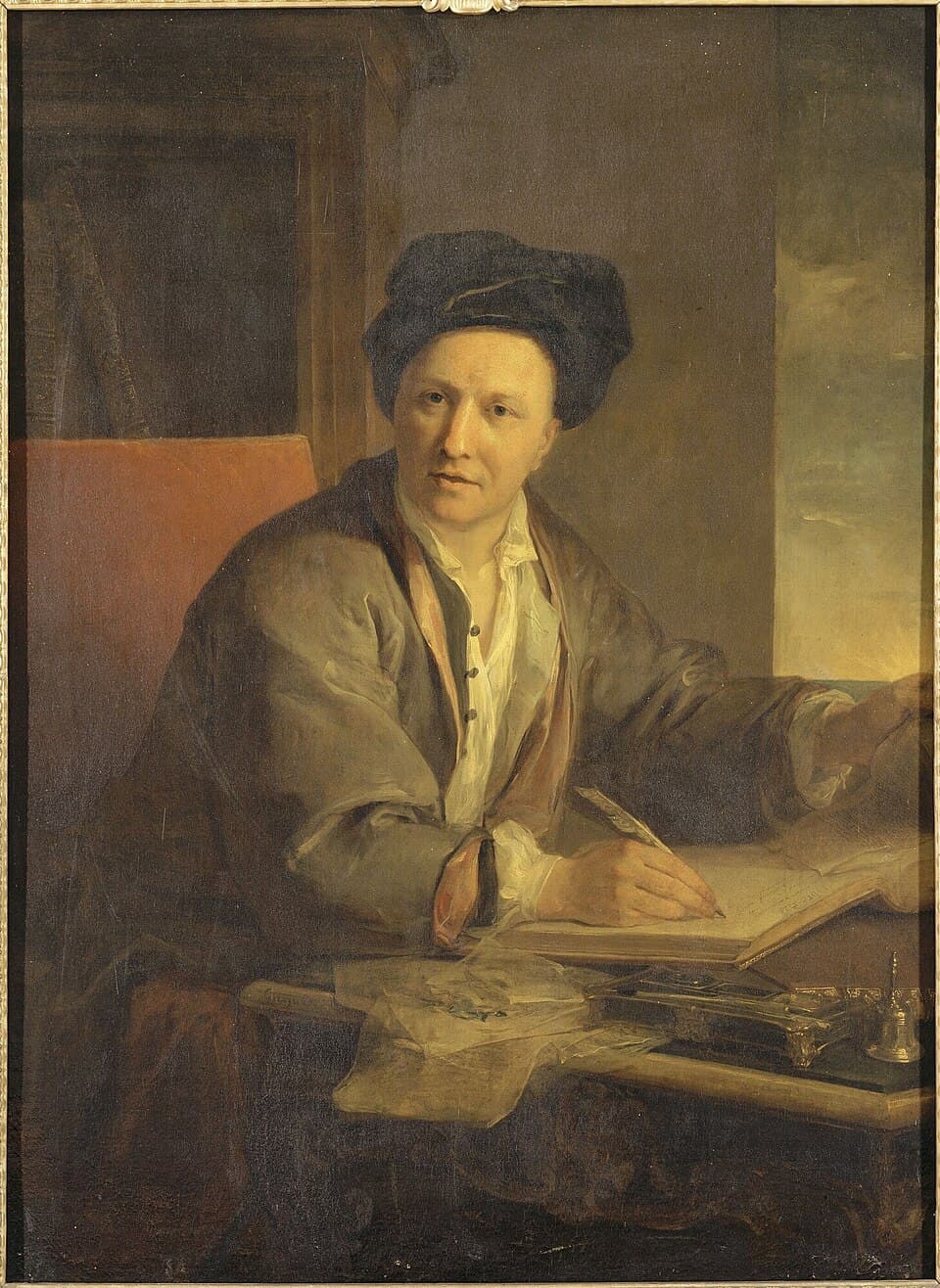
Paris, winter 1740. The perpetual secretary has just left his post after forty-two years of service; we find him in his study on rue Saint-Honoré, among his registers and a dusty celestial globe. At eighty-three, his eye bright under the powdered wig, he takes a pinch of snuff and agrees to speak.
—How did you come up with the idea of explaining the world system to a marquise rather than to a college of scholars?
You see, scholars talk among themselves in a language that reeks of the schoolroom, and the world turns away yawning. I thought a marquise, in the cool of a garden, under a star-spangled sky, would listen better than a doctor from the Sorbonne. In my Conversations on the Plurality of Worlds, I simply show her, with a telescope at hand, that each of those points of light might be a sun like ours. All philosophy, I told her, comes down to two things: "one has a curious mind and poor eyes; for if you had better eyes than you do, you would see whether the stars are suns." Nothing more. The gallant is not the enemy of truth; he is its carriage.
The gallant is not the enemy of truth; he is its carriage.
—What did you reply to those who thought it unworthy to mix the coquetry of salons with the dignity of astronomy?
Let them keep their dignity, I'll keep my readers! When I place a celestial globe on the table of a study and invite a lady to run her finger among the constellations, I profane nothing: I convert. Descartes wanted planets to swim in great vortices of subtle matter; to make that understood, should I have bludgeoned the public with geometry? I prefer they dream first, and calculate later. Copernicus and Galileo moved the Earth from the center of the world; my more modest office was to move science from the depths of academies into the conversation of polite society. I have been reproached for being too charming. It is a fault I shall not correct.
—You sought to dismantle ancient oracles. Where does one begin when one wants to destroy such a venerable superstition?
At the beginning, which everyone neglects! People rush to the cause before establishing the fact. In my History of Oracles, inspired by the Dutchman Van Dale, I lay down a rule I am rather proud of: "Let us make sure of the fact before we worry about the cause." How many wonders vanish upon close examination! I was told of statues that spoke; I asked who had heard them, and the chain of witnesses always broke somewhere. This method is slow, I admit, and displeases impatient minds who prefer a fine explanation to a bare truth. But it is this, and not the thunder of eloquence, that dispels oracles.
How many wonders vanish upon close examination!
—In "On the Origin of Fables," you explain the birth of myths by ignorance. Isn't that an insult to the wisdom of the Ancients?
No insult: compassion. Early men saw a river overflow, a storm break out, and having neither books nor instruments, they peopled these forces with spirits and gods in their image. In On the Origin of Fables, I show that fable is not willful falsehood, but ignorance telling itself a story to avoid dying of fear before the unknown. Our ancestors were children, and every child invents monsters in the dark. What moves me is that the same operation of the mind is found under all latitudes: Greeks, barbarians, American savages, all fabricate the same tales for lack of the same lights. Understanding how error arises is already a step beyond it.
—The Quarrel of the Ancients and the Moderns tore apart the letters of your time. Why did you so clearly take the side of the Moderns?
Because nature does not run out! In my Digression on the Ancients and the Moderns of 1688, I reduce this whole great Quarrel to a very simple question: "whether the trees that once stood in our countryside were taller than those of today." And they are not. Men born now have the same brains as Homer or Aristotle; but they also inherit everything those men discovered. A Modern is an Ancient standing on the shoulders of another Ancient. To venerate Antiquity so much as to forbid surpassing it would be to condemn the human mind to turn eternally in the same circle. I believe, for my part, that it advances.
A Modern is an Ancient standing on the shoulders of another Ancient.
—Did you form this idea that knowledge accumulates and is transmitted alone, or did you owe it to your surroundings?
One never thinks entirely alone, whatever solitaries say. I grew up in Rouen, in the shadow of my uncle Pierre Corneille, among books and theatrical disputes; then Paris threw me into the ruelles and salons where everything was debated, from comets to comedies. It was there, in that perpetual conversation, that I came to the conviction that knowledge is a good passed from hand to hand, growing at each relay. Each generation bequeaths a slightly larger capital to the next. Gazettes, academies, correspondence between scholars from one end of Europe to the other: these are the true channels through which the tide of the Enlightenment rises.
—For forty-two years, you eulogized dead scholars. What does one learn about a life when one must summarize it after death?
That a discovery is almost always more beautiful than the one who made it! From 1697 to 1740, as perpetual secretary of the Royal Academy of Sciences, I wrote hundreds of eulogies, bent over my registers, goose quill in hand. My art was to extract, beneath the man — often vain, sometimes unbearable — the part that deserved to endure: the theorem, the observation, the invention. The eulogy is not a sermon; it is a way to bring the general public into the geometer's study. Thus I made familiar to polite society names that no one would have read in their memoirs. Believe me, it takes a lifetime to die properly in the eyes of the Academy.
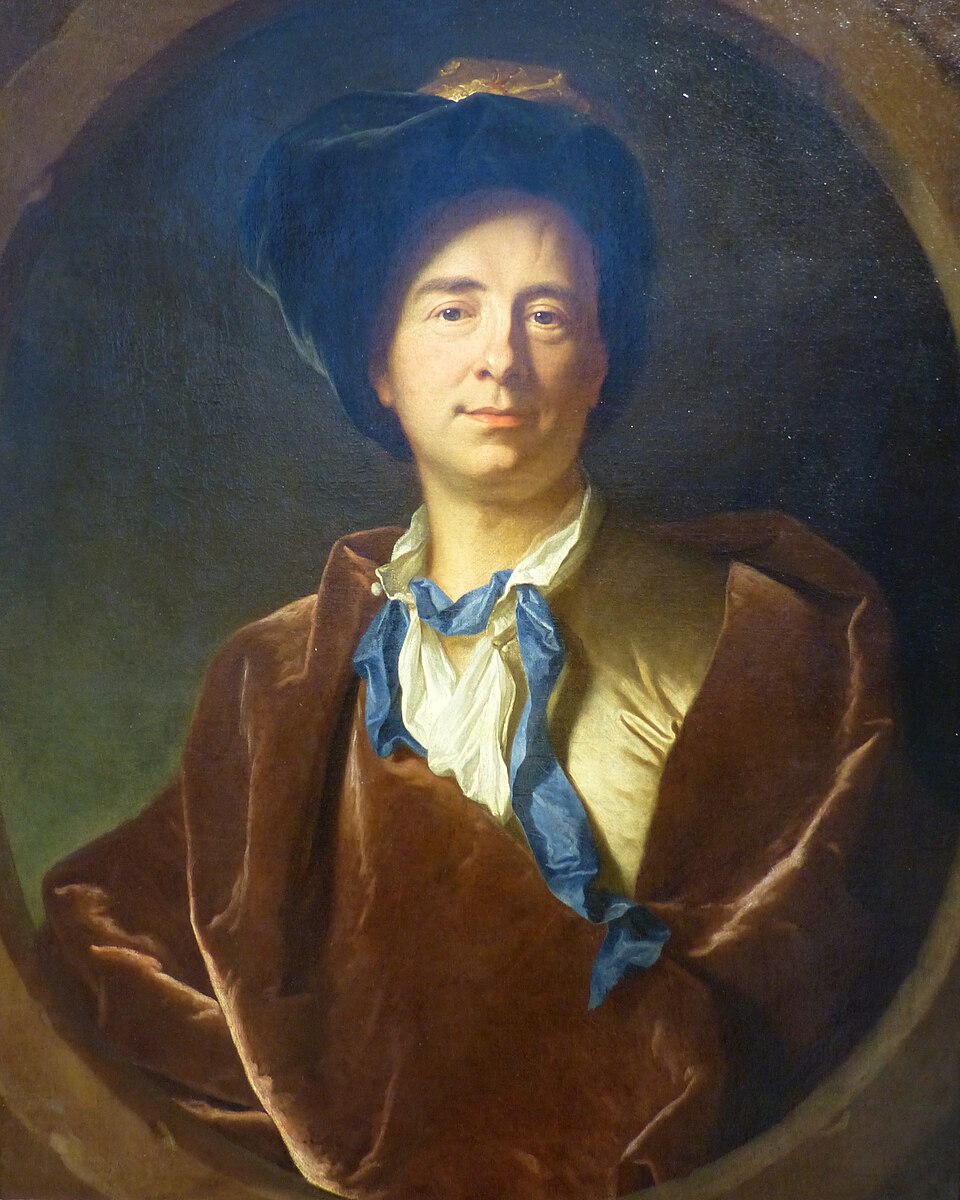
—You wrote the eulogy of Newton, whose ideas contradicted those of Descartes, which you had defended. How did you decide?
I did not decide; I weighed, which is the duty of an honest man. Newton died in 1727, and justice had to be done, and I did so without hiding that his gravitation ruined the vortices of my dear Descartes, which I had long held true. I observed with a smile that his glory had provoked "a kind of lawsuit between the English and the Germans, quite similar to that which seven cities of Greece waged over the birth of Homer" — regarding the calculus he disputed with Leibniz. A perpetual secretary does not serve a school; he serves the truth, even if it is English. Admitting one was wrong about causes is still applying my old rule: the fact first.
A perpetual secretary does not serve a school; he serves the truth, even if it is English.
—A thousand witticisms are attributed to you in the salons. Do you remember that lady who asked you what distinguished her from a clock?
Ah, that evening! It was in the salon of Madame de Lambert, I believe, among the lorgnettes and snuffboxes, at the hour when wit sparkles better than wine. The lady, half-coquette half-philosopher, wanted to embarrass me: what difference between her and a clock? I replied that a clock marks the hours, while she makes them forget. Much laughter ensued, myself first. That is the whole secret of these ruelles: one slips a truth under a gallantry, an idea under a flower. I never despised these games of wit; it is in this banter that science and philosophy made their entry into the world, through the small door of the ladies.
—You are approaching a century of existence. When asked about the secret of such a long life, what do you reply?
That I have chased neither women nor honors, and that I eat strawberries! People smile at this answer, but it is more serious than it seems. I have lived in moderation: frugal table, a broth in the morning, little wine, no passions that devour. Born under Louis XIV in 1657, here I am witness to the Regency and the reign of his successor — I will have crossed the centuries as one crosses a long garden, without hurrying. A calm temperament preserves better than all the remedies of doctors, whom I have always avoided. If I miss my hundredth birthday by a few weeks, I will not complain: it is already much to have seen so many things born.
I will have crossed the centuries as one crosses a long garden, without hurrying.
Read further
This imaginary interview was generated by artificial intelligence from sources documented in Fontenelle's profile. It dramatises what the figure might have said based on what we know about them, but does not constitute attested historical testimony. For primary sources and factual documentation, refer to the full profile.