Imaginary interview with Freya
by Charactorium · Freya · Mythology · 7 min read
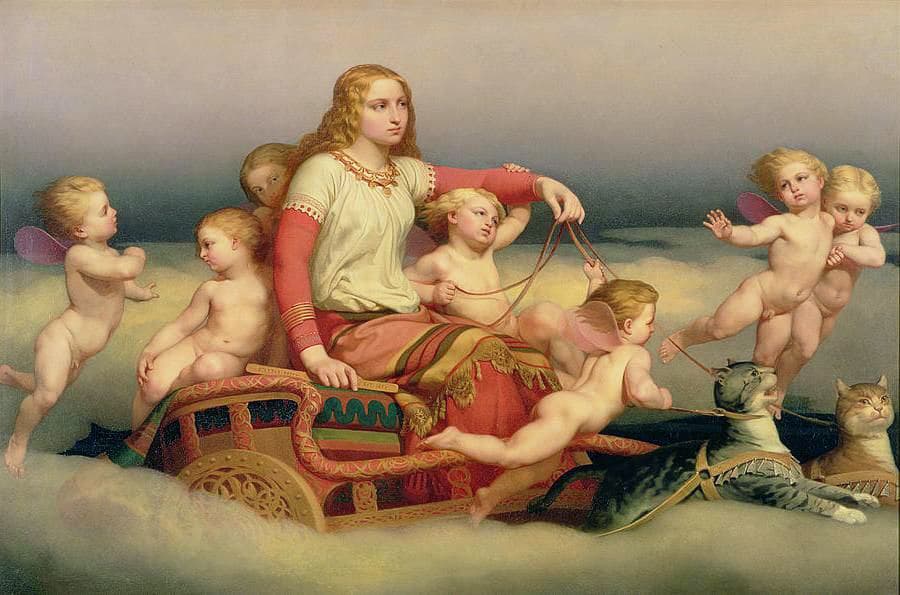
Twilight falls on Folkvangr, and the golden fields rustle with the footsteps of warriors who have just arrived. Seated in her chariot, two large cats curled at her feet, Freyja agrees to speak — not as one questions a goddess, but as one listens to a seeress who has seen worlds born and die. At her throat gleams a necklace whose radiance seems to hold all the gold of the dwarfs.
—They say your necklace is the most coveted object in the nine worlds. How did you obtain it?
Go down under the earth, where the hammer never falls silent, and you will understand. I saw Brísingamen on the anvil before it was finished, and I knew that nothing I possessed was worth that twisted light in the metal. Four smiths had brought it forth; four times I paid the price they demanded, one night for each. They still reproach me for it in the halls, as if a goddess of love should blush for having loved. I do not blush. What shines belongs to me, they say among the Æsir — and I never haggled over my beauty, I spent it like a queen spends gold. The necklace has rested on my throat since that day. It weighs exactly the price it cost me.
I never haggled over my beauty, I spent it like a queen spends gold.
—Has that necklace ever caused you trouble?
Everything that shines too brightly attracts grasping hands. Loki, especially, who prowls around my coffers like a fox around the henhouse. He stole it from me once, transformed into some creeping beast, and all the cunning of Asgard was needed to take it back from him. But you see, a treasure that no one covets is not a treasure — it is a stone. Brísingamen is valuable precisely because they want to tear it from me. When Loki throws in my face, during the quarrel, that I am a shameless goddess, I answer him with my pride and nothing else. The Æsir and the Vanir know who I am. The thief may say what he will: the necklace always returns to my throat, and he always returns to his lies.
—Many associate the battle-dead only with Odin. What is your role among them?
People believe that all the brave go to Valhalla, under Odin's hall. That is half the truth — the other half comes to me. Each day, when the bodies grow cold on the fields of men, I take my share, and they cross the gates of Folkvangr, the field of the people. Here, no perpetual fury, no battles that begin again at dawn. Here, orchards, golden fields, and the rest of those who have earned a goddess rather than a war-god. Men are astonished that a goddess of love claims a share of the slain. But what is death in battle, if not the final act of love for one's own? I welcome those. Odin has his half. I have mine, and I yield it to no one.
What is death in battle, if not the final act of love for one's own?
—What do you say to those who judge your rank inferior to Odin's?
Let them count. Half for him, half for me: where do they see the inferior? I was born among the Vanir, those gods of sap and abundance, and I came to the Æsir not as a supplicant but as a pledge of peace, after the great war that mingled our two families. My Folkvangr stands facing Valhalla, and no one has ever dared say that one hall is worth less than the other. When Loki, in the great flyting of the gods, tried to belittle me, I spoke as an equal among the Æsir. I preside over love, the fertility of the land, the marriages of the living — and the keeping of the valiant dead. Few deities hold both ends of existence in the same hand. That is my rank.
—They say you master a magic that even Odin had to learn. What is it?
Seiðr. A word that men speak in a low voice, because it opens the threads of fate and lets you lay a hand on them. With it, you see what is not yet, you turn the course of things, you bend the future like you bend cloth on a loom. This art came to the Æsir through me, daughter of the Vanir. Yes, Odin himself, the All-Father, learned this knowledge from me — he who already knows so many things. To hold the seiðr wand is to hold a power that warriors, despite their spears, will never possess. They say this art is unseemly for proud gods, that it belongs to women, to völur. So be it. I am a goddess. I am not ashamed to know what kings must come and learn at my feet.
I am not ashamed to know what kings must come and learn at my feet.
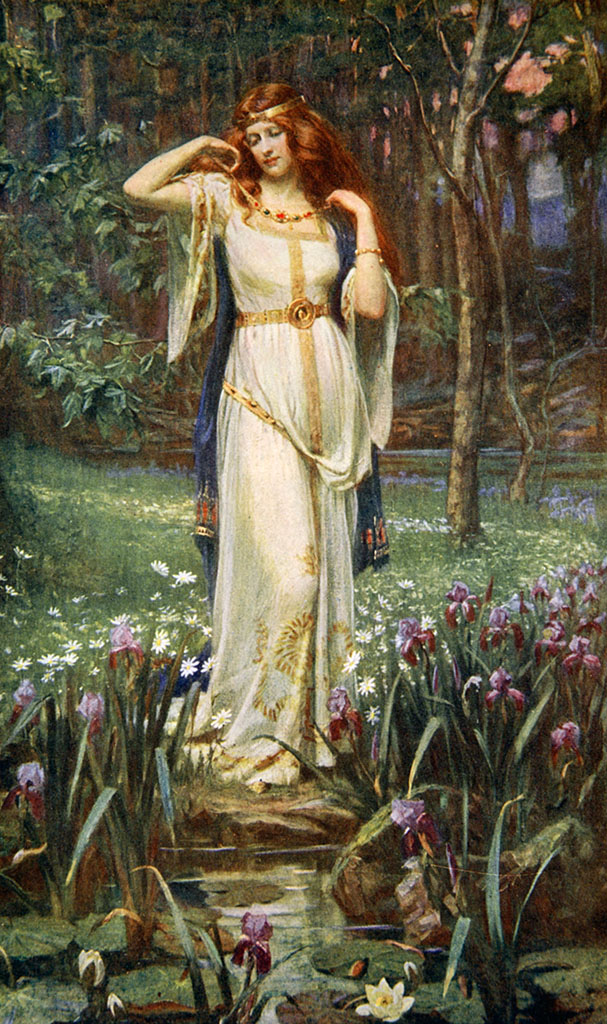
—How would you describe a woman who practices this art among mortals?
She is called a völva. She comes, staff in hand, to sit at the threshold of farms when winter bites and no one knows if spring will return. The living fall silent around her; she chants, she enters a trance, and the threads I weave up there, she brushes with her fingertips. She will tell who will die, which harvest will rise, which woman will bear a son. It is my art descended among men, and those who bear it enjoy an authority that neither chieftain nor warrior contests. For to predict is to govern destiny a little — and destiny, in our northern lands, is the only master that even the gods respect. When one consults a völva, it is a little of me that one questions.
—How do you travel from one world to another?
In several ways, for no world is closed to me. My chariot is drawn by two great cats — do not smile, they are beasts more powerful than Odin's horses, and they know roads that hooves ignore. When I want to go faster and higher, I don my cloak of falcon feathers: then I am nothing but flight, shadow, and talons above the nine worlds. And when I ride Hildisvíni, my boar with golden bristles, the earth itself opens before us. The boar, you see, is the animal of fertility, of the strength that comes from the soil. Chariot, feathers, tusks: the goddess of love is never still. Whoever loves moves, crosses, goes toward the other. That is all I have done since the beginning.
Chariot, feathers, tusks: the goddess of love is never still.
—Your cats surprise those who expect more martial mounts. Why them?
Because you do not tame a cat, you make it love you — and that is my whole domain. War-gods have their wolves, their ravens, their eight-legged horses. I have these two felines who pull my chariot through Asgard and beyond, supple and secret like the magic I carry. A horse obeys the bridle; my cats come because they want to, and that is precisely what fertility, love, seiðr are: forces that you do not chain, that you call and that consent. When I appear in my chariot in the midst of a feast, adorned with Brísingamen, it is not beasts of battle that announce me, but two animals that all the North knows to be fierce and free. My team resembles me. That is why I chose it.
—You were worshipped throughout the North. What was that cult like?
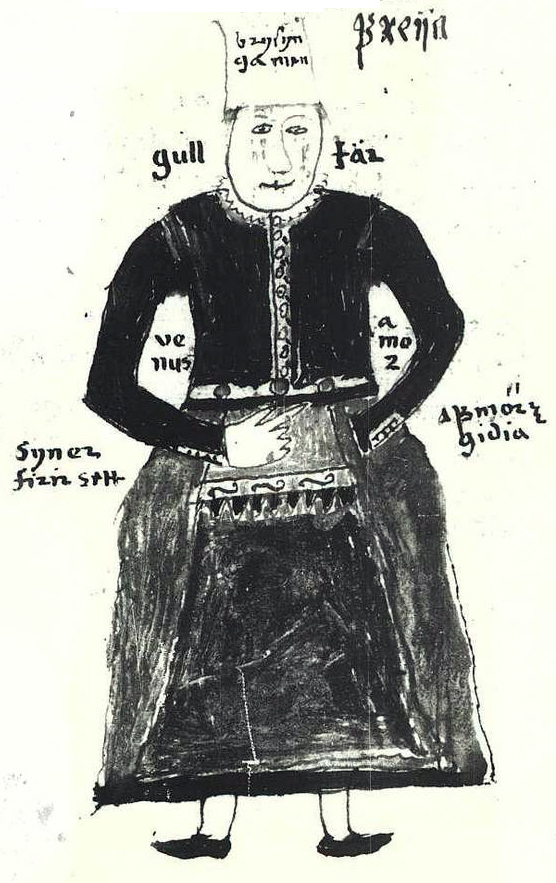
Go to Uppsala, in Swedish lands, where the great temple stands. I am honored there alongside Odin and Thor, and men do not go to war without offering me their share. My name is carved on rune stones; in the black earth of the fields, they lay the best game animals and the first sheaves of the harvest. For whoever wants children, crops, a fertile bed, it is to me they turn — from Denmark to the fjords of Norway. And so that no one forgets me as the weeks pass, an entire day bears my name: Freyadagr. Think of it: the week itself bows to make room for me. I am not a goddess prayed to on great occasions. I am she from whom they made a day that returns ceaselessly.
I am she from whom they made a day that returns ceaselessly.
—A new faith is gradually winning over your lands. What do you think of it?
I feel it, yes. Around the turn of the millennium, the kings of the North bow before a god from elsewhere, and the temples where they offered me game are closed. The great sanctuary at Uppsala itself will eventually fall silent. But a goddess does not die as a man falls in battle. My name will still be whispered in cottages, the völva and her staff will still be feared, and fate will still be spun on the loom as I taught. And Freyadagr will return every week, in the very mouths of those who think they have forgotten me. You can overturn an altar; you cannot overturn a day of the week. Peoples keep their old gods in their words long after they have driven them from their prayers. That is where I will survive.
You can overturn an altar; you cannot overturn a day of the week.
—Deep down, what is the thing that men understand least about you?
That one can be, in the same breath, the goddess of lovers and the guardian of the dead. They want their gods cut from a single piece: this one for war, that one for love. But I rule over Folkvangr where the slain rest, and over the bed where the living are made. I wear the necklace of the dwarfs and the wand of seiðr, beauty and the magic that sees death coming. It is the same hand that blesses the harvest and takes its half on the battlefield. Love and the end are not two foreign kingdoms; they are the two banks of the same river, and I stand on the bridge. That is what they misunderstand. That, perhaps, is why I have been so loved — and so feared.
Love and the end are not two foreign kingdoms; they are the two banks of the same river.
Read further
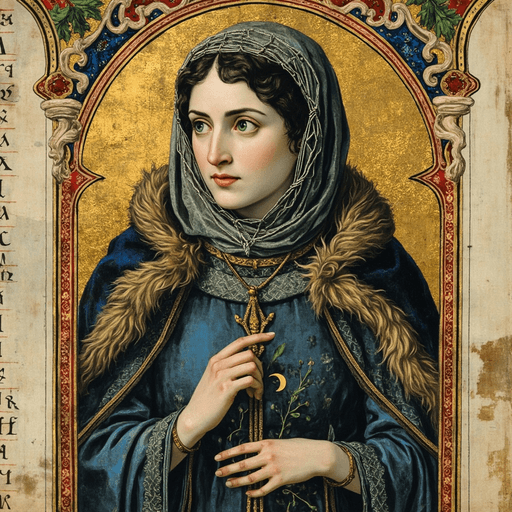
This imaginary interview was generated by artificial intelligence from sources documented in Freya's profile. It dramatises what the figure might have said based on what we know about them, but does not constitute attested historical testimony. For primary sources and factual documentation, refer to the full profile.