Imaginary dialogue between Loki and Freya
by Charactorium · Freya · Mythology · 5 min read
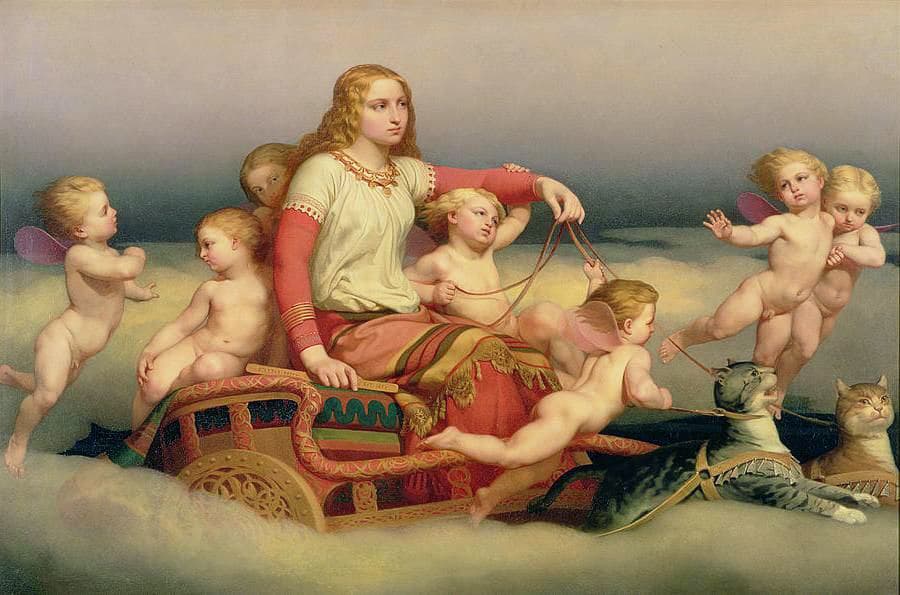
It is in the golden orchards of Folkvangr that Loki comes to find Freyja, one evening when the fallen warriors gather for the feast. The low light catches the links of the Brisingamen at her throat, and one can hear the purring of the two great cats harnessed to her chariot. They have known each other for a long time, since the halls of Asgard where Loki sows his mockery — and he arrives this evening with a sly smile, determined to push her to her limits. She awaits him without fear, for she knows what his tongue is capable of.
—You still wear that Brisingamen, Freyja. They whisper about the price you paid for it to the four dwarves who forged it. Tell me yourself.
You who always watch for fault, Loki, you would have me lower my eyes. I will not. The Brisingamen came from the hands of the dwarves in the stone, and yes, I gave what was needed for it to become mine. Such a necklace is not traded for ordinary gold — it is won with what one is. I am the goddess of love and desire; should it surprise you that I pay in my own coin? What others call scandal, I call sovereignty. This necklace shines at my throat because nothing that shines is foreign to me, and I am ashamed of no path by which it came to me.
What others call scandal, I call sovereignty.
—Each day you receive half of the slain, the other goes to Odin's Valhalla. You, a Vanir, sharing the dead as an equal with him — how did you obtain that?
I did not obtain it, Loki: I have it. When warriors fall, half go up to Valhalla and the other half come to me, in my Folkvangr, the field of the people. This division is not a favor granted by Odin; it is the order of things since the Vanir joined the Aesir. You know this hall: here too we feast, we sing glory, we honor courage. Many imagine that a goddess of love cannot rule over the battle-slain. They are wrong. Love and death touch each other more closely than one thinks, and I preside over both with the same hand.
Love and death touch each other more closely than one thinks, and I preside over both.
—I remember that feast where I named you all one by one. I hurled my accusations at you, Freyja. Why did you not bow before me?
I remember it too, Loki — you went from one to another, your tongue cut like a blade, and you thought you would make me blush. But I am a Vanir become one of the Ásynjur, and I have lived through the war that welded our two peoples together. One does not bend one who has seen the Vanir and Aesir cease to slaughter each other. You accused me; I answered without averting my gaze, because my authority does not depend on what your mouth says of it. You may tarnish all the names of Asgard one after another — mine stands firm. Perhaps that is why you come back this evening: you know I do not fear your bite.
One does not bend one who has seen the Vanir and Aesir cease to slaughter each other.
—They say that seiðr, that magic of destinies, you taught it to the Aesir — to Odin himself. The All-Father, your pupil? Really?
Really, Loki. Seiðr came with us, the Vanir, and I carried it into Asgard. To see the future, to unravel or tie the thread of a fate, to bend what seemed straight — that is my art, that of the völva. And yes, Odin himself lent an ear and learned from me. That bothers more than one, for this magic is held to be women's work, and seeing him submit to it seems unworthy to some. I see in it proof that knowledge has no rank: even the sovereign of the Aesir bows before one who knows. My wand needs no throne to command destinies.
Even the sovereign of the Aesir bows before one who knows.
—Your cats, your boar Hildisvíni, your falcon-feather cloak — you change mounts like moods. Which carries you farthest, goddess?
Each in its own way, Loki. My chariot is drawn by two great cats, and when they spring forth I cross the lands of the gods like a queen on her road. My boar Hildisvíni carries me through the nine worlds when I seek lineages and secrets hidden in blood. But it is my falcon-feather cloak that you yourself have borrowed more than once, I do not forget — the one that lets me cleave the air between realms. To fly like that is to see from above what others ignore below. A goddess who sees the future must also be able to go everywhere: seiðr in the mind, wings on the body.
Seiðr in the mind, wings on the body.
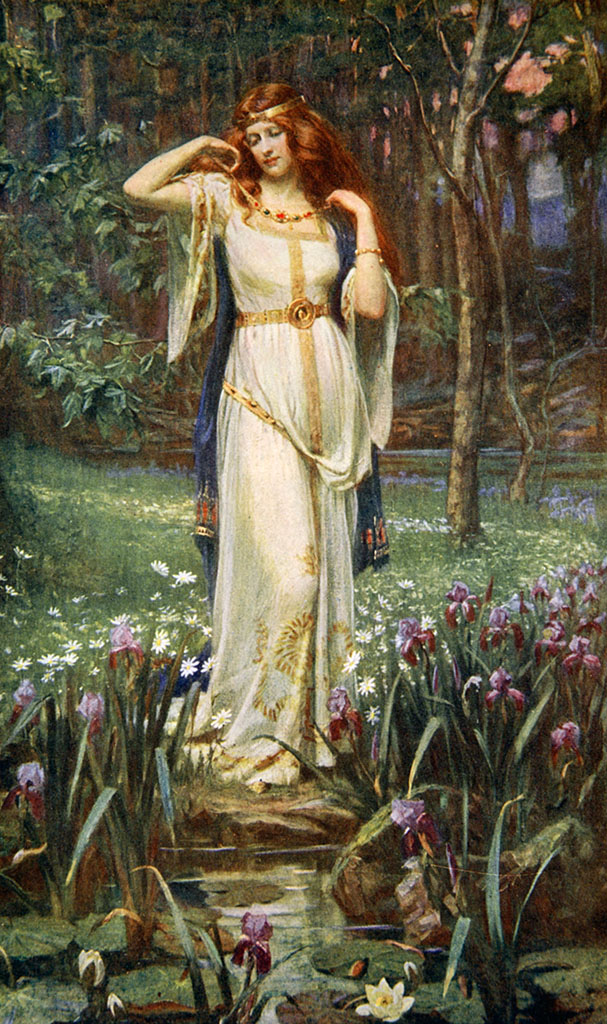
—In your Folkvangr, in the evening, you receive those broken warriors. What do you offer them, who have already lost everything on the battlefield?
They have not lost everything, Loki — they have won their place beside me. When evening comes, my hall fills with those who have fallen with honor, and I welcome them as a hostess welcomes her own. We drink mead, we tell of battles, we sing the deeds that brought them here. I am not only a goddess of tenderness; I am also she who watches over the brave beyond their last breath. At night, I gaze upon the worlds of the living from my dwelling, and I hear those who invoke me for their harvests, their weddings, their wars. My Folkvangr is not a tomb — it is a hearth that never goes out.
My Folkvangr is not a tomb — it is a hearth that never goes out.
—They call you the most beautiful, the most desired. Is that beauty, Freyja, an ornament you wear, or a weapon you wield?
Both, Loki, and you know it better than anyone, you who constantly play with appearances. My beauty is not an ornament placed upon me like the Brisingamen at my throat; it is what I am. Everything that shines belongs to me, they say, and it is true — radiance recognizes me as its own. But whoever believes me fragile because I am desirable is gravely mistaken. I rule over love, fertility, the abundance of lands; without me, weddings would be sterile and fields silent. My beauty opens hearts, but my will commands destinies. One may desire me; one does not possess me.
One may desire me; one does not possess me.
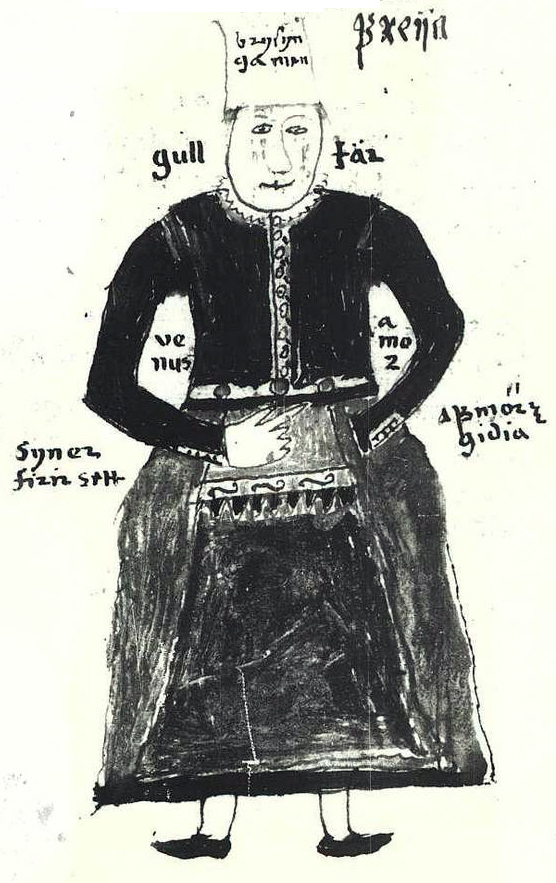
—That seiðr frightens as much as it fascinates. When you read the future, do you also see your own end, and ours — the Ragnarök they whisper about?
I see much, Loki, but seeing is not always being able to tell. Seiðr unrolls the thread of destinies before me like cloth on a loom, and some of its patterns are so dark that even a völva hesitates to name them. A time will come when the forces of the world will clash, when the order we built after the war of the Vanir and Aesir will be undone. That, I sense. But I do not lament: what must be woven will be woven, and what must be reborn will be reborn. I prefer to rule over what lives today — love, sowing, feasts — rather than consume myself staring at what is not yet.
What must be woven will be woven, and what must be reborn will be reborn.
—You came from the Vanir, they from the Aesir. After so much blood spilled between your peoples, are you never a stranger among us, in Asgard?
A stranger? Ask those who eat at my table, Loki. I came from the Vanir, yes, taken as a hostage of peace when our two peoples ceased war. But I did not enter the walls of Asgard as a supplicant: I entered with my magic, my dead, my Brisingamen, and my name. Today I am counted among the most honored Ásynjur, alongside Frigg. Peace did not erase what I am; it made it shine farther. You too were not born quite one of them, and yet you prowl their halls. Perhaps we two know what it is to hold one's place without owing it to anyone.
Peace did not erase what I am; it made it shine farther.
—One last thing, Freyja. When you ride Hildisvíni between the worlds, what do you truly seek, beyond the realms of the gods?
I seek what hides, Loki. On the back of Hildisvíni, I trace lineages, I unravel forgotten ancestries, I go to fetch knowledge where it sleeps. A goddess of fertility is not only she who fecunds the fields: she is she who knows bloodlines, filiations, the promises woven between beings. That is why I travel. And when my cats bring me back to Folkvangr, I bring what I have seen, for those who invoke me and for my own. You have often followed me sidelong in these journeys — so you know: I never move for nothing. Every path I take nourishes what I rule over.
A goddess of fertility knows bloodlines, filiations, the promises woven between beings.
Read further
This imaginary interview was generated by artificial intelligence from sources documented in Freya's profile. It dramatises what the figure might have said based on what we know about them, but does not constitute attested historical testimony. For primary sources and factual documentation, refer to the full profile.