Imaginary interview with Medusa
by Charactorium · Medusa · Mythology · 5 min read
One does not meet a Gorgon: one approaches her backward, eyes fixed on the polished bronze of a shield. It is thus, in a damp cave on the Libyan borders, that Medusa's voice reaches us — hissing, still charged with the rustle of snakes. She agrees to speak, on condition that we never look up.
—Before the monster, who were you among your sisters?
We were three, and I was the only one who carried death within me. Stheno and Euryale, my sisters, would never age, never bleed; I was said to be mortal from the cradle, like a promise whispered by the Moirai. The Theogony tells that I united with the god of the golden sword in a meadow covered with spring flowers — a moment of sweetness rarely spoken of, because it does not make one shudder. I did not always dwell in this remote cave, far from the fires of civilization. I knew warm grass before cold stone. That is what is forgotten: a monster, too, once had its spring.
A monster, too, once had its spring.
—How did that face, said to be charming, become this horror?
One enters a temple thinking to find refuge, and emerges changed. It was in Attica, in the sanctuary of Athena, that everything turned. The goddess, jealous, they say, of my hair — for I was famous for it — or furious at a defilement of her sacred place, laid her hand upon my head. And my curls, whose brilliance was praised, twisted into venomous snakes that still hiss at my temples. Divine punishment does not argue; it strikes and shapes. I became punishment made flesh, condemned to bear on my brow the wrath of a goddess who never saw me as a woman, only as a fault to be corrected.
Divine punishment does not argue; it strikes and shapes.
—Describe the life you now lead in these distant lands.
Morning finds me already awake, for sleep flees the accursed. My dwelling is a cave carved into the flank of the known world, where no city fire shines on the horizon. I tend my snakes as another would braid her hair — they have become my only adornment, my only garment. By day, I watch the entrance, for I know that monster hunters dream of my head. By night, darkness absolves me: in the dark, my face petrifies no one, and I become almost a simple solitude again. They think me fierce; I am mostly imprisoned. This cavern is not a home, it is a cell that the gods carved for me.
In the dark, my face petrifies no one.
—What really happens when a being meets your eyes?
There is no cry, no struggle. There is an exchanged glance, and then the silence of stone. Flesh stops, blood freezes, and the man who has seen me becomes his own statue — petrified witness of his last second. Around my cave stand these stone forms, warriors and beasts caught mid-charge, a funereal garden I never wanted. Petrification is not a weapon I wield; it is a curse I carry, and whose effects I cannot turn aside, even when I wish to. Such is the irony of my gift: it empties the space around me every time I seek a gaze in which to recognize myself.
The man who has seen me becomes his own statue.
—Do you remember Perseus's arrival?
I was sleeping. That is all his cunning, and all my defeat. Perseus came borne by Hermes's winged sandals, silently, and he never made the mistake of looking me in the face. In his shield of bronze, polished like a mirror, he saw my inverted image, a bronze ghost that could not turn him to stone. Then his adamantine harpe, that indestructible sickle, cut through sleep and neck in one stroke. They will say that cunning triumphed over brute force — and it is true. But consider: a god lent him wings, another forged his blade, and a mirror ensured he never truly faced me. I was not vanquished; I was circumvented.
I was not vanquished; I was circumvented.
—What would you say about that strategy of the reflection, which undid you?
The mirror is the weapon of cowards grown wise. Perseus could not meet my gaze, so he looked at my shadow, my copy trembling in the bronze. It is a lesson the Greeks love to repeat: intelligence turns aside what valor dares not face. The reflection in the bronze shield, as in a mirror, delivered my contours to him without delivering him to my death. I admit it: there was genius in that detour. But what heroism is there in killing what one refuses to see? They have made this dodge a feat; I see a man so afraid of my face that he preferred to gaze only at its lie.
What heroism is there in killing what one refuses to see?
—Why is it said that your power survived you, even beheaded?
Death did not extinguish my gaze; it only detached it from me. Pausanias reports in his Description of Greece: my severed head retained the power to petrify those who stared at it, even the dead Gorgon. Perseus locked it in the kibisis, that magic pouch, to transport it without perishing. Then he used it as a weapon, raising my face against his enemies at Seriphos, against King Polydectes who tormented his mother. Consider the strangeness of my condition: they took my life, but kept my eye, because it was more useful than my whole being. I became a tool, a gaze without a body, condemned to kill still for the man who killed me.
They took my life, but kept my eye.
—How did your face become a protective sign?
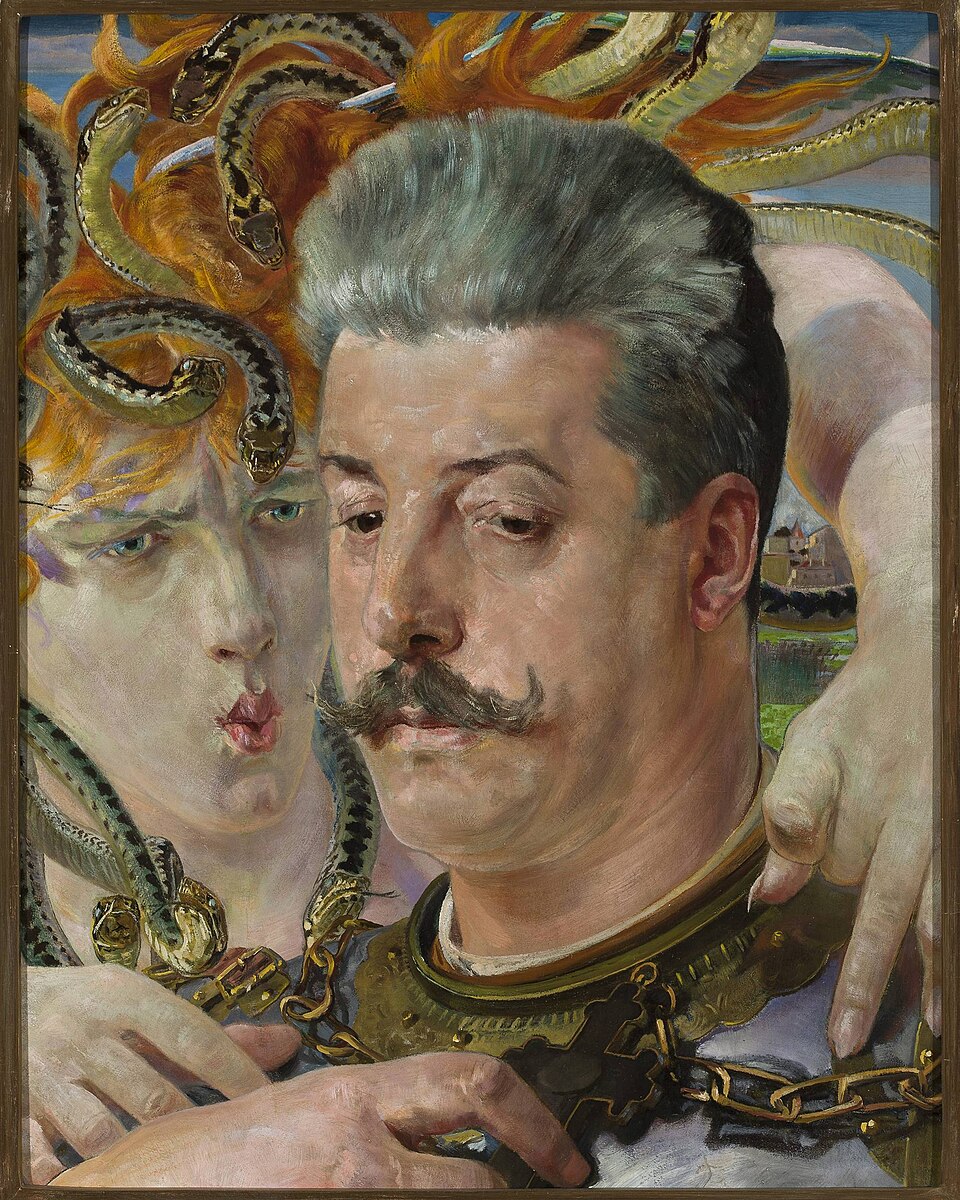
This is the greatest reversal: what made people flee became what protects. Athena placed my head on her aegis, and my grimacing face, bristling with snakes, no longer served to petrify innocents but to repel evil. Greek warriors engraved my effigy on their shields, made it a bronze amulet, a sign called apotropaic — that turns away misfortune. My mask of terror became a bulwark. Consider: the goddess who cursed me now bears my image as a trophy and a talisman. She who made me a monster now displays me to frighten her own enemies. My horror, so long fled, now guards thresholds and watches over the living.
What made people flee became what protects.
—How do you feel seeing yourself multiplied on vases and temples?
I recognize myself everywhere, and nowhere. On ceramic amphorae, on coins, on temple pediments, they paint my snake-haired face with wide eyes, tongue protruding, frozen in a grimace that is no longer quite mine. The Greeks turned me into a motif, an ornament, a Gorgoneion. My face adorns hoplite shields to chill the enemy's blood before the clash of spears. There is something bitter in becoming so familiar, so useful, when alive I inspired only flight. They have tamed my terror by repeating it a thousand times on clay. I am the image everyone possesses and that no one, ever, has dared to look in the face.
I am the image everyone possesses and that no one has dared to look in the face.
—Deep down, do you feel guilty, or a victim?
Who can be guilty of a sacrilege that was perhaps imposed upon them? I entered the temple of Athena beautiful and mortal, I emerged hideous and cursed, without ever being asked for my account. They speak of defilement, of divine jealousy — the versions vary depending on the mouth that tells them. But none gives me a voice before the sentence. I bore alone, in my remote cave, the weight of a punishment decided by others. Guilty? I have known only punishment. Victim? The word is too soft for what the gods do to those who displease them. Let us say that I am the living — or dead — proof that in the Greek pantheon, one can be condemned before even understanding one's crime.
I entered beautiful and mortal, I emerged hideous and cursed.
This imaginary interview was generated by artificial intelligence from sources documented in Medusa's profile. It dramatises what the figure might have said based on what we know about them, but does not constitute attested historical testimony. For primary sources and factual documentation, refer to the full profile.