Imaginary dialogue between Poséidon and Medusa
by Charactorium · Medusa · Mythology · 5 min read
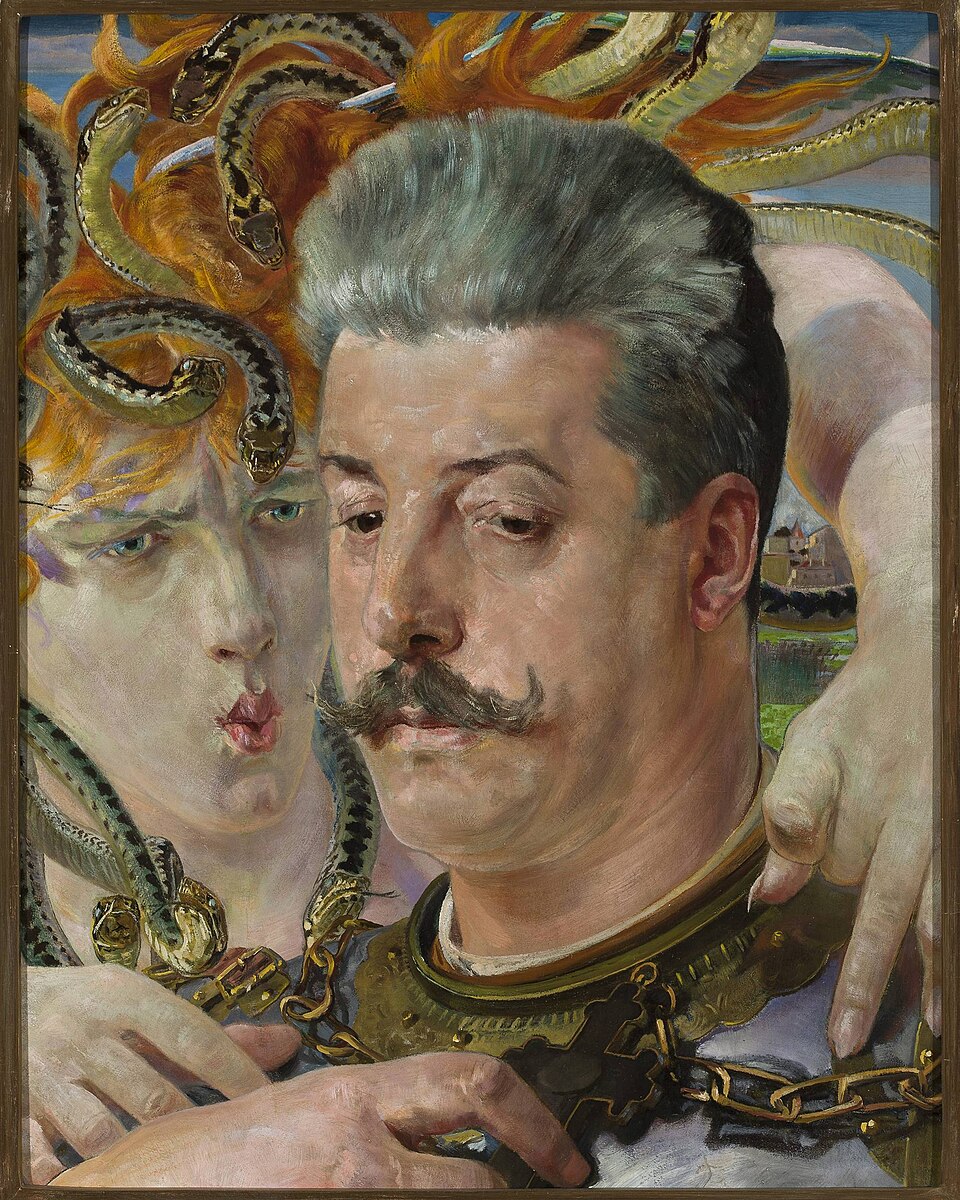
At the edges of the known world, in a cove beaten by waves where the Gorgon's cave opens onto the sea, Poseidon returns to find Medusa. The foam clings to the rocks, the snakes of her hair hiss in the salty gloom. The god of the golden trident loved her once, in a meadow covered with spring flowers, long before her face became terror. He comes to listen, without averting his eyes like all others, to the woman who survives behind the monster.
—Medusa, I knew you mortal when your two sisters, Stheno and Euryale, were not. Does this fate that sets you apart from them weigh on you?
You remember, then, you god of the golden trident, that among the three Gorgons I am the only one who can die. Stheno and Euryale will never age, never bleed; I carry death within me like a share of humanity that was not taken away. That spring meadow where you loved me, I still see it — I was beautiful, I was alive, and that meant I could end. My sisters watch over me in this cave at the world's end, but they do not understand the fear I have of the blade. To be mortal among immortals is to be alone twice: a monster among men, perishable among goddesses.
To be mortal among immortals is to be alone twice.
—It is whispered that Athena changed you. You who were so beautiful, so proud of your hair — tell me what happened in her temple.
My hair, yes — they celebrated it more than all the rest of me. Then came the wrath of Athena. According to what men report, she found me defiling her sanctuary, or else jealous of my beauty, and with a gesture she turned my curls into venomous snakes. The face you caressed, she twisted into a grimace. I did not choose this cold hissing that now crowns my brow. Do you understand this, you who know well who I was before? They say I am guilty, they say I am punished, but no one ever asks if the fault deserved such a punishment. The goddess turned a woman into a living warning.
They say I am punished, but no one ever asks if the fault deserved such a punishment.
—Living like this, cut off from men — how do you spend your days since your gaze petrifies everything it touches?
I wake up in this cave at the edge of the world, where Greek civilization sends only glory hunters. In the morning, I no longer dare turn toward a face, because turning means killing. I tend my snakes like one tends a wound that does not heal. In the afternoon, I watch the entrance, knowing that one day a man will come with a sword and cunning. In the evening, in the darkness, I become almost what I was — a form that threatens no one, since no one sees it. You were the last to look at me without turning to stone. Since then, my gift has become my prison: I petrify even my own solitude.
I petrify even my own solitude.
—A hero will come, it is said, armed by the gods. If he cannot meet your gaze, by what means do you think he will reach you?
By cheating, my friend, by indirection. No man can look me in the face — that is both my strength and my curse. So he will come otherwise: they say Hermes will lend him winged sandals, and Athena, always her, will give him a bronze shield polished like a mirror. He will see me only in that reflection, an inverted and cold image, and it is my own reversed face that will betray me. Think of the irony: the power that petrifies the world will be defeated by a simple gleam of bronze. They will not face me, they will sidestep me. The true courage of men is not to look at me — it is not to have to.
The power that petrifies the world will be defeated by a simple gleam of bronze.
—Does this mirror trick revolt you, you who could strike down anyone who faced you openly?
Revolt me? No. I know too well the law of the stories the Greeks tell. The monster is always powerful, and the hero always cunning — that is how they like their adventures to end. What troubles me is that the reflection condemns me to die without seeing my killer. I will see an image in a shield, not a man's gaze. You who loved me eye to eye, in that meadow of flowers, you measure what this takes from me. They say cunning is better than brute force; the poets will repeat it. But no one says what she feels who is struck down by turning away, as one does not look at a shameful thing.
I will see an image in a shield, not a man's gaze.
—And after the sword stroke, what becomes of that gaze? Do you think your death will extinguish what you carry, or that it will survive you?
That is what both soothes and terrifies me: my power will not die with me. The ancients say that my severed head will retain its stony force, even separated from my body, even with eyes closed by death. The hero will slip it into a magic bag, the kibisis, to carry it without perishing. Then he will use it — against a king, against enemies, still petrifying. Imagine, you who plumb the depths: to be dead and still kill. They even say it will end up set on the aegis of Athena, the very one who undid me, an ornament of her power. My face of torment will become the goddess's weapon. I will not know the rest of ordinary dead women.
To be dead and still kill.
—On the island of Seriphos, it is said, your head will serve a purpose. Does that console you to still be useful, or is it merely a second servitude?
Useful — what a strange word for a head without a body. At Seriphos, they say the hero will brandish my face against a king who persecuted him, and that king will turn to stone in the midst of his court. Thus I will serve a vengeance that is not mine, in a quarrel in which I have no part. Is that a consolation? I think rather it is the prolongation of my misfortune. Alive, I petrified those who approached; dead, I am brandished like a torch to petrify those they designate. My gaze no longer belongs to me, it serves the hand that holds me. You who loved me free in a meadow, you see what they have made of me: an object of terror that is drawn.
My gaze no longer belongs to me, it serves the hand that holds me.
—Yet your face will cover the shields of warriors, engraved to ward off evil. What do you feel about becoming, you the monster, a sign of protection?
That is the greatest reversal, and it surpasses me. The Greeks will take my grimacing mask — this face that Athena deformed to punish me — and place it on their shields, their doors, their amulets. They will call it the Gorgoneion, the effigy that turns away evil. The terror I inspire, they will turn against their own enemies, like a shield of fear. Think of the strangeness: the monster that is fled will become the guardian that is invoked. On the clay of amphorae, on the bronze of weapons, my dread will protect homes. I who petrify will watch over the living. They made me hideous to banish me; they will make me sacred to defend themselves. There is no logic of men, only their need for signs.
The monster that is fled will become the guardian that is invoked.
—On vases and temples, artists will reproduce you endlessly. This image that will survive you, do you recognize it as yourself, or as another?
Another, assuredly. The potters and sculptors will not carve the woman of the spring meadow, nor even the creature who suffers in this cave. They will freeze a mask: furrowed brow, tongue out, snakes raised, a cry arrested in clay. It is the terror they want, not me. My image will last longer than my former name, and it will say nothing of what I was before the wrath of Athena. You alone, perhaps, will keep the memory of the other face. Men love their monsters simple — a mouth that howls, a gaze that kills. They do not need me to also be a wounded woman. On their pottery, I will be eternal and unrecognizable at once.
My image will last longer than my name, and it will say nothing of who I was.
—Before returning to my depths, tell me, Medusa: if you could erase one moment from this whole story, which would you choose?
You ask the only question that still wrings something from me. I would not erase the meadow, nor your love, nor the flowers of that spring — that is all that remains of sweetness for me. I would not even erase my coming death, for a mortal must end, and there is a peace in that certainty. What I would erase is the moment my face became a weapon in the hands of others: the transformation, yes, but above all the use they will make of it afterward. To live a monster, I endure it. But to serve as sword and shield for quarrels not my own, even on the aegis of the one who undid me — that is what I wish I never had to bear. The rest, keep in memory for me.
I would not erase the meadow nor your love — that is all that remains of sweetness for me.
This imaginary interview was generated by artificial intelligence from sources documented in Medusa's profile. It dramatises what the figure might have said based on what we know about them, but does not constitute attested historical testimony. For primary sources and factual documentation, refer to the full profile.