Imaginary interview with Mirabai
by Charactorium · Mirabai (1498 — 1546) · Spirituality · Literature · 6 min read
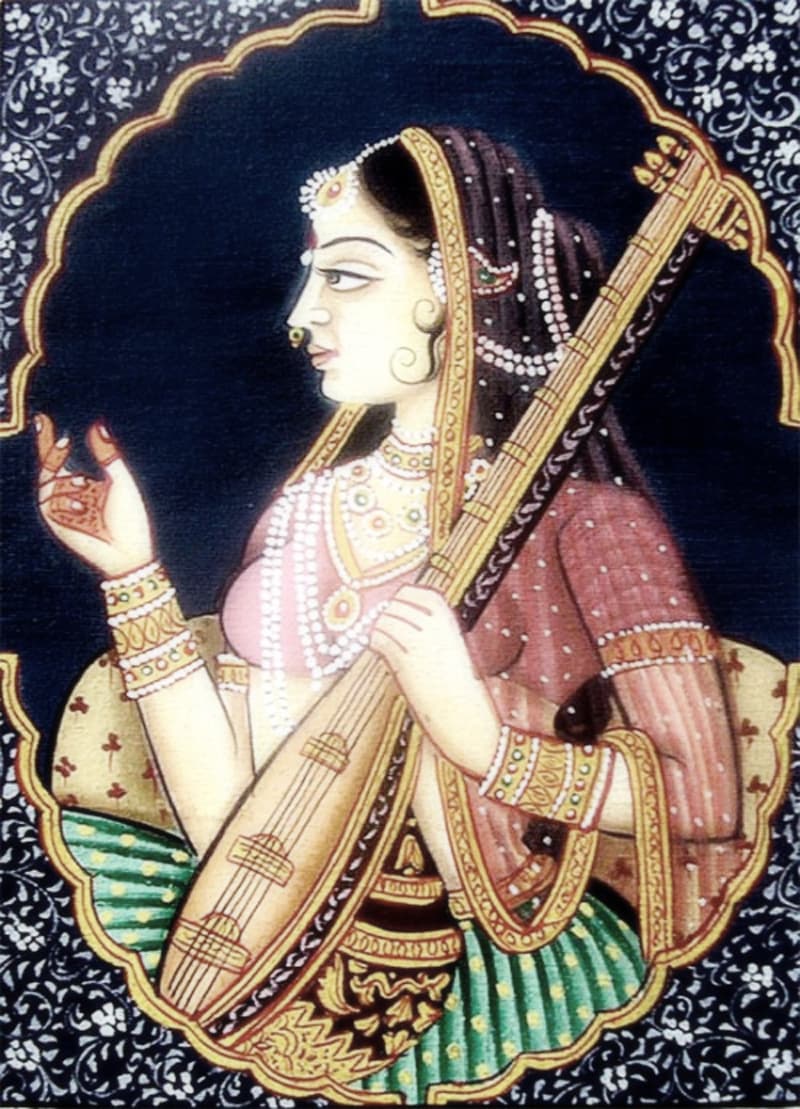
At dusk, on a ghat of Dwarka where Gujarat meets the sea, a woman in saffron veils sets down her ektara against the still-warm stone. They say she was a princess of Mewar; she says she has never had but one husband. She agrees to speak, on condition that she be allowed, between answers, to hum the name of her beloved.
—Do you remember the moment Krishna entered your life?
I was a child in Kudki, Rajasthan, when a wedding procession passed beneath our windows, and with it a small statue of Giridhar carried like a bridegroom. I asked my mother to whom that handsome husband belonged. She smiled, thoughtlessly, and replied: he is yours. A mother's word, light as a grain of dust — but I gathered it like an oath. From that day, the god who lifts Mount Govardhan was no longer a clay image for me: he became my husband, my only husband. Other little girls played at getting married; I was already a wife, and I knew it only too well. People laugh at such things in palaces. They laughed less when I refused to budge all my life.
A mother's word, light as a grain of dust — but I gathered it like an oath.
—At the death of your earthly husband, sati was expected of you. How did you resist that expectation?
When Bhoj Raj died, in 1521, the women of the house already brought me the red of widows promised to the pyre. A Rajput woman does not argue sati: she mounts her lord's fire, and the clan's honor burns with her. But how could I be the widow of a man, I who had never ceased to be the wife of another? One does not throw oneself into flames for a husband when one's true husband is eternal and does not die. I said this without lowering my eyes, and it chilled them more than my refusal. A woman who weeps is consoled; a woman who does not feel widowed because she considers herself married to a god is feared. That day, my in-laws understood that I would never belong to them.
One does not throw oneself into flames for a husband when one's true husband is eternal and does not die.
—How are your bhajans born? Where does this flood of songs come from?
They are born before daybreak. I rise when night still hesitates, I offer Krishna the flower, the incense, the flame of the diya, I tell my mala of tulsi while reciting his names — and the verses rise on their own, like water from a spring that no one dug. The simplest of all is one line I repeat tirelessly: "Mero to Giridhar Gopal, dusaro na koi" — "My only support is Giridhar Gopal, there is no other." The rest of the day, I sing it in the squares, my ektara with a single string against my shoulder, that poor lute of a wandering saint that can play only one note, always the same, like my heart. I do not compose: I let flow what overflows.
—Your songs blend with classical music as well as folk dances. Why this mix?
Because Krishna is danced as much as he is prayed. I have set some of my songs to the ragas of classical music — this is what is called my Raag Govind — so that devotion marries the rigor of the modes. But I have also given my verses to the women of Gujarat who circle for the garba, during the nights of Navratri, clapping their hands around the lamp. There, caste matters little, rank matters little: in the evening kirtan, the maidservant sings beside the queen, and the god makes no distinction. That is what bhakti taught me — not a science reserved for Brahmins, but a love that the lowliest peasant woman can sing as loudly as I. My bhajans have no owner; they belong to every mouth that repeats them.
In the evening kirtan, the maidservant sings beside the queen, and the god makes no distinction.
—It is said that someone tried to poison you. What happened?
My public devotion shamed the royal house of Chittorgarh: a princess who dances barefoot with sadhus, who opens her door to beggars, who sings of her divine husband before everyone — what dishonor for Rajputs! So they sent me, several times, what they presented as prasad, the sanctified food that no devotee refuses. The poison was hidden in it. I brought the cup to my lips while uttering the name of Giridhar, as I would have done with any offering, for what comes in the Lord's name cannot harm me. And I did not die. People spoke of a miracle; I see only the simplicity of trust. Whoever drinks thinking of Krishna never drinks death.
Whoever drinks thinking of Krishna never drinks death.
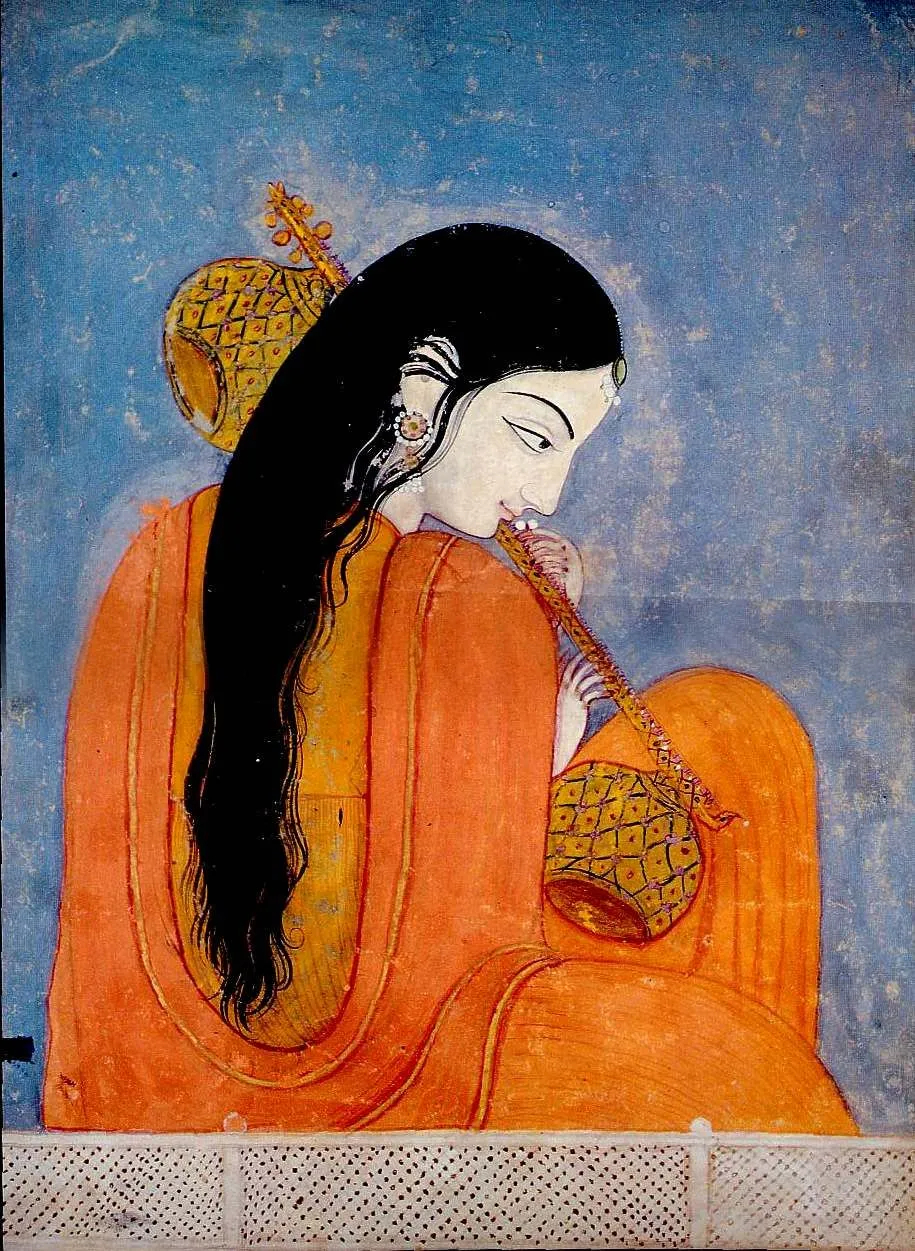
—Why did your in-laws so fear your songs in the streets?
Because a queen of Mewar does not show herself. Her place is behind walls, her honor in silence, her face hidden. And yet, from 1527, I openly frequented holy men, sat with them, sang on the temple steps like a common woman. The Rana saw in my fervor an insult to his name, almost a betrayal, for in the Rajput code a woman's dharma comes before her soul. They watched me, locked me up, threatened me. But how can you stop a river from flowing to the sea? The more they tightened the walls, the more my bhajans overflowed. I understood then that I could not serve two masters: the clan that wanted my shame silent, and the god who wanted my joy sung. I chose the song.
—What finally decided you to leave the palace for good?
A day comes when the cage, even if made of marble, no longer suffices. Around 1534, I crossed the gates of Chittorgarh for the last time, without escort, without heavy jewels, taking only my statuette of Krishna and the patra, that pilgrim's bowl in which one receives alms. I left royal apartments for temple porticos, a silk bed for a mat laid on the bare earth, festive prasad for the handful of rice a devotee hands you. They thought me fallen; I felt freer than ever. The road to Vrindavan and Mathura, to the childhood lands of my beloved, was worth all the thrones of Rajasthan to me. A queen can lose everything and lose nothing, if what she seeks is not found in any chest.
They thought me fallen; I felt freer than ever.
—In Vrindavan, an ascetic is said to have refused to receive you because you were a woman. What did you reply?
Yes. I arrive in Vrindavan, my heart full of the places where Krishna played as a child, and I am told that a great ascetic does not receive women, that no woman may cross the threshold of his retreat. I smiled at this misunderstanding. I sent back word that to my knowledge there existed in the whole universe only one true man — Krishna himself — and that all of us, he the saint and I the pilgrim, were but maidservants in love with that sole husband. How, then, could one claim to be a man before Him? They said he came out at once to greet me, confounded. I had not meant to mock him: it is the naked truth of bhakti. Before the Beloved, there is no caste, no rank, no man, no woman — there are only souls awaiting a glance.
Before the Beloved, there is no caste, no rank, no man, no woman — there are only souls awaiting a glance.
—It is said that Emperor Akbar himself came to hear you. What remains of that encounter?
They say he came disguised as a simple beggar, mingling with the crowd of devotees to hear my bhajans without being recognized. I did not know that Emperor Akbar was sitting there among the sadhus in rags — and what would I have done with a crown, I who sang for another majesty? At the end, he placed, they say, a precious necklace at my feet, as a tribute. One jewel more or less changes nothing for one who has already given everything; but the gesture touched me, for it came from a man who had no reason to bow. Before Krishna, the most powerful sovereign of India was only an anonymous devotee among others. That is what my songs do, when they are true: they erase thrones.
Before Krishna, the most powerful sovereign of India was only an anonymous devotee among others.
—That visit, however, brought you new misfortunes. How did it end?
When the Rana of Mewar learned that a Muslim, and the emperor at that, had entered his sister-in-law's circle and touched a Rajput princess with his offerings, his fury knew no bounds. For him, it was a stain added to the scandal, the clan's honor trampled once again. The threats redoubled, and I understood that I had to go farther, to Dwarka, the holy city of Gujarat where they say my Krishna once reigned. It was there, on those ghats facing the sea, that I spent my last years, around 1546, still composing. Tradition holds that I merged into the statue of the Ranchhod temple, absorbed by the one I had loved all my life. I do not know; I only know that I never stopped walking toward him.

This imaginary interview was generated by artificial intelligence from sources documented in Mirabai's profile. It dramatises what the figure might have said based on what we know about them, but does not constitute attested historical testimony. For primary sources and factual documentation, refer to the full profile.