Imaginary dialogue between Merlin and Morgan le Fay
by Charactorium · Morgan le Fay · Mythology · 5 min read
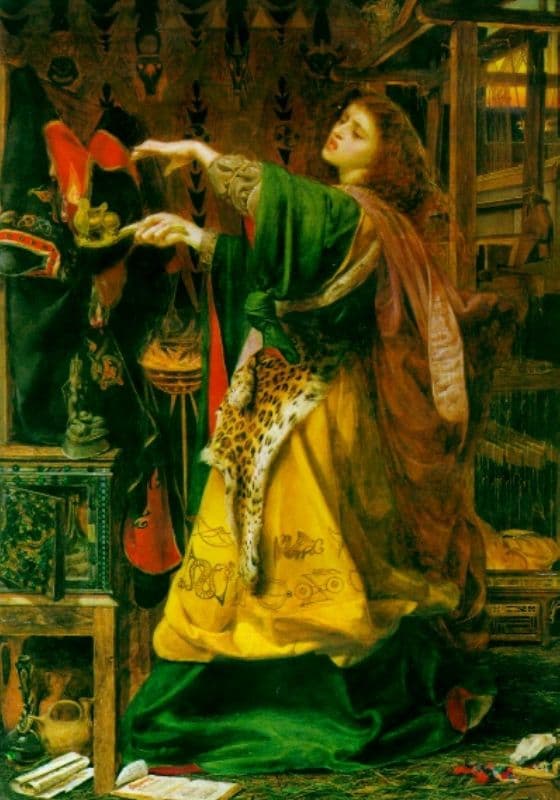
It is on the misty shores of the lake that leads to Avalon, where water merges with sky, that Merlin meets Morgan one evening when the willows bend under the Breton wind. A dark boat waits, moored to a rusty iron ring, and the scent of medicinal herbs rises from the island's gardens. They have known each other since the days of Arthur's court, where their arts so often measured themselves against each other and sometimes allied. Merlin has not come as a judge, but as a rival who wants to hear, from the enchantress's own mouth, what she has done with her magic.
—Morgan, here you are queen of this Avalon that no one else can reach. You who have so often defied me, tell me: what did you want to make of this island?
You know better than anyone, Merlin, you who have seen the kingdoms of men crumble like sandcastles. Avalon is not a land, it is a threshold — a place outside time where wounds stop bleeding and where the ancient arts do not die. My nine sisters reign with me, skilled in the science of plants and balms. When the world of men burns its pyres and forgets Celtic knowledge, I keep them here, safe. They have called me evil; but who else built a refuge for what kings let die? Avalon is my answer to a world that only knows how to destroy.
Avalon is not a land, it is a threshold where the ancient arts do not die.
—It is whispered that you took in Arthur after Camlann. You crossed the lake with his broken body — why save the one they call your enemy?
You ask as if hatred and care were mutually exclusive, Merlin. My brother lay on the field of Camlann, his side opened, abandoned by his own. I sailed to Avallon, as it is written, where I could heal his wounds with my art. I did not heal him to return him to the throne: I put him into a sleep without end, suspended between life and death. You would call me a conductor of souls, and you would not be wrong. A king does not truly die as long as a woman's hand watches over him. Whether that disturbs or reassures you, it is I who now hold Arthur's sleep.
A king does not truly die as long as a woman's hand watches over him.
—Daughter of Ygerne and the Duke of Cornwall, half-sister of the king — and yet you supported Mordred against him. How do you bear this double nature?
Blood does not make obedience, Merlin. Yes, I was born at Tintagel, daughter of Ygerne, and the same womb carried us, Arthur and I. But this brother, I saw him ascend a throne that magic had pulled him to — and you are not innocent in that matter, you who deceived Ygerne. When I supported Mordred, I did not betray: I claimed a share that had been denied me. Men say I am a witch and evil. So be it. I am the shadow that reminds the king that he is not alone in ruling. They will never understand me with a single glance, and that is just fine.
I am the shadow that reminds the king that he is not alone in ruling.
—You speak of my deceptions without flinching. Do you remember, when we both sat at court, how our arts opposed each other? What did you think of me then?
I found you brilliant and reckless, Merlin — immense knowledge at the service of a single king. You bet all your science on Arthur, and I distrusted thrones. We were two slopes of the same mountain: you the counselor, I the enchantress relegated to the margins. I remember that you feared my castles and the enchantments with which I bound those who ventured into them. You were right to fear them. But I never wished your downfall; I wanted to prove that a woman could equal the greatest of mages. Even today, speaking with you is sweeter to me than speaking with kings.
We were two slopes of the same mountain: you the counselor, I the enchantress relegated to the margins.
—Your mirrors, your potions, your grimoires — they say you rival me in the art of enchantments. Where does this knowledge come from, Morgan?
From where all true knowledge comes: from time and patience, Merlin. My mornings I spend bent over grimoires and treatises on herbalism, even before the court awakens. I know the plants that heal and those that put to sleep, the mirrors where visions of what is not yet can be read, the potions that transform. These are the arts of the ancient Celts, those before the crosses and the new altars. You would call them sorcery; I call them memory. One learns these things drop by drop, never all at once. My power is not a gift fallen from the sky — it is a lifetime of vigils.
You would call them sorcery; I call them memory.

—They say you possess a mirror where hidden things can be seen. What have you read in it, you who claim to know secrets even I am ignorant of?
The mirror does not show what one desires, Merlin, but what one fears. I saw the Round Table scatter, the knights fall one by one, and the kingdom of Britain retreat before those who come from the East. I also saw things I will not tell — for shared knowledge becomes a weapon in hands that do not deserve it. You understand that, you who kept your own prophecies to better dispense them. The mirror teaches me above all humility: seeing the future does not mean being able to change it. You gain clairvoyance, you lose peace.
The mirror does not show what one desires, but what one fears.
—And the sword — that Excalibur whose forging they say you know? What is your part in the destiny of that blade?
Much has been embroidered about that blade, Merlin, and you know how bards like to exaggerate our roles. Let's say I know the secret of weapons that do not break, and that nothing enchanted in this kingdom is entirely foreign to me. Excalibur is more than iron: it is royal power made metal. Whether they say I forged it or only guarded it, the essential lies elsewhere: such a weapon always calls for a guardian, and it is a woman's hand that rises from the lake to receive it. The king thinks he possesses the sword. In truth, it is the sword that chooses whom it returns to — and I watch over that return.
The king thinks he possesses the sword; in truth, it is the sword that chooses whom it returns to.

—It is whispered that you abducted the young Lancelot to raise him with your magic. Is that true, or is it just another tale the clerics attribute to you?
The clerics attribute everything to me, Merlin — the worst as well as the wonderful. Yes, in some traditions, I took in the child Lancelot and kept him near me before returning him to the world of knights. Protective, some say; manipulative, others say. The truth is that storytellers never know where to place me, so they make me in turn a benevolent fairy and a treacherous enchantress. That suits me. A woman who cannot be confined to a single story keeps her power intact. Raising a hero, training him, then letting him go: that is an art more subtle than war, and far less recognized.
A woman who cannot be confined to a single story keeps her power intact.
—The manuscripts rewrite you constantly, from one parchment to the next. Does it not trouble you to be thus reshaped by hands you do not know?
Trouble me? On the contrary, Merlin. As long as they write about me, I live. Each copyist, each clerk bent over his manuscript remakes me in his image: sometimes a wise healer, sometimes a malevolent witch. Geoffrey called me learned in medicine and incantations; others want me as the king's sworn enemy. No matter the contradiction — it is what makes me elusive. A figure too clear wears out and is forgotten; an ambiguous figure crosses the centuries. You too will be rewritten, my old rival, and you will not be able to do anything about it. Better to be a living enigma than a dead truth stored on a shelf.
As long as they write about me, I live.
—The hour grows late and the lake darkens. Before I take my boat again, tell me, Morgan: what do you fear to see disappear?
Knowledge without a guardian, Merlin. The balms that will no longer be prepared, the plants that will be called cursed, the ancient voices that will be drowned out by hymns. The world of men advances, and with each step it forgets a little more where it comes from. That is why I keep Avalon, why I watch over Arthur's sleep and over the relics of the kingdom. As long as my island remains, nothing is entirely lost. You and I are the last of a time when magic and knowledge were one. Go, take your boat — but remember that on this lake, it is always a woman's hand that decides who passes.
As long as my island remains, nothing is entirely lost.
Read further
This imaginary interview was generated by artificial intelligence from sources documented in Morgan le Fay's profile. It dramatises what the figure might have said based on what we know about them, but does not constitute attested historical testimony. For primary sources and factual documentation, refer to the full profile.