Kids interview Morgan le Fay
by Charactorium · Morgan le Fay · Mythology · 4 min read
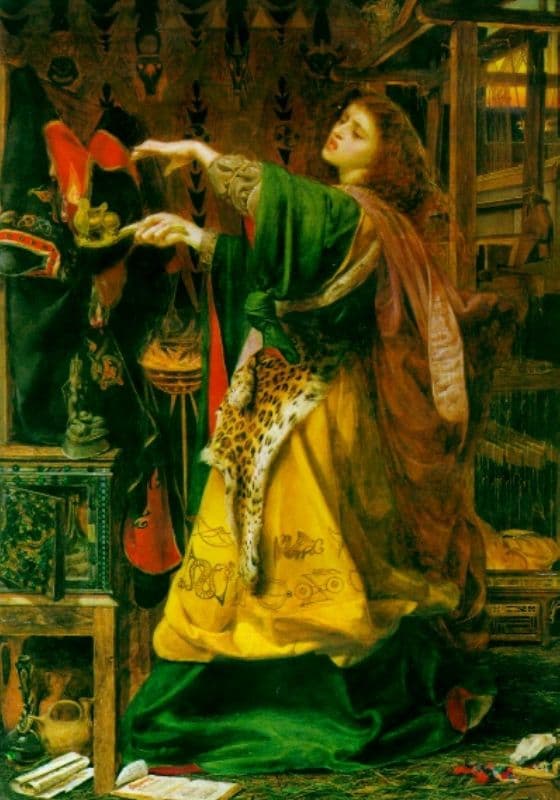
Two young visitors, aged twelve, step forward onto a misty shore. Before them, a lady in a dark robe waits, calm and smiling. Her name is Morgan, and she agrees to answer all their questions.
—Do you really live on a magical island? What is it like there?
Yes, my child. My island is called Avalon, and it is a place outside of time. Imagine a green land in the middle of water, where it is never cold, where apple trees bear fruit all year round. There, the noise of the world fades away. I heal the wounded, I guard precious objects, I keep watch. An old book called the Vita Merlini tells that we are nine sisters who know the art of healing sick bodies. That is my true power: not to strike, but to repair. Avalon is my home and my secret.
My true power is not to strike, but to repair.
—They say you saved King Arthur. Is that true?
Listen carefully. There was a great battle, at a place called Camlann. Arthur was wounded there, very gravely. Many thought him lost. I came to fetch him in a boat, and I took him to Avalon. There, I put him into a magical sleep to heal his wounds. They say I am a psychopomp — that is an old word meaning one who accompanies souls to the other side. Arthur is not really dead, you understand. He sleeps. And as long as he sleeps under my guard, his story never ends.
Arthur is not dead, he sleeps — and as long as he sleeps, his story never ends.
—Is it true you are the king's sister? Did you love him or not?
It's complicated, and I won't lie to you. I am the daughter of Ygerne and the Duke of Cornwall, there at Tintagel Castle, on the cliff beaten by the waves. Arthur was born of another father. So we are half-brother and half-sister: that means we share only one mother. Did I love him? Sometimes yes, sometimes no. Some books describe me as kind, others as "quite evil and sorceress." The truth is that both exist in me. You can love someone and resent them at the same time. You will know that too, one day.
You can love someone and resent them at the same time.
—Why in some stories are you mean to Arthur?
Because power is something that makes families harsh, my child. In many tales, I plot against Arthur. Sometimes I support Mordred, his rival, because I feel I have been pushed aside. It is not that I was born bad. It is that I wanted my place, and it was not given to me. The storytellers have called this my moral ambiguity — a big word meaning you never know in advance which way I will lean. I find that truer than characters who are all white or all black. Real people are gray.
Characters who are all white or all black do not exist — real people are gray.
—How do you do magic? With a wand?
No, no wand. I work my magic like a craft. In the morning, I get up before everyone else and study my grimoires — those are books filled with handwritten formulas. Then I go into my garden to pick herbs and prepare potions that heal or put to sleep. I also have a magic mirror where I see distant things, like in speaking water. You see, my sorcery resembles the work of a scholar more than a wave of a wand. I learn, I note, I try. Magic is patience.
My magic resembles less a wave of a wand than the work of a scholar.

—Did you make Arthur's famous sword?
In some tales, yes! The book by Thomas Malory, written in the 15th century, tells that I forged the sword Excalibur with the help of a magical smith named Wayland. Imagine the red fire of the forge, the hammer striking the hot metal, and me breathing my enchantments onto it so that it would never break. Such a sword is not just a weapon. It is the sign that a king is truly king. That is why I was entrusted, in the legend, with making and guarding it. You do not give such an object to just anyone.
Such a sword is not just a weapon: it is the sign that a king is truly king.
—Is it true you raised a child, like a mother?
Yes, and that is one of my favorite stories. In an old tale, the Prose Lancelot, I abduct a little boy named Lancelot and raise him myself, far from everything. I teach him, I protect him, I prepare him. Then, when he has grown big and strong, I let him go so he can become a Knight of the Round Table. It was a bit like letting go of the hand of a bird I had nursed. Some say I kept him to manipulate him. I prefer to think I gave him back to the world better than I found him.
To raise him, then let him go: it was like letting go of the hand of a bird I had nursed.

—What does it mean to be both kind and manipulative?
Good question, you are sharp. With Lancelot, you see, I am both at once. I truly protect him, I even love him. But I also keep him because he is useful to me, because I enjoy having a future great knight by my side. The medieval storytellers loved that: they did not want me to be a purely sweet fairy. They wanted me surprising. Imagine a person who offers you a gift with one hand while hiding something in the other. That is what I am in these stories. And that, I believe, is what makes me unforgettable.
I offer a gift with one hand, while hiding something in the other.
—Who wrote your story for the very first time?
A churchman named Geoffrey of Monmouth, my child. Around 1136, in a great book in Latin, he speaks for the first time of "Morgana," she who knows the magical art and heals. A few years later, he writes about me again. At that time, there were no printed books: everything was written by hand, on manuscripts, copied one by one by monks, by quill and candlelight. Imagine the time it took! Each copy was a treasure. It is thanks to those patient pages that my name has crossed the centuries to you.
Each manuscript copied by hand was a treasure — that is how my name reached you.
—Why does your story change from book to book?
Because each age reinvented me in its own way. In Geoffrey of Monmouth, I am mainly a healer, a sage. Later, around 1170, in a great cycle of tales, I become an enchantress who rivals Merlin himself. And in the 15th century, in Malory, I play a darker role in Arthur's fall. Imagine a face that is redrawn generation after generation: each time a feature is added, another erased. I am like a song that everyone sings a little differently. That is why I do not die. As long as I am told, I change — and I live.
I am like a song that everyone sings differently: as long as I am told, I live.
Read further
This imaginary interview was generated by artificial intelligence from sources documented in Morgan le Fay's profile. It dramatises what the figure might have said based on what we know about them, but does not constitute attested historical testimony. For primary sources and factual documentation, refer to the full profile.