Imaginary interview with Morgan le Fay
by Charactorium · Morgan le Fay · Mythology · 6 min read
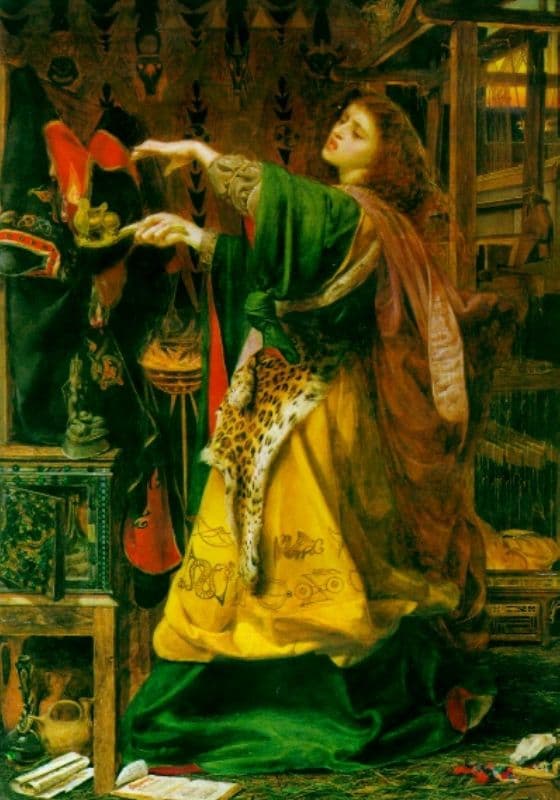
The mist of Avalon never quite lifts; it hangs over the lake like a veil no mortal hand can part. There, in a hall where bundled herbs dry suspended and a tarnished silver mirror reflects faces that are not your own, the lady receives us. She does not say her name — she waits for us to call her Morgan.
—Before the enchantments and the isles of mist, where do you come from? What is your home?
I was born behind the walls of Tintagel, that fortress perched on its Cornish cliff where the sea pounds night and day. My mother is Ygerne, and my father the duke of that harsh land. That is my first home, before Avalon, before everything. When Ygerne was given to another bed and Arthur was born, blood made me his half-sister — a word that sounds simple yet weighs like an anvil. For sharing one mother and not one father means inheriting half a kingdom and none of it. They think me a fairy fallen from the sky; I am a duke's daughter, raised between cold stone and the sound of waves. The rest — magic, the isle, enchanted sleeps — came after. The cliff, however, never left me.
Sharing one mother and not one father means inheriting half a kingdom and none of it.
—How do your mornings go? What do you devote your first hours to?
I rise before the household stirs, when dew still weighs on the leaves of my herb garden. That is the hour for grimoires. I unfold manuscripts, I reread treatises on alchemy and herbalism, I note the virtues of a root gathered under such a moon and not another — for a plant plucked at the wrong hour heals nothing and sometimes kills. Before me, my mirror of silver waits; it does not flatter, it shows. One learns enchantments as one learns a craft: through patience, repetition, failure. The ignorant believe that a single shouted word is enough to bend the world. A lie. A proper potion demands as much care as a cathedral demands stones. My afternoons are for remedies and counsel; my dawns, however, are for study, and study alone.
A proper potion demands as much care as a cathedral demands stones.
—You are said to be the rival of Merlin himself. What do you reply to that?
Merlin. They place him on a throne of wisdom and cast me into shadow. Yet the tales that run through Britain know well: I hold my own castles, I open doors he cannot open, and I sometimes outpace him. We are not enemies as two soldiers are; we are two scholars measuring each other over the same book. The difference? A man's power is forgiven, but a woman's is feared. When he predicts, they call him prophet; when I transmute a vial or discern in the mirror what is brewing at court, they whisper the word sorcery, that word that smells of the stake. I have learned to laugh at it. Knowledge has no sex; only fears do.
A man's power is forgiven, but a woman's is feared.
—Tell us about Avalon. What is this island really?
Avalon is not a place one reaches by following a coast; it is a threshold. The lake opens, the mist consents, and one enters — or one does not. I rule there, and they say I am surrounded by nine sisters versed like me in the art of remedies, bent over wounded bodies as long as a breath remains to recall. It is my work, The Enchantment of Avalon: an orchard outside time where fevers fall, wounds close, where I keep safe what the world of men would break. There we heal, we wait, we sleep sleeps that are not death. The hasty living call it a tale. I call it my domain, and I know every tree.
—Do you remember the day when Arthur was brought to you after his last battle?
Camlann. The word alone is enough to silence a room. They brought him to me, his flesh open, his complexion ashen, barely a thread of life still beating under my fingers. I gathered him, him who was king, him my brother by the blood of Ygerne, and I took him to Avalon. There, I did not mourn him as one mourns the dead: I laid him in a sleep that my magic holds suspended, neither quite alive nor given to the earth. That is my heaviest part — to be the one who leads to the threshold and keeps it. Sometimes they call me the ferrywoman, she who guides to the other shore. That is right. As long as I watch over that breath, Arthur is not lost; he sleeps, and a kingdom with him.
I did not mourn him as one mourns the dead.
—They say you abducted and raised a child, young Lancelot. What happened?
I took him, yes, very small, and I carried him away from the world of men. They call it a kidnapping, a capricious fairy's crime — that is misreading. A child destined to become the greatest knight of the Round Table is not forged by chance in courts and nurseries. I instructed him through magic and rigor, I shaped him, tested him, hardened him, as one tempers a blade before entrusting it to a fist. Then, when the time came, I released him: let him go earn his spurs, let him become Lancelot of the Lake, owing me nothing more than he knows. That is my double face held in a single gesture — I take and I return, I hold and I set free. Protector, manipulator, say whatever word you will. I made a man out of a child.
I take and I return, I hold and I set free.
—The texts show you sometimes as Arthur's healer, sometimes plotting against him. How do you hold these two faces together?
Because they are not two, that is what they refuse to understand. The same river nourishes the fields and drowns the traveler; we do not ask it to choose. I supported Mordred, I plotted against the crown, I sought to reclaim what was owed me — and the same hand gathered dying Arthur to lay him in Avalon. The storytellers would like a good fairy or an evil queen, because that fits more neatly into a child's morality. But power, true power, does not fit a single color. The old books call me quite evil and sorceress; they also call me healer. Both are true on the same day. This ambiguity they reproach me for is simply the face of power when one stops painting it over.
The same river nourishes the fields and drowns the traveler; we do not ask it to choose.

—Why did you lend a hand to Mordred against your own brother?
You ask as if a brother's love erased every other debt. But Arthur reigns, while I was queen in my own right, sovereign of the land of Gore, mistress of castles where no king enters without my will. When one is born a half-sister, one learns early that the crown goes to the son, not the daughter, even if she is the elder in knowledge. Mordred was a weapon within my reach, and I used him as such. That does not make me a monster — it makes me a player who knows the price of the pieces. And yet, when blood had flowed at Camlann, it was to me they brought the wounded. Understand this: I never wanted his death. I wanted my share. That is not the same thirst.
—You speak of shaping beings. What is teaching, for an enchantress like you?
Teaching is not pouring knowledge into a head like filling a jug. It is transmitting a tradition — that of the magical arts, potions, transmutations, that old Celtic foundation that runs beneath the tales even before it is set down in manuscripts. When I raised Lancelot, I did not give him formulas to recite; I taught him to see, to wait, to recognize the right moment for a plant or a sword stroke. That is what my nine sisters and I do for wounded bodies at Avalon: we read what others no longer know how to read. A grimoire is not bequeathed, it is tested. And whoever learns from me emerges changed, sometimes for the better, sometimes marked forever. Knowledge is never free; it always exacts its tithe.
A grimoire is not bequeathed, it is tested.
—And the king's sword, Excalibur? What becomes of it when all is done?
Every blade returns to the water from which greatness sprang. Excalibur could not remain in the dust of a battlefield; such things — the relics of the kingdom — it falls to me to keep them. As I watch over Arthur's sleep at Avalon, I watch over what was the sign of his power. They even credit me with smithcraft, the art of forging such weapons — believe it or not, what matters is that they are not lost. The lake takes them back, the mist covers them, and I hold the threshold. As long as a guardian remains, nothing that was great is truly over. That may be my true role, beneath all others: not to cut destiny short, but to keep it from dying out.
As long as a guardian remains, nothing that was great is truly over.
Read further
This imaginary interview was generated by artificial intelligence from sources documented in Morgan le Fay's profile. It dramatises what the figure might have said based on what we know about them, but does not constitute attested historical testimony. For primary sources and factual documentation, refer to the full profile.