Imaginary dialogue between Horus and Thoth
by Charactorium · Thoth · Mythology · 5 min read
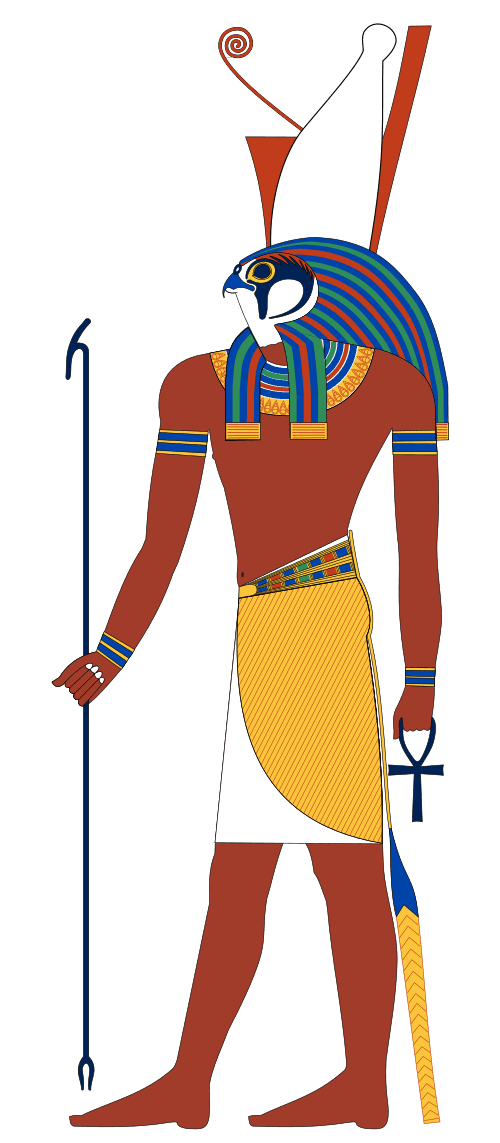
It is in Khemenu, which men will one day call Hermopolis, that Horus comes to find Thoth in the great hall of the temple where the papyri sleep. The evening light glides over the bronze ibis statues, and the scent of cut reeds still lingers near the palette of the god-scribe. Horus has not forgotten: it was this ibis-headed sage who, before the tribunal of the gods, weighed the words and restored his right against Seth. The falcon comes to question the one who holds the reed by which everything was recorded.
—Thoth, you who gave the scribes their craft, tell me: where does this power come from to trace the sacred signs that men call hieroglyphs?
Horus, these signs are no chance invention. When the gods needed to fix their decrees, it was I who gave form to the sacred figures, as the old formulas carved in the stone of the Pyramids still say: he who gave form to the hieroglyphs. Every bird, every reed, every stroke you see on papyrus is a word made eternal. The scribes know this: without the sign, thought flies away like incense smoke. That is why they invoke me before setting down the reed, why they celebrate my festival every year. I entrusted them with the art of holding the world on a thin sheet. As long as a man traces my first sign, nothing that was said will ever be quite lost.
Without the sign, thought flies away like incense smoke.
—I have seen you so often with palette in hand, master of Khemenu. Why do these humble scribal tools matter so much to a god?
Because greatness, Horus, sometimes lies in small things: a wooden palette with two cavities, black and red, and a simple cut reed. With so little, the scribe records the harvests, the decrees, the names of the gods, and the count of days. The reed is my hand extended toward men. When a child learns to sit cross-legged, the board on his knees, it is my craft he receives, and it is me he honors without always knowing it. I also gave numbers and measures, for writing is not enough: one must count the granaries, survey the fields after the flood. These modest tools are the foundations on which all the order of the land rests.
The reed is my hand extended toward men.
—You remember the tribunal, Thoth. When Seth and I tore each other apart over Osiris's throne, it was you who weighed our words. Why did you take that role?
I remember it as if the balance still hung before me, Horus. You were young, burning with your right, and Seth roared his strength. Between the two of you, there needed to be someone who held neither for the fist nor for the cry, but for Maat, the balance of the world. I recorded every argument, recalled every law, weighed what had to be weighed. A mediator is not weak: he is the one who prevents the sky from splitting. If I had leaned out of favor, the order of the gods would have broken, and with it the order of men. I spoke so that justice would decide, not violence. Your throne you owe not only to your spear, but also to the reed that inscribed your cause.
A mediator is not weak: he is the one who prevents the sky from splitting.
—Seth is powerful and feared. Did you never fear, sage of Khemenu, that by arbitrating our quarrel you would make an enemy among the gods?
Fear is not the concern of the scribe, Horus. My weapon is not the club but the just word, and against it even Seth can engrave nothing lasting. My role is to keep the balance between forces, not to flatter them. Seth is the necessary disorder, the desert that borders the black land; you are the legitimate heir. To hold both in the same balance—that is to serve Maat. A counselor who only thinks of making friends betrays his charge. I said what was right, and I inscribed the verdict so that no one could later twist it. That is why the gods, even quarrelsome ones, return to me: one does not stay angry long with one who speaks truth.
My weapon is not the club but the just word.
—In the judgment hall, it is still you who inscribes the fate of the dead. What do you see, Thoth, when you place the heart on the balance of Maat?
I see the truth of an entire life, Horus, reduced to the weight of a heart. In the great hall, the deceased advances trembling; on one pan of the balance is placed his heart, on the other the feather of Maat. I stand there, reed ready, and I inscribe the verdict without anger or pity—only accuracy. If the heart weighs no more than the feather, the soul passes to the light. If it is heavy with lies, I record that too, for my function is not to save but to speak true. This is the gravest task entrusted to me: no one buys my reed, no one corrects my writing. What I inscribe before Osiris remains for eternity.
I see the truth of an entire life reduced to the weight of a heart.
—Your father Osiris rules over the dead, and it is before him that you write. Does it not weigh on you, Thoth, to hold the fate of souls at the tip of your reed?
It weighs, Horus, and that is right—a light judge would be a dangerous judge. Before Osiris, your father, I am not the master of fate but its faithful witness. I invent nothing: I read what the balance shows, and I fix it so that no voice, divine though it be, can change it. That is my heaviest greatness. Men pray to me that my reed be merciful to them, but my reed does not lie, even for those who love me. The deceased who lived according to Maat has nothing to fear from me; he who strayed from it, my writing reveals. To hold this reed is to bear the weight of all justice. I accepted it because without written memory, even the gods would forget their own laws.
My reed does not lie, even for those who love me.
—Men imagine you sometimes as an ibis, sometimes as a crouching baboon. Tell me, sage, why do you show yourself under these two animal faces?
Each form says something about me, Horus. The ibis, with its long curved beak that probes the Nile mud, patiently seeks its food as the scribe seeks knowledge: without haste, sign after sign. The baboon, for its part, rises at dawn and greets the rising sun; its vigilance and cunning speak of the intelligence that watches. Men have understood this: in their necropolises, they have mummified thousands of ibises and baboons to honor me, depositing these bodies like frozen prayers. I am not imprisoned in a single form, for knowledge too has no single face. Sometimes patient as the marsh bird, sometimes alert as the morning monkey—always turned toward the light of knowledge.
Knowledge too has no single face.
—You are also called lord of the moon, Thoth. What link binds the master of writings to the star that watches over Khemenu?
The moon and writing are sisters, Horus, for both measure and preserve. Look at the night star: it waxes, wanes, returns—and it is by it that I count the months, fix the festivals, order the time of men. Here in Khemenu, my priests watch its phases as one watches a great celestial register. The sun of Ra lights the day, but it is the moon that cuts duration into portions that can be written. I wear on my brow the crescent and the disk, for he who holds the reed must also hold the calendar. Without measurement of time, no harvest at the right moment, no ritual at the proper hour. Counting the nights is yet another way of writing the world.
Counting the nights is yet another way of writing the world.
—Foreign merchants flock to our temples, Thoth. You who know all languages, what will become of your name in the mouths of peoples from abroad?
Peoples change, Horus, but the need for knowledge does not change. Those who come from the islands and distant shores cannot pronounce my name in the Nile manner; yet they will recognize me under other words, for wherever men write, count, and seek wisdom, it is my function they name. The god of words and measures does not die when language changes; he translates. I will be called thrice-great, my treatises will be mingled with their mysteries. This does not trouble me. True knowledge travels better than an army and crosses borders that your spears will never cross. As long as any people, whoever they are, wants to hold the world through writing, I will be among them under whatever face.
True knowledge travels better than an army.
This imaginary interview was generated by artificial intelligence from sources documented in Thoth's profile. It dramatises what the figure might have said based on what we know about them, but does not constitute attested historical testimony. For primary sources and factual documentation, refer to the full profile.