 flip
flipSaffron Pilaf with Almonds and Currants
Saffron Pilaf with Almonds and Currants
Why this dish? Pilaf is the foundation of every Ottoman table, from the janissary's mess tin to the sultan's golden dish. At Topkapi, Mehmed II's kitchens prepared mountains of it daily; rice, a precious imported commodity, was a prestige food that saffron turned into edible gold.
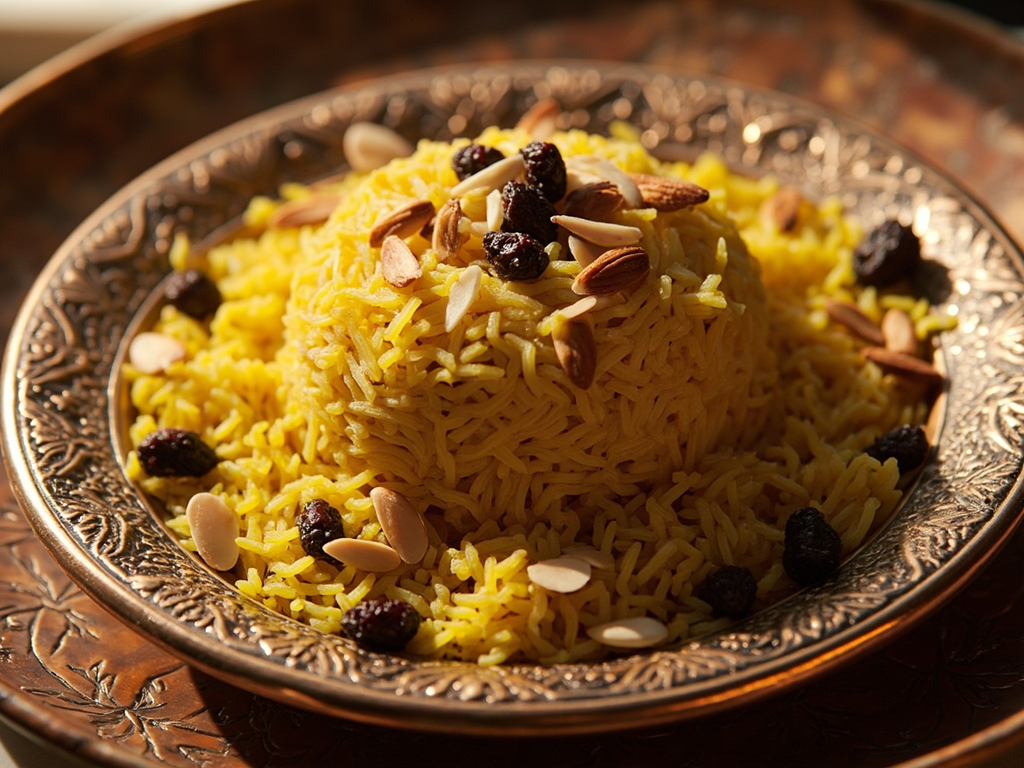
A pearly rice, bound with clarified butter, tinted with saffron, and studded with toasted almonds and tart little dried currants. Subtly sweet-savory, it is the noble everyday dish par excellence, the one that accompanies meats and stews.
Come closer and look at this rice that my cooks pile into a golden pyramid. I who took the city of Constantine and made Qustantiniyya my capital, I do not forget that an empire is first nourished by pilaf. We wash the rice until the water runs clear as the Bosphorus, sear it in melted butter, then let it swell covered, never disturbing it. The secret, mark it well: a cloth under the lid to absorb the steam, and the steeped saffron that colors each grain like a sun of victory.
- •Long-grain rice — a large measure (base)
- •Clarified butter (sadeyağ) — as needed (fat, binder)
- •Saffron — a few threads (color and aroma)
- •Blanched almonds — a handful (crunch)
- •Currants — a handful (sweet-sour note)
- •Salt — to taste (seasoning)
Saffron Pilaf with Almonds and Currants
A pearly rice, bound with clarified butter, tinted with saffron, and studded with toasted almonds and tart little dried currants. Subtly sweet-savory, it is the noble everyday dish par excellence, the one that accompanies meats and stews.
Why this dish? Pilaf is the foundation of every Ottoman table, from the janissary's mess tin to the sultan's golden dish. At Topkapi, Mehmed II's kitchens prepared mountains of it daily; rice, a precious imported commodity, was a prestige food that saffron turned into edible gold.
Come closer and look at this rice that my cooks pile into a golden pyramid. I who took the city of Constantine and made Qustantiniyya my capital, I do not forget that an empire is first nourished by pilaf. We wash the rice until the water runs clear as the Bosphorus, sear it in melted butter, then let it swell covered, never disturbing it. The secret, mark it well: a cloth under the lid to absorb the steam, and the steeped saffron that colors each grain like a sun of victory.
Ingredients (period version)
- Long-grain rice — a large measure (base)
- Clarified butter (sadeyağ) — as needed (fat, binder)
- Saffron — a few threads (color and aroma)
- Blanched almonds — a handful (crunch)
- Currants — a handful (sweet-sour note)
- Salt — to taste (seasoning)
Ingredients
- Basmati rice — 300 g (base)
- Butter (or ghee) — 60 g (fat, binder)
- Saffron — 1 pinch steeped in 2 tbsp hot water (color and aroma)
- Slivered almonds — 40 g (crunch)
- Dried currants — 40 g (sweet-sour note)
- Water or light broth — 450 ml (cooking liquid)
- Salt — 1 tsp (seasoning)
Method
- Rinse the rice in cold water until it runs clear, then drain.
- Toast the slivered almonds in a little butter, set aside. Soak the currants in a little warm water.
- Melt the remaining butter, add the rice and stir gently for 2 minutes until translucent.
- Pour in the salted hot water and steeped saffron, bring to a simmer, cover, and cook on very low heat for 12 to 15 minutes.
- Remove from heat, place a clean cloth between the pot and the lid, and let rest for 10 minutes.
- Fluff with a fork, scatter almonds and currants on top, and serve mounded.
How it was made : Topkapi kitchen records attest to enormous quantities of rice and clarified butter. Saffron and fruit-laden pilaf (almonds, currants, sometimes jujubes) belongs to the Persian tradition adopted and refined by the Ottoman court.
The contemporary twist : Mounded into a dome and dusted with saffron threads, styled as “Conqueror’s Rice,” with a spritz of rose water at serving.
Mehmet II · Charactorium