 flip
flipSinigang na baboy (sour pork soup)
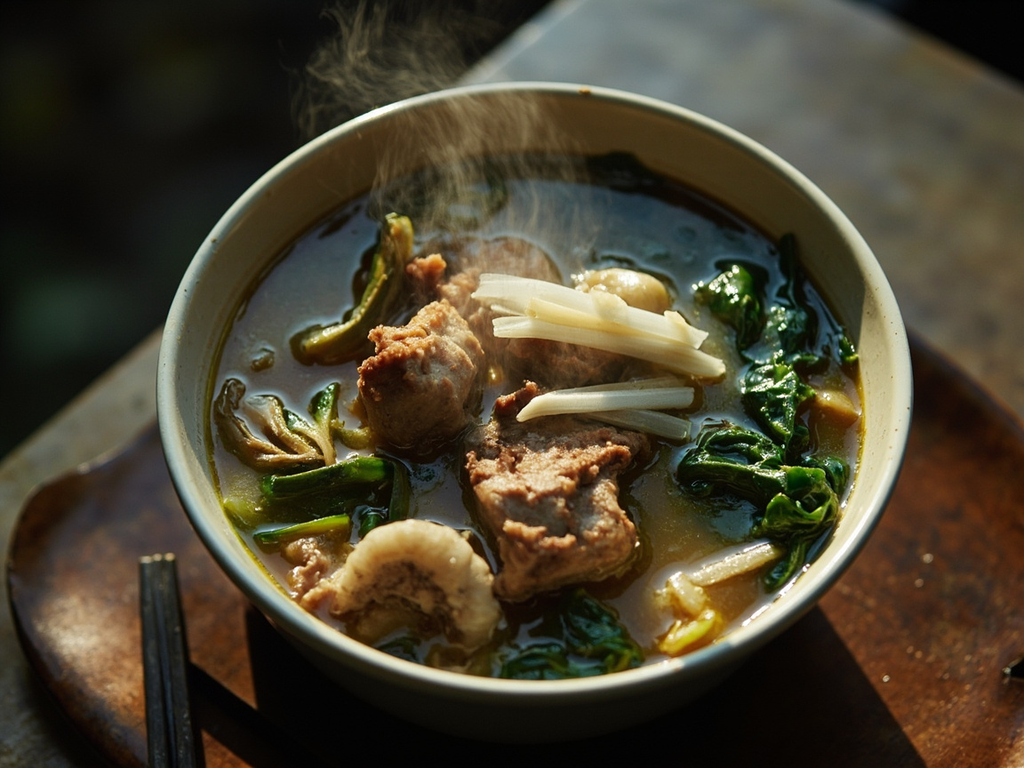
Sinigang na baboy (sour pork soup)
Why this dish? Sinigang, the sour tamarind soup, is cited in Abra's anchoring as one of his known meals. It's the comfort soup of Filipino families, warming during the monsoon, shared by pouring the broth over rice.
A clear soup made tangy with tamarind (sampaloc), filled with tender pork and vegetables: white radish, long beans, eggplant, water spinach. The lively acidity whets the appetite and balances the meat's fat.
When it rains on Manila – and believe me, it pours – there's nothing better than a good steaming sinigang. My family would boil the pork a long time so it got really tender, then we'd mash the sampaloc to get all its sourness, that taste that wakes up your mouth. We'd throw in labanos, sitaw, kangkong at the end so they stay crunchy. You pour the hot broth over your rice, dip a little bagoong in, and then you're good, really. It's the dish that brings you back home, no matter where you are.
- •Pork with bone (ribs) — a gelatinous piece (meat, broth)
- •Fresh tamarind (sampaloc) — a handful of pods (signature acidity)
- •White radish (labanos) — one, cut into chunks (vegetable)
- •Long beans (sitaw) — a bunch (vegetable)
- •Eggplant (talong) — one (vegetable)
- •Water spinach (kangkong) — a bunch (green vegetable)
- •Fish sauce (patis) — to taste (salty umami)
Sinigang na baboy (sour pork soup)
A clear soup made tangy with tamarind (sampaloc), filled with tender pork and vegetables: white radish, long beans, eggplant, water spinach. The lively acidity whets the appetite and balances the meat's fat.
Why this dish? Sinigang, the sour tamarind soup, is cited in Abra's anchoring as one of his known meals. It's the comfort soup of Filipino families, warming during the monsoon, shared by pouring the broth over rice.
When it rains on Manila – and believe me, it pours – there's nothing better than a good steaming sinigang. My family would boil the pork a long time so it got really tender, then we'd mash the sampaloc to get all its sourness, that taste that wakes up your mouth. We'd throw in labanos, sitaw, kangkong at the end so they stay crunchy. You pour the hot broth over your rice, dip a little bagoong in, and then you're good, really. It's the dish that brings you back home, no matter where you are.
Ingredients (period version)
- Pork with bone (ribs) — a gelatinous piece (meat, broth)
- Fresh tamarind (sampaloc) — a handful of pods (signature acidity)
- White radish (labanos) — one, cut into chunks (vegetable)
- Long beans (sitaw) — a bunch (vegetable)
- Eggplant (talong) — one (vegetable)
- Water spinach (kangkong) — a bunch (green vegetable)
- Fish sauce (patis) — to taste (salty umami)
Ingredients
- Pork spare ribs or ribs — 800 g (meat, broth)
- Tamarind pulp (or sinigang sa sampaloc mix) — 3 tbsp (acidity)
- White radish (daikon) — 1, sliced (vegetable)
- Long beans or green beans — 150 g (vegetable)
- Eggplant — 1, cut into chunks (vegetable)
- Spinach or water spinach — 1 bunch (green vegetable)
- Tomatoes and onion — 2 + 1 (aromatic base)
- Fish sauce (patis) — 2 tbsp (saltiness)
Method
- Boil the pork with onion and tomatoes in 2 L water; skim and simmer for 1 h until tender.
- Add tamarind pulp (or mix) to sour the broth; taste and adjust.
- Add radish, cook 5 min, then eggplant and long beans.
- Season with patis, add water spinach at the very end (1 min, it should stay green).
- Serve piping hot, with white rice and a small bowl of bagoong on the side.
How it was made : The souring agent varied with the season: tamarind, but also green guava, kamias (bilimbi), green mango, or batuan in the Visayas. Sinigang predates the arrival of the Spanish; it embodies the Filipino taste for asim (sourness). The tomato, added later, is a post-1492 contribution.
The contemporary twist : Metro Manila food courts offer sinigang in salmon version (sinigang na salmon) or even as sour ramen for young urbanites.
Sources : Doreen G. Fernandez, Tikim: Essays on Philippine Food and Culture, 1994
Abra · Charactorium