 flip
flipLauzīnaj (Almond and Rose Water Pastry)
Lauzīnaj (Almond and Rose Water Pastry)
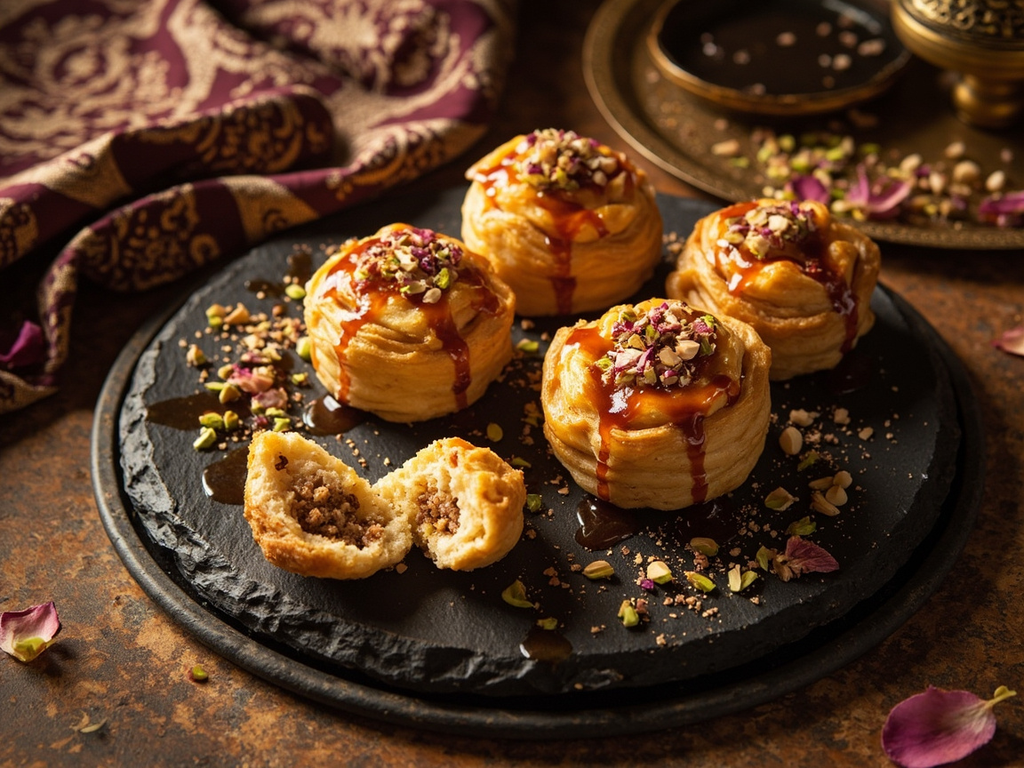
Why this dish? Lauzīnaj, a sweet of almonds in crispy leaves drenched in rose water syrup, was the most prestigious pastry of the Abbasid court. Al-Farghānī, originally from Ferghana — a region rich in almond trees — certainly found in this dish a taste of his homeland, served at scholarly receptions in Baghdad.
Thin pastry leaves filled with ground almonds mixed with sugar and musk, bathed in a rose water-scented syrup. Ancestor of baklava, this delicate morsel is the jewel of Abbasid sweets, so prized that poets celebrated it in their verses.
The almonds of my native Ferghana are the sweetest I have known. When I arrived in Baghdad as a young man eager for knowledge, I found their flavor in the lauzīnaj that the pastry makers of the souk prepared in leaves so thin one could read a manuscript through them. They fill them with ground almonds and sugar, fold them, fry them, then drown them in a syrup perfumed with rose water. The crunch gives way under the tooth and releases sweetness — like a calculation that, after effort, finally reveals the elegance of the solution.
- •Very thin dough (ruqāq) — several leaves (crispy wrapper)
- •Blanched almonds — a good measure (main filling)
- •Sugar or honey — to taste (sweetener)
- •Rose water — a few spoonfuls (floral perfume)
- •Musk or camphor (trace) — a pinch (noble perfume)
- •Sesame oil for frying — enough (cooking)
Lauzīnaj (Almond and Rose Water Pastry)
Thin pastry leaves filled with ground almonds mixed with sugar and musk, bathed in a rose water-scented syrup. Ancestor of baklava, this delicate morsel is the jewel of Abbasid sweets, so prized that poets celebrated it in their verses.
Why this dish? Lauzīnaj, a sweet of almonds in crispy leaves drenched in rose water syrup, was the most prestigious pastry of the Abbasid court. Al-Farghānī, originally from Ferghana — a region rich in almond trees — certainly found in this dish a taste of his homeland, served at scholarly receptions in Baghdad.
The almonds of my native Ferghana are the sweetest I have known. When I arrived in Baghdad as a young man eager for knowledge, I found their flavor in the lauzīnaj that the pastry makers of the souk prepared in leaves so thin one could read a manuscript through them. They fill them with ground almonds and sugar, fold them, fry them, then drown them in a syrup perfumed with rose water. The crunch gives way under the tooth and releases sweetness — like a calculation that, after effort, finally reveals the elegance of the solution.
Ingredients (period version)
- Very thin dough (ruqāq) — several leaves (crispy wrapper)
- Blanched almonds — a good measure (main filling)
- Sugar or honey — to taste (sweetener)
- Rose water — a few spoonfuls (floral perfume)
- Musk or camphor (trace) — a pinch (noble perfume)
- Sesame oil for frying — enough (cooking)
Ingredients
- Brick or phyllo pastry sheets — 8 sheets (crispy wrapper)
- Ground almonds — 200 g (main filling)
- Powdered sugar — 100 g (+ 150 g for syrup) (sweetener)
- Rose water — 2 tbsp (floral perfume)
- Water — 100 ml (for syrup) (syrup base)
- Melted butter — 80 g (cooking and binder)
- Crushed pistachios — 2 tbsp (garnish)
Method
- Prepare the syrup: in a saucepan, bring water and 150 g sugar to a boil. Let thicken for 5 minutes, remove from heat and add rose water. Let cool.
- Mix ground almonds with 100 g sugar.
- Brush a brick sheet with melted butter, place 2 tbsp of almond mixture in the center, fold into a rectangle.
- Repeat with remaining sheets.
- Arrange the pastries on a buttered baking sheet. Brush tops with melted butter.
- Bake at 180°C for 15-18 minutes, until golden and crispy.
- Generously drizzle with cold syrup as soon as they come out of the oven.
- Sprinkle with crushed pistachios. Let soak for 10 minutes before serving.
How it was made : Lauzīnaj is documented in al-Warrāq's Kitāb al-Ṭabīkh and in many Abbasid literary texts. The poet Kushājim (10th century) devoted an entire poem to it. The original version used extremely thin dough leaves (ruqāq), fried in sesame oil. Musk and camphor, luxury spices, marked the palatial version.
The contemporary twist : Cut into diamonds and arrange on a slate plate with a quenelle of thick rose water cream and a few dried rose petals.
Sources : Ibn Sayyār al-Warrāq, Kitāb al-Ṭabīkh — chapter on sweets (ḥalwiyyāt) · Nawal Nasrallah, Annals of the Caliphs' Kitchens, Brill, 2007 · Charles Perry, "The Taste for Layered Bread among the Nomadic Turks and the Central Asian Origins of Baklava", in A Taste of Thyme, Tauris Parke, 2000
Al-Farghani · Charactorium