 flip
flipBregaglia Polenta with Butter and Alpine Cheese
Bregaglia Polenta with Butter and Alpine Cheese
Why this dish? Giacometti was born in Stampa, in Val Bregaglia, an Italian-speaking valley where corn polenta has been the daily staple of peasant meals since the 19th century. His family — his father Giovanni was a painter — lived simply on this mountain cooking before Paris turned him into a man of cafés and cigarettes.
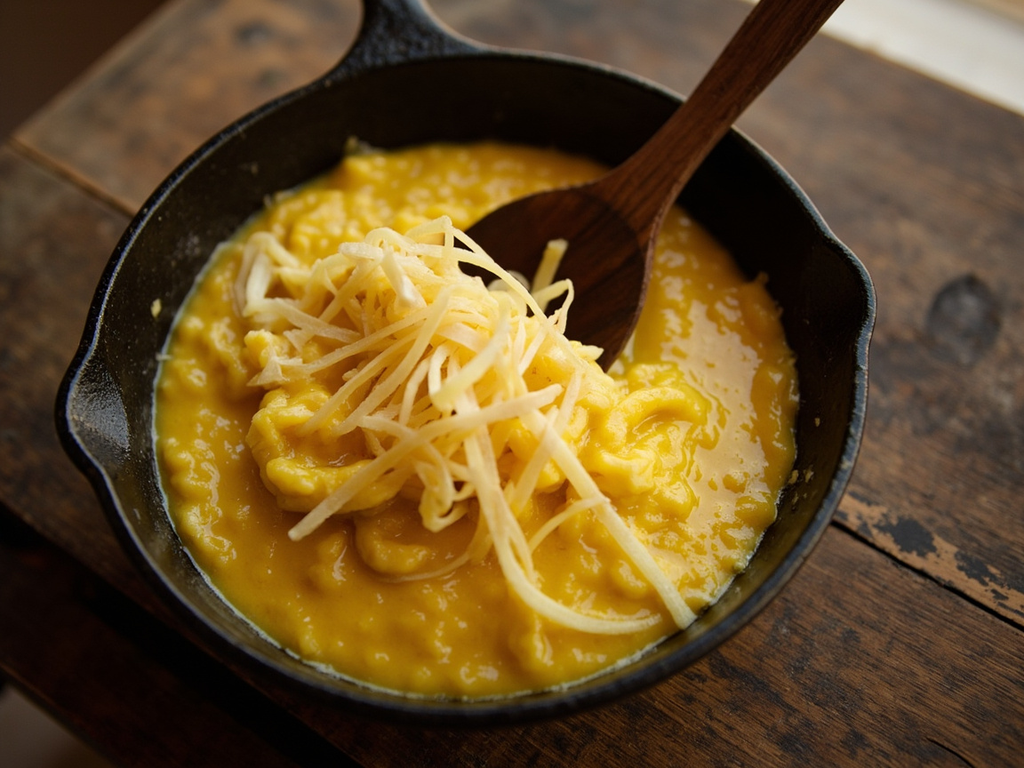
A slowly stirred cornmeal mush, melted with butter and mountain cheese. The comfort dish of the Grisons valleys: eaten with a ladle, piping hot, around a single pan placed in the center of the table.
At home in Stampa, polenta was the foundation of everything, like plaster is the foundation of my studio. My mother Annetta would stir with the wooden spoon for an hour, without stopping, otherwise it sticks and it's ruined. We'd drown it in butter and alpine cheese, and plant our spoon straight into the pan, all together. You see, I never needed much to eat — work comes first, always, but this, this keeps a man on his feet.
- •Cornmeal (bramata, coarse grind) — two handfuls per person (base)
- •Spring water — as needed (cooking)
- •Salt — a pinch (seasoning)
- •Mountain butter — a good knob (fat binder)
- •Alpine cheese (Bregaglia or Bündner Bergkäse type) — a generous piece (melting)
Bregaglia Polenta with Butter and Alpine Cheese
A slowly stirred cornmeal mush, melted with butter and mountain cheese. The comfort dish of the Grisons valleys: eaten with a ladle, piping hot, around a single pan placed in the center of the table.
Why this dish? Giacometti was born in Stampa, in Val Bregaglia, an Italian-speaking valley where corn polenta has been the daily staple of peasant meals since the 19th century. His family — his father Giovanni was a painter — lived simply on this mountain cooking before Paris turned him into a man of cafés and cigarettes.
At home in Stampa, polenta was the foundation of everything, like plaster is the foundation of my studio. My mother Annetta would stir with the wooden spoon for an hour, without stopping, otherwise it sticks and it's ruined. We'd drown it in butter and alpine cheese, and plant our spoon straight into the pan, all together. You see, I never needed much to eat — work comes first, always, but this, this keeps a man on his feet.
Ingredients (period version)
- Cornmeal (bramata, coarse grind) — two handfuls per person (base)
- Spring water — as needed (cooking)
- Salt — a pinch (seasoning)
- Mountain butter — a good knob (fat binder)
- Alpine cheese (Bregaglia or Bündner Bergkäse type) — a generous piece (melting)
Ingredients
- Coarse polenta — 200 g (base)
- Water — 1 L (cooking)
- Salt — 1 tsp (seasoning)
- Butter — 60 g (fat binder)
- Grated mountain cheese (Bergkäse, or substitute Comté) — 120 g (melting)
Method
- Bring salted water to a simmer in a large heavy-bottomed pot.
- Pour in the polenta in a steady stream while whisking to prevent lumps.
- Reduce heat and stir with a wooden spoon for 40 to 45 minutes, until the mass pulls away from the sides.
- Off the heat, stir in the butter and then the grated cheese until smooth and creamy.
- Serve immediately, very hot, directly in the pan placed at the center of the table.
How it was made : In the Grisons valleys, polenta was cooked in a copper cauldron (paiöl) hung over the fire, stirred constantly with a stick. Corn, which arrived in Europe in the 16th century, had become by the 19th century the staple food of the poor in the Italian-speaking Alps, often at the cost of pellagra when there was nothing else to add. Butter and cheese were the luxury of good days.
The contemporary twist : Spread out and left to set, then cut into bars and pan-fried until a golden crust forms — a 'sculpted' polenta to eat standing in the workshop.
Sources : Cuisine traditionnelle des Grisons (patrimoine culinaire suisse, Kulinarisches Erbe der Schweiz) · Yves Bonnefoy, Giacometti (1991) — on the origins of Stampa
Alberto Giacometti · Charactorium