 flip
flipEaster Kulich
Easter Kulich
Why this dish? Solzhenitsyn, having returned to the Orthodox faith of his ancestors, saw in Russian Christianity a force of resistance to totalitarianism. Kulich, the tall brioche blessed at Easter, is the festive peak of the Orthodox calendar: its contrast with the camp black bread speaks the whole distance between the night of the gulag and the hope of the resurrection.
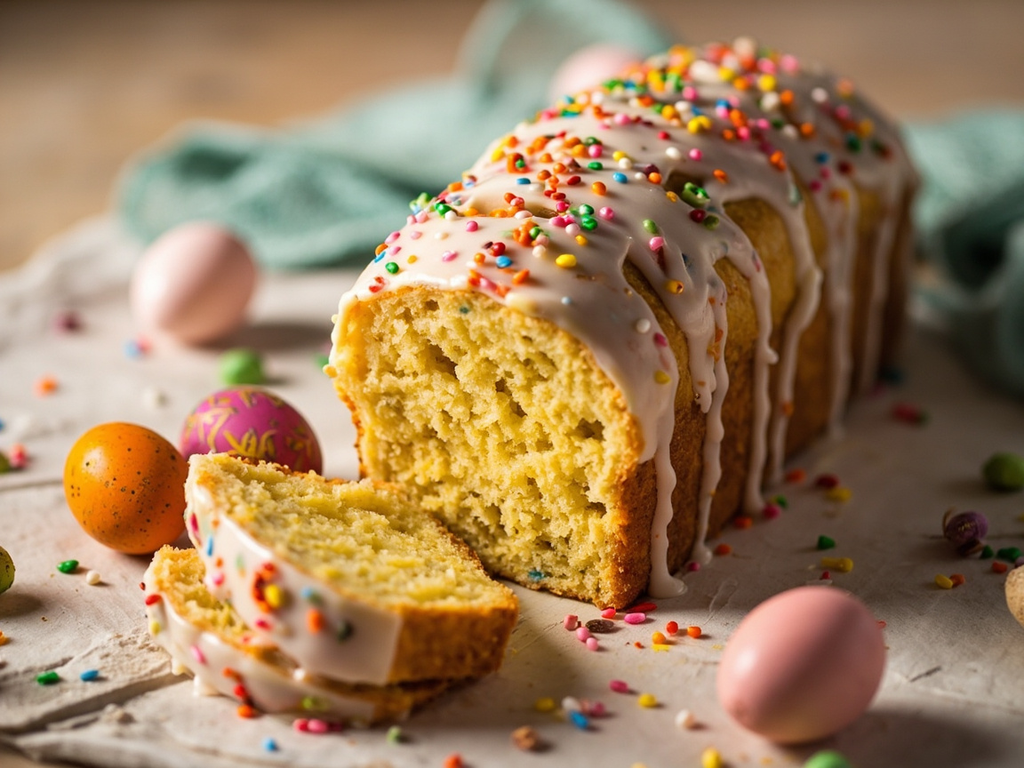
A tall, golden, cylindrical brioche, flavored with candied peel and saffron, topped with a white glaze that falls like snow. Rich, sweet, festive: the absolute opposite of the camp ration, celebrated once a year in the joy of Easter.
Here is the bread of bright days, inspired by the great feast of the Resurrection. All year we eat the humble black bread, but at Easter, you see, the dough becomes rich, golden, fragrant — as if the bread itself rose again. We crowned it with white, we decorated it, and around it the modest table became royal. After the darkness I have passed through, believe me: there is no sweeter bread than the one we break while saying that life, despite everything, prevails.
- •Wheat flour — a lot (base)
- •Sourdough starter or yeast — a little (leavening)
- •Milk — a bowl (liquid)
- •Eggs — several (richness)
- •Butter — generously (softness)
- •Sugar — as much as wanted for the feast (sweetness)
- •Candied peel and raisins — a handful (filling)
- •Saffron — a few threads (color and flavor)
Easter Kulich
A tall, golden, cylindrical brioche, flavored with candied peel and saffron, topped with a white glaze that falls like snow. Rich, sweet, festive: the absolute opposite of the camp ration, celebrated once a year in the joy of Easter.
Why this dish? Solzhenitsyn, having returned to the Orthodox faith of his ancestors, saw in Russian Christianity a force of resistance to totalitarianism. Kulich, the tall brioche blessed at Easter, is the festive peak of the Orthodox calendar: its contrast with the camp black bread speaks the whole distance between the night of the gulag and the hope of the resurrection.
Here is the bread of bright days, inspired by the great feast of the Resurrection. All year we eat the humble black bread, but at Easter, you see, the dough becomes rich, golden, fragrant — as if the bread itself rose again. We crowned it with white, we decorated it, and around it the modest table became royal. After the darkness I have passed through, believe me: there is no sweeter bread than the one we break while saying that life, despite everything, prevails.
Ingredients (period version)
- Wheat flour — a lot (base)
- Sourdough starter or yeast — a little (leavening)
- Milk — a bowl (liquid)
- Eggs — several (richness)
- Butter — generously (softness)
- Sugar — as much as wanted for the feast (sweetness)
- Candied peel and raisins — a handful (filling)
- Saffron — a few threads (color and flavor)
Ingredients
- All-purpose flour — 500 g (base)
- Dry baker's yeast — 7 g (leavening)
- Warm milk — 150 ml (liquid)
- Eggs — 3 (richness)
- Softened butter — 100 g (softness)
- Sugar — 120 g (sweetness)
- Raisins and candied peel — 100 g (filling)
- Saffron or vanilla — 1 pinch (flavor)
- Powdered sugar + egg white — for the glaze (decoration)
Method
- Dissolve the yeast in warm milk with a spoon of sugar and a little flour; let foam for 15 min.
- Add beaten eggs, remaining sugar, infused saffron, then flour; knead at length before incorporating the softened butter. Knead until smooth and elastic.
- Let rise in a warm place for 1.5 to 2 h, then fold in raisins and candied peel.
- Fill a tall cylindrical mold (lined tin can) to one-third, let rise again to the rim.
- Bake at 180 °C for 35-45 min depending on size (test with a skewer). Cool, glaze, and decorate.
How it was made : Kulich is prepared on Holy Saturday to be blessed at church, then shared on Easter morning with paskha (a sweet cheese spread). Believing Soviet families often made it in secret, the word 'Easter' being frowned upon under the regime — making it an act of faithfulness as much as a treat.
The contemporary twist : Lemon glaze and dried edible flowers on top: kulich becomes a photogenic festive pastry, while keeping its blessed tower silhouette.
Sources : Elena Molokhovets, A Gift to Young Housewives (1861) · William Pokhlebkin, The Art of Russian Cuisine (1978)
Aleksandr Solzhenitsyn · Charactorium