 flip
flipTuwon dawa da miya kuka (sorghum paste with baobab leaf sauce)
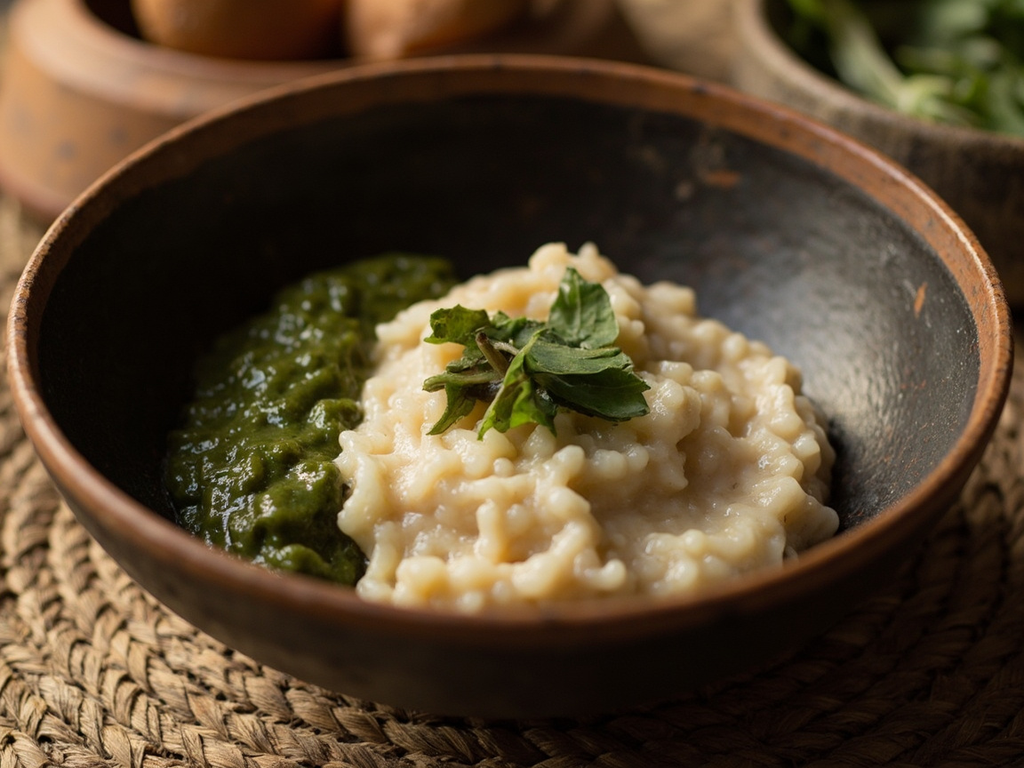
Tuwon dawa da miya kuka (sorghum paste with baobab leaf sauce)
Why this dish? This is the everyday meal of the Hausa people that Amina shared: the sorghum porridge mentioned in her known diet, eaten by hand with a leaf sauce. Before and after campaigns, this simple paste fed the city of Zazzau, from soldiers to the queen.
A firm, warm sorghum paste, shaped into balls with the fingertips to dip into a dark green, slightly sticky sauce made from dried baobab leaves and seasoned with dawadawa. Filling, comforting, it is the very taste of Sahelian daily life.
Approach, and do not be ashamed to eat with your hands as we do in Zazzau. You take a ball of tuwo, hollow it with your thumb, and dip it into the miya kuka — see how the sauce clings. My warriors swallowed this before mounting their horses, for this paste stays in the belly a whole day's march. Never skimp on the dawadawa: without it, the soup has no soul, and a queen does not serve at her table a soulless soup.
- •Sorghum flour (dawa) — a good bowlful (base of the paste)
- •Well water — as needed (cooking the paste)
- •Dried and pounded baobab leaves (kuka) — a handful (body and binder of the sauce)
- •Dawadawa (fermented locust beans) — two crumbled cakes (umami, fermented salty base)
- •Shea butter or mutton fat — a spoonful (fat)
- •Rock salt — to taste (seasoning)
Tuwon dawa da miya kuka (sorghum paste with baobab leaf sauce)
A firm, warm sorghum paste, shaped into balls with the fingertips to dip into a dark green, slightly sticky sauce made from dried baobab leaves and seasoned with dawadawa. Filling, comforting, it is the very taste of Sahelian daily life.
Why this dish? This is the everyday meal of the Hausa people that Amina shared: the sorghum porridge mentioned in her known diet, eaten by hand with a leaf sauce. Before and after campaigns, this simple paste fed the city of Zazzau, from soldiers to the queen.
Approach, and do not be ashamed to eat with your hands as we do in Zazzau. You take a ball of tuwo, hollow it with your thumb, and dip it into the miya kuka — see how the sauce clings. My warriors swallowed this before mounting their horses, for this paste stays in the belly a whole day's march. Never skimp on the dawadawa: without it, the soup has no soul, and a queen does not serve at her table a soulless soup.
Ingredients (period version)
- Sorghum flour (dawa) — a good bowlful (base of the paste)
- Well water — as needed (cooking the paste)
- Dried and pounded baobab leaves (kuka) — a handful (body and binder of the sauce)
- Dawadawa (fermented locust beans) — two crumbled cakes (umami, fermented salty base)
- Shea butter or mutton fat — a spoonful (fat)
- Rock salt — to taste (seasoning)
Ingredients
- Sorghum (or millet) flour — 250 g (base of the paste)
- Water — 750 ml + a little (cooking)
- Baobab leaf powder (kuka) — 3 tbsp (binder and flavor of the sauce)
- Dawadawa / iru — 2 tbsp crumbled (fermented umami (substitute: 1 tsp mild miso))
- Edible shea butter or sesame oil — 1 tbsp (fat)
- Salt — 1 tsp (seasoning)
Method
- Bring 500 ml of water to a boil. In a separate bowl, mix the sorghum flour with a little cold water to prevent lumps.
- Pour half of the flour mixture into the boiling water, stirring vigorously with a wooden spoon until thickened.
- Gradually add the remaining flour, beating strongly; cover and cook over low heat for 8-10 minutes: the paste should be smooth and firm. Keep warm.
- For the sauce, heat 250 ml of water with the crumbled dawadawa and salt; let infuse for 5 minutes.
- Dissolve the baobab powder in a little cold water, pour into the sauce while stirring: it thickens and becomes silky. Add the fat, cook for 5 minutes.
- Shape the tuwo into moistened balls and serve alongside the hot miya kuka.
How it was made : In Amina's time, sorghum and millet were pounded in a mortar then cooked in earthenware pots on three stones. Baobab leaves harvested in the rainy season were dried and ground into powder to last all year — a precious vegetable preserve in the Sahel. Dawadawa, made by women through fermentation of locust bean seeds, was (and remains) the king seasoning before any idea of bouillon cubes.
The contemporary twist : Serve the paste as a quenelle smoothed with a water-dipped spoon, drizzled with a streak of kuka sauce and a sprinkle of toasted, crushed dawadawa as 'umami powder'.
Amina de Zaria · Charactorium